Tag Archive: Bilingualism

April 13, 2016

On Multilingualism and Bilingualism: Journals

If you find multilingualism a fascinating subject that you want to explore, you might want to be updated on current research, observations and discussions on the topic. Below you will find a list I have prepared of journals on multilingualism and bilingualism.

International Journal of Multilingualism – focuses on the psycholinguistic, sociolinguistic and educational aspects of multilingual acquisition and multilingualism. It is published quarterly and subscription is available both online and printed (or payable per issue or per article).
On Multilingualism and Bilingualism Magazines and Journals 1

International Journal of Bilingualism – focuses on linguistic, psychological, neurological and social issues with a focus on the linguistic behaviour of bilingual and multilingual individuals. Is it published quarterly and subscription is available both online and printed (or payable per issue or per article).

On Multilingualism and Bilingualism Magazines and Journals 2

International Journal of Bilingual Education and Bilingualism – promotes theoretical and applied research into bilingual education and spreads ideas about initiatives in bilingualism and bilingual education. It is published in 6 issues per year and subscription is available both online and printed (or payable per issue or per article).
On Multilingualism and Bilingualism Magazines 3

Journal of Multilingual and Multicultural Development – covers topics on the sociology and social psychology of language, in language and cultural politics, policy, planning and practice. It is published in 7 issues per year and subscription is available both online and printed (or payable per issue or per article).
On Multilingualism and Bilingualism magazines 4

Bilingual Research Journal. The Journal of the National Association for Bilingual Education – covers bilingualism. It is published quarterly and subscription is available both online and printed (or payable per issue or per article).

On Multilingualism and Bilingualism Magazines 5

Written by Kinga Macalla

March 16, 2016

Interview with Multilingual Matters

Multilingual Matters is an international independent publishing house with lists in the areas of bilingualism, second/foreign language learning, sociolinguistics, translation and books for parents.

Most publishing companies tend to be based in London. Why did you choose Bristol?
The company was originally based in Clevedon where the company’s founders Mike and Marjukka Grover lived. When they retired and their son Tommi Grover became Managing Director we moved our office to Bristol as that’s where the majority of the staff lived.

As your publications are highly specialised, are your staff also experts in the area?
We are not all specialists in applied linguistics and tourism studies, our expertise lies in publishing not the world of academia. All our books are peer reviewed by academics working in the field to ensure that the content is accurate and appropriate.

Are all your publications written by academics or are other professionals also considered?
The majority of our books are written by academics but we do publish a small number of books aimed at parents and teachers, some of which are written by non-academics. These books are usually for a more general audience and are more accessible to the general reader. The most popular of these titles is A Parents’ and Teachers’ Guide to Bilingualism by Colin Baker which is a guide for parents bringing up their children with more than one language or teachers working with multilingual children.

Do you organise any events, such as meetings with authors or discussion forums?
We don’t tend to organise our own events but we attend a number of conferences every year where we meet with authors and often we participate in a publisher session where we advise academics, particularly younger postgraduates, on the process of academic publishing and how to get their research published.

What would you say are the most interesting aspects of working in publishing?
Working for a small independent publisher allows for a lot of variety and flexibility that isn’t always possible in bigger publishers. It’s also great to work with the same people over several years so you can build good relationships – both with colleagues in the office and authors in the academic world.

How has the publishing sector changed in the era of e-books?
People have been saying for decades that the increasing popularity of ebooks will cause the death of the print book but so far that hasn’t happened although we are selling fewer print books and more ebooks all the time. More university libraries are purchasing electronic content for students and many of our customers prefer to read books on a tablet or e-reader rather than in print these days. However, we’re pretty sure that the print book isn’t going to disappear any time soon!

Thank you!

Multilingual Matters -- photo

Interviewed by Bristol Language School  
Photo courtesy of Multilingual Matters

March 9, 2016

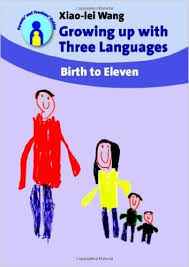
Book Review: Growing up with Three Languages by Xiao-Lei Wang

Raising children bilingually sounds challenging enough, but trilingually? Xiao-Lei Wang and her husband decided to teach their children their heritage languages: Chinese and French, while living in the USA. They were very serious about this project and gave their full attention and creativity to make it work for their boys who are now trilingual! Xiao-Lei Wang described their experience in the book Growing up with Three Languages. Birth to Eleven and says that one of the motives behind this publication was the lack of successful examples of multilingual upbringing practises. By writing this book Xiao-Lei Wang wanted to help parents discover the possibilities of raising multilingual children. This is not to say that the task in itself was somehow easy and without difficulty or frustration, rather it was overall an enjoyable and rewarding process.

Growing up with three languages

Growing up with Three Languages was recommended to me by a friend who is planning to raise her daughter trilingually and found some of the book’s guidelines very useful. I particularly enjoyed its style, case studies, real-life examples, friendly reader approach and long lists of resources. I would point out however that the addition of an all-in-one bibliography would have been useful.

The author highlights a number of key factors on the process of raising children trilingually. Firstly , if we are planning to raise our children multilingually, we must ask ourselves a number of questions: from our reasons and motives, practicalities and teaching methods to our children’s names (yes, that is important, too!) and then deciding whether they should be going to a supplementary school or not. Secondly, let’s make the whole process as interesting, enjoyable and also positively challenging as we can, so that it does not feel like a chore both for us and for our little ones. Thirdly, we should not forget that communication should always be the most important priority and that language learning is a life-long process (I certainly agree with this!).

I would definitely recommend this book to any parent who is planning to raise their children multilingually, and it is an undeniably helpful resource for those whose heritage languages are Chinese or French.

Written by Kinga Macalla