Today, I’d like to wish you a wonderful and calm Christmas, and a most prosperous New Year 2026.
Thank you for reading my blog and let’s meet here in 2026!
With love,
Kinga

Today, I’d like to wish you a wonderful and calm Christmas, and a most prosperous New Year 2026.
Thank you for reading my blog and let’s meet here in 2026!
With love,
Kinga
This is one of my favourite Christmas cakes and I’ve been making it for many years now. I often bake the first gingerbread cake of the winter season at the beginning of December to start Advent and pre-Christmas preparations. Then I usually bake it every weekend in December, as it’s easy to make and yummy to eat. It’s a Polish tradition to eat gingerbread cake at Christmas and the recipe was inspired by Kwestia smaku. It’s gluten-free and you can make it healthier without sugar, eat it as it is, or make it fancy with plum jam and covered in melted chocolate. Enjoy!
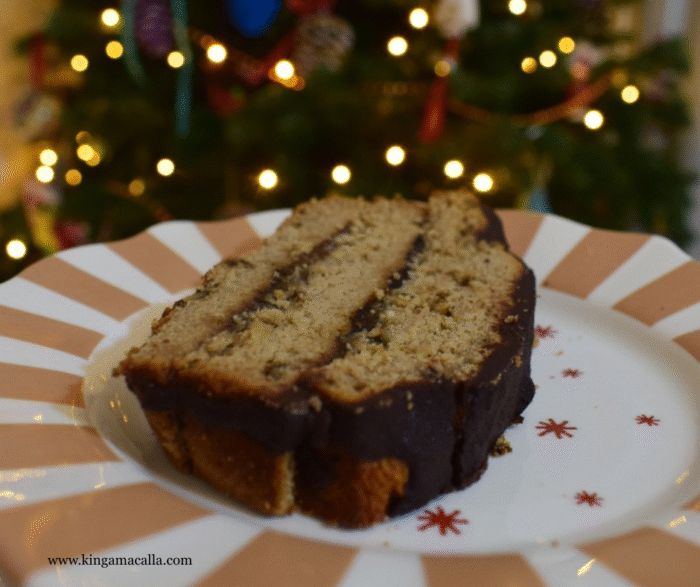
Here is the recipe:
Ingredients
130g butter, ghee or coconut oil
80g honey
30g sugar (you can add more / less or even omit it)
1-2 spoons of gingerbread spices
2 teaspoons of soda
300g flour (100g rice flour, 50g coconut flour, 50g almond flour (or grounded almonds), 50g potatoes flour, 50g corn flour)
250g milk (diary or plant, e.g. almond or hazelnut)
½ glass of finely chopped walnuts (optional)
2 eggs
Extra: you can fill it with plum jam and / or cover the cake in melted chocolate (1/3 glass of a coconut cream or diary cream and 100g of dark chocolate)
Preparation
Pre-heat the oven to 175 degrees. Use a loaf tin (cca 12x25cm) and line it with paper parchment. In a pan using a little heat, melt butter with honey, sugar (if used) and gingerbread spices. Take the pan off the heat and add all the flours and soda and mix it with a spoon. Add milk and walnuts (if used) and mix it and finally, add eggs and mix it again. Pour the dough into the loaf tin and put it into the pre-heated oven. Bake it for 40-45 mins: check if the cake is ready with a wooden skewer. Once ready, take it from the oven and cool it down. Keep it in a cake box.
You can fill the cake with a plum jam and/or cover it with melted chocolate (warm cream with chocolate up and keep stirring till it’s finely combined).
What’s your favourite Christmas cake? Please let me know in the comments below.
PS. If you’d like to try another Christmas recipe and bake ‘pierniczki’, Polish gingerbread biscuits, my recipe is on the school’s blog.

As the festive time approaches, we would like to thank you for this wonderful year and wish you all a very Merry Christmas, Veselé Vánoce! / Счастливого Рождества! (Schastlivogo Rozhdestva) / С рождеством Христовым! (S rozhdyestvom Hristovym!) / Wesołych świąt Bożego Narodzenia! / Feliz Navidad! / Buon Natale! / Joyeux Noël! / Bon Nadal! / Feliz Natal! / Fröhliche Weihnachten! / Zalige Kerstdagen! / Merry Christmas! メリークリスマス (Merīkurisumasu) /圣诞快乐 (Shèngdàn kuàilè) / عيد ميلاد المسيح” (‘eed milaad al-maseeH).

We hope that you enjoy your festive break and we are hoping to see you back in January 2020!
Thank you for learning languages with us!
Lots of love,
BLS Team
PS. What would be the perfect present this Christmas? The answer is easy: to learn a new language!
“A calm Christmas does not have to be a small Christmas or even a quiet Christmas.” [p. 121]

It’s a beautiful read which attempts to prepare readers for Christmas; calm Christmas. I read it in October which may seem to be too early, but actually no, it’s the perfect time to start thinking about the Christmas one wishes to have this year. The book mindfully guides us through the pre-, during- and post-Christmas times and through questions, stories and quotations coming from the author’s own experiences or those of her friends’ or the community’s. The reader may reflect/question/re-invent their own way of celebrating the festive season. The book is simply published, yet the magic is felt on every page.
And if you’re wondering whether there are any language-related digressions, I can only point out that the author has a Masters degree in Japanese.
What inspirational read on Christmas would you recommend? Let me know down in the comments.
Kinga Macalla
Christmas is coming, and many of us are excitedly preparing for it. But beyond the presents, food, family gatherings and decorations, have you ever stopped to wonder where the word “Christmas” comes from, what it really means, and what its meaning is in other languages? This post looks at the origins of the word for “Christmas” in the languages you can study at BLS. Many of them are similar, so we will group them by meaning. We would love to hear more, if you know the word for Christmas in any other languages. Please add them in the comments if you do.

Nadal / Natal / Natale / Navidad / Boże Narodzenie / Рождества / 圣诞
The word for “Christmas” in Catalan is “Nadal”. It comes from the Latin, nātālis [diēs Dominī], or the “birthday of the Lord”. This is similar in the Portuguese “Natal”, “Natale” in Italian and “Navidad” (similar to the English, “nativity”, the feast celebrating the birth of Jesus Christ”) in Spanish. The Polish term, “Boże Narodzenie” also means “the holy birth”. This on its own can be used for “Christmas”, but “Święta Bożego Narodzenia” (“celebration of the holy birth”) is the full version. The Russian (“С рождеством Христовым!” “S rozhdyestvom Hristovym!”) has the same root (it means “Congratulations on the birth of Christ!”). “Merry Christmas” in Chinese is “圣诞快乐(Shèngdàn kuàilè)”, meaning “to be happy at the birth of a saint”. In Arabic it is “عيد ميلاد المسيح” (“‘eed milaad al-maseeH”), “celebration of birth of the-Messiah”.
Noël
There is some debate about the origin of the French “Noël” (which also exists in English, without the umlauts (in songs like “The First Noel”)). The roots of the English word are in the French “noël” anyway, and this may come from the Old French “nael”, deriving from the Latin “natalis”, meaning “birth”, as above. Other commentators think that it may come from the French “nouvelles”, meaning “news”, as in the news of Christ being born.

Weinachten / Vánoce
The German “Weinachten” comes from Middle High German “zeden wīhen nahten” (“in the holy nights”). In German, “Weihnachten” can be the singular or plural form. It is plural in the greetings “Frohe, gesegnete, schöne … Weihnachten” but singular in sentences like “Weihnachten ist ein christliches Fest” (“Christmas is a Christian celebration”.) The Czech, “Vánoce” is a borrowing from this.
Kerstmis / Christmas / クリスマス
The Dutch “Kerstmis” (or simply “Kerst”) and English “Christmas” come from the same root, the celebration (holy mass) of Christ. The Japanese version “クリスマス” (“Kurisumasu”) is borrowed from the English.
Suzannah Young

As the festive time is approaching, we would like to wish you all a very Merry Christmas, Veselé Vánoce! / Счастливого Рождества! (Schastlivogo Rozhdestva) / С рождеством Христовым! (S rozhdyestvom Hristovym!) / Wesołych świąt Bożego Narodzenia! / Feliz Navidad! / Buon Natale! / Joyeux Noël! / Bon Nadal! / Feliz Natal! / Fröhliche Weihnachten! / Zalige Kerstdagen! / Merry Christmas! メリークリスマス (Merīkurisumasu) /圣诞快乐 (Shèngdàn kuàilè) / عيد ميلاد المسيح” (‘eed milaad al-maseeH). We hope that you enjoy your well-deserved break!
With love,
BLS Team
As the year is officially coming to an end, many of us will reflect back on the past twelve months and make plans for the upcoming year. Do you already have a list of New Year’s resolutions? Will you want to learn a new language or improve your skills in 2017?
I definitely want to maintain my language skills in Czech and improve my French. I’m trying to implement this rule to have a 5-minute activity with each language every day (similar to these ideas). Do I want to learn a new language? That would be very exciting, I’m thinking of Russian, but will let you know more once some progress has been made.
As for the blog, I’m planning to research interesting subjects and write inspiring articles (ambitious, I know!). I’ll look for some beautiful scenery to take photos and videos of. I’d also like to invite inspiring professionals to share their wisdom and knowledge on our blog. Would you find that interesting? What would you like to read more about?
As the festive time is approaching, myself and my colleagues would like to wish our readers a very Merry Christmas, Joyeux Noël, Fröhliche Weihnachten, Feliz Navidad, Veselé Vánoce or Wesołych Świąt. We hope that you enjoy your festive break!
Written by Kinga Macalla
A few examples of Christmas traditions from around the world!
ITALY
Unlike in any other country, Christmas presents are delivered by Befana, an old witch, who visits all Italian children in the night of 5th January, travelling the country on her broomstick. Being a good housekeeper, some say she will sweep the floor before she leaves. To some the sweeping meant sweeping away of the problems of the year. The child’s family usually leaves a small glass of wine and a plate of regional food for the Befana.
Another interesting tradition is Lancio dei Ciocci, which consists of throwing old crockery out the window at midnight on New Year’s Eve, symbolising the riddance of old negativity and evil. It is also common to leave doors and windows open in order to let good spirits in.
POLAND
Christmas in Poland, just like in many European countries, is celebrated on the 24th of December, known as Wigilia. It is a tradition to prepare twelve dishes, one for each of the apostles that accompanied Jesus during the Last Supper. As meat is banned on Christmas Eve, fish dishes are served instead, the most typical being karp. It is not uncommon to find one swimming in somebody’s bathtub in the days leading up to Christmas!
Before the dinner, families share Christmas wishes and opłatek (similar to a communion wafer), which is served on a small pile of hay, referring to the stables in which Jesus was born.
GERMANY
Germans are famous worldwide for their Christmas markets and advent calendars, but they also have some lesser known traditions. In some part of Germany, children write to the Christkind (‘the Christ child’), a traditional giver of gifts. In Nürnberg a young girl is chosen each year to participate in a parade as the Christkind. She wears a long white and gold dress, has blond hair and wears a gold crown and sometimes also wings, like an angel. She is responsible for the official opening of the Christmas market and visits old people’s homes and hospitals during the Advent.
FRANCE
The 6th of January is celebrated in France as Fête des Rois (Day of the Kings). A flat almond cake is eaten called Gallete des Rois in Northern France and Gâteu des Rois in the South of the country. A small charm is placed inside the cake and the person who finds it has to either buy a beverage for everyone around the table or offer to host the next king cake at theirs. This can extend the festivities through all of January!
SPAIN
Christmas celebrations in Spain start on the 22nd of December, with the launch of Sorteo de Navidad, a Christmas lottery, which takes place every year and is broadcasted on national television. There are long queues at the ticket selling points, even as early as a month before! After all, everybody is hoping to win the main price, El Gordo, literally ‘the fat one’.
On New Year’s Eve, during the countdown to midnight, twelve grapes are eaten, one for each stroke of the clock: that’s one grape per second! They represent the twelve months of the year and are meant to bring happiness in the upcoming year.
On this note, we would like to wish you all a very Merry Christmas! No matter how and where you spend it, we hope that it will be a time of rest, spent with family and friends. We would also like to wish you all the best in the New Year, let it be a year filled with love and happiness.
See you in January 2016!
Written by Alicja Zajdel