Tag Archive: Film Review

October 2, 2019

Series review: Better Than Us (Russian: Лучше, чем люди), Netflix

Better Than Us is set in Russia, in the near-future, where humanoid robots are being used to serve humans as cleaners and manual workers. A Chinese company creates a “bot” called Arisa (played by Paulina Andreeva), a bot which can understand human emotion – but also doesn’t follow the Three Laws of Robotics. In short, she can kill.


Russian robotics manufacturer Viktor Toropov buys the prototype Arisa, and intends to use it to cement his company’s place at the top of the robotics industry. There’s only one problem – Arisa escapes and bonds with a young girl, Sonya. Then follows a roller-coaster of a ride as Toropov tries to reclaim the fugitive bot, by any means necessary. Throw into the mix a group of anti-A.I. extremists, Arisa’s evolution as she starts to experience emotions of her own, and Sonya’s family’s private drama, and you have a series which stands head-and-shoulders above your standard sci-fi fare.
I personally give it a 9/10!

Darren Cameron

February 6, 2019

Film review: Dangal (2016)

Last weekend I decided to treat myself to an evening of Netflix, to practise my quickly-rusting language skills. My film of choice? The award-winning Hindi-language biographical wrestling movie, Dangal (2016). The film is loosely based on the lives of Geeta Phogat and Babita Kumari, daughters of Mahavir Singh Phogat, a national level wrestling champion in India who had a dream of raising a son to become an international wrestling champion.
He was, instead, blessed with four daughters. Thinking his dream would never become true, he sank into depression – until a fight between his two oldest daughters and a couple of local lads gave him an idea… Starring and produced by Aamir Khan, I thoroughly enjoyed every moment. The story is believable and very well-acted, with a great soundtrack (featuring one of my favourite artists, Daler Mehndi). This tale of struggle, loss, hard work and persistence in the face of ridicule, makes for a great evening’s viewing, running at 161 minutes.
I watched it with Polish subtitles (trying to practise two languages at once) but English subtitles are available.
Darren Cameron
September 10, 2015

Film Review: Santiago’s Path in “The Way”

Some weeks ago we were talking in class about the cities called Santiago in the world, such as Santiago de Cuba, Santiago de Chile and Santiago de Compostela (Spain). All of them have something in common: the Spanish language. For the sake of geographical proximity, although unknown to me, I will focus on the last one: Santiago de Compostela. The main reason why people know the city is because of Santiago’s pilgrimage route, known as Camino de Santiago, which runs along the north of Spain and has been walked for centuries. It takes between one and two months during which we can explore new places, enjoy the breathtaking landscapes, meet interesting people, discover new flavors and realize what we are capable. During the class conversation appeared the title of a film, The Way, an American and Spanish co-production, directed by Emilio Estévez and starring Martin Sheen.
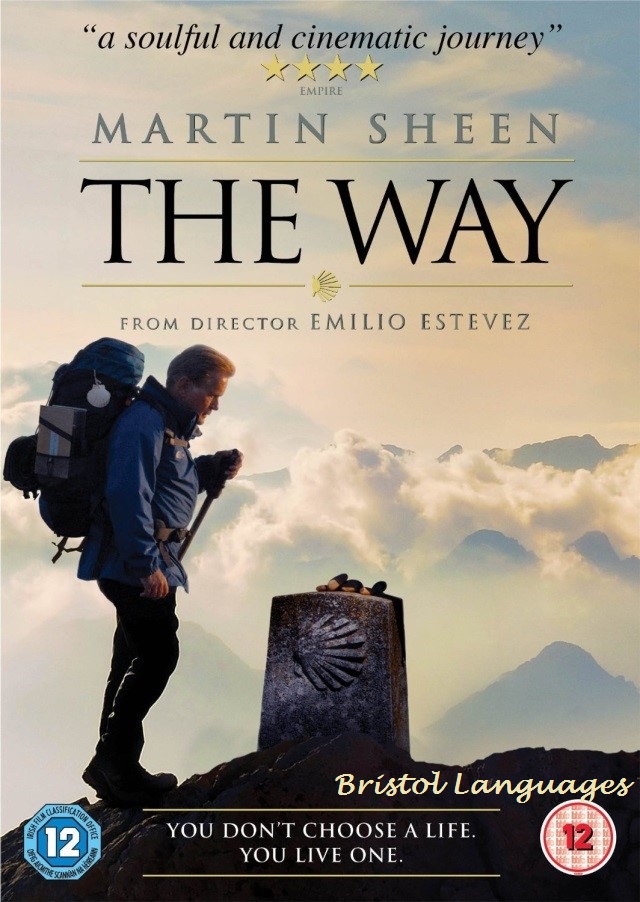
The Way

The protagonist, Tom Avery, is a widowed ophthalmologist, who finds out that his son, Daniel, has died at the beginning of the route in the French Pyrenees. The relationship between the father and son wasn’t very close, because the first didn’t understand the lifestyle of his offspring. The last time they spoke on the phone, just before the journey, the son told him: “you don’t choose a life, you live one”. After the news of his son’s tragic death, Tom travels to France to collect the remains, and there he decides to walk the route with Daniel, each in a different world.

The film is not characterized by action scenes or sudden plot twists, but it concentrates on some Spanish topics, such as bulls, gypsies and typical foods like pinchos. The main characters are an Irishman who walks the way to lose weight, a Canadian woman who hides the fact that her husband was abusive and seems to have the purpose of quitting smoking and a writer looking for inspiration for his next book. At first, Tom shows no interest in making friends, not even engaging in conversations with fellow travelers. He only thinks of reaching the goal and scattering his son’s ashes along the way until they arrive to Galicia. There, having completed his journey, he releases the rest of the ashes into the Cantabrian Sea. He also puts his son’s name on the completion certificate awarded to each pilgrim in Santiago.

Besides the beautiful landscapes of northern Spain, several debates are presented in the film. What is the reason to begin the journey to Santiago de Compostela? Some people do it for religious reasons, others to find inspiration or as a means of meditation, others do it just for the challenge or to experience something different. Some even do the journey with a banal reason to quit smoking or to lose weight. Unlike the original travelers who used to make the journey with no help, nowadays many people choose to complete the pilgrimage on bike or use the help of modern technology. I think that the Camino should be a time to disconnect from everything to allow us to refocus on what it is important in life.

From my perspective, I think every day there are fewer people who have faith and belief in God. I would like to travel these sandy paths, crossing the refreshing rivers, but mostly I would like to have a suitable environment for meditation to regain the faith I lost some time ago. It is incredible how as the years pass, the religious origins are lost, forgotten, yet we keep the traditions and festivities. In my opinion we should be more concerned with the origins and reasons of celebrations, to understand better our roots and direct the society toward fellowship, kindness, empathy and understanding.

I cannot comment about the experience yet, but I can say the film made me even more interested to arrive in front of the Cathedral of Santiago de Compostela having found my inner peace, sticking my victory flag in the Galician land.

Written by Mireya Sevillano
Edited by Alicja Zajdel

February 23, 2015

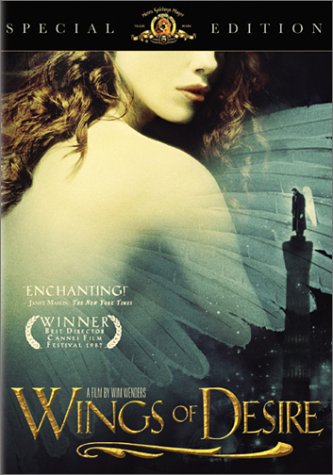
Film Review: WINGS OF DESIRE

Wings of desire (Der Himmel über Berlin) is the only film I have seen more than once and it is definitely my favourite. It was directed by Wim Wenders in 1987 and awarded at the Cannes Film Festival. 

Wings of Desire

There are several reasons which make the film so special and lyrical. First of all, it is the romantic fantasy plot. The film tells the story of two angels, Damiel and Cassiel, who observe West Berlin’s life and listen to people’s thoughts while remaining invisible. The angels are immortal observers and can’t interact with people and their world. It changes when Damiel falls in love with Marion, a trapeze artist and decides to become human. With this decision the black and white film becomes colourful and Damiel is able to experience human sensory pleasures, such as food and the touch of his beloved woman.

One of my favourite scenes takes place in a library, where several angels sit by the readers while they immerse themselves in literature. There is an old man among them, named Homer, who dreams of an epic of peace. He expresses his disappointment that peace doesn’t inspire poets as much as war. His thoughts are illustrated with the real images of a ruined city and the victims of war.

The film not only praises peace but also music. Damiel meets Marion on the Nick Cave and the Bad Seeds concert. It is the beginning of their relationship. Music is shown as one of the greatest human pleasures with a power to bring people together.

It is also the poetic language of the inner monologues that makes the film so special. One can find inspirations of Rainer Maria Rilke’s poetry. Wings of desire begins with the poem Song of Child written by Peter Handke, who also wrote much of the dialogue and poetic narrations. One of the most significant monologues are Damiel’s plans for the first day after his metamorphosis, which expresses his passion for life: First, I’ll have a bath. Then I’ll be shaved by a Turkish barber who will massage me down to the fingertips. Then I’ll buy a newspaper and read it from headlines to horoscope. On the first day, I’ll be waited upon… For requests, ask the neighbour. If someone stumbles over my legs, he’ll have to apologize. I’ll be pushed around, and I’ll push back. In the crowded bar, the bartender will find me a table. A service car will stop, and the mayor will take me aboard. I’ll be known to everyone, and suspect to no one. I won’t say a word, and will understand every language. That will be my first day.

Wings of desire encourages the viewer to appreciate every simple moment of life. It also gives them a feeling that people and animals are not the only inhabitants of the Earth. The film was an inspiration for the City of angels with Nicolas Cage and Meg Ryan and it is also an inspiration for everyone who has watched it.
Quotations;

Written by Joanna Michta
Edited by Alicja Zajdel