Tag Archive: interview

September 28, 2016

Interview with Babel Magazine

1. What is Babel Magazine, who writes it and who is your audience?

Babel magazine was set up by Lesley Jeffries and Dan McIntyre, two linguists at the University of Huddersfield. Lesley and Dan found it strange that the newsagent’s shelves had magazines for subjects such as history and geography, but nothing that covers linguistics. They knew that many people – not just linguistics professors! – are interested in all sorts of things to do with language, and decided that they ought to do something about it. Babel is a quarterly magazine for both linguists and those with a general interest in languages and linguistics, based on new research but interesting and accessible for all. (You can watch an animated take on the origins of Babel magazine here).
Each issue is written by many linguistic researchers from far and wide – this helps us make sure that we cover a wide range of topics, from the secret language of gay men in the 1950s, to the future of translation through new technology. But we also write Babel’s regular features ourselves – Lesley and Dan write the entries for our Linguistic Lexicon, and our editorial staff – Jane Lugea, Matt Evans and Hazel Price – put everything together and handle Language in the News.
babel-magazine-photo-1-1

2. How do you decide on the content? Do you receive letters from the readers? Do you consult specialists/academics? 

We have been very lucky – we have had a constant stream of contributions coming in from linguists around the world from ever since our first issue (which you can read for free). We are looking forward to publishing new articles that we have been sent on topics such as adverbs, the language of comedy and marketplace metaphors.
Sometimes we put a call out for specialists – for example, Twitter was very handy for assembling a team of contributors for our recent special issue on the pioneering linguist Ferdinand de Saussure. We also accept readers’ requests! Our regular Ask a Linguist feature addresses readers’ burning linguistic questions, and if readers suggest a topic, then we’ll try to find a linguist to write an article on it.

3. Can you tell us more about the Babel Young Writers Competition?

Our Young Writers’ Competition is our way of recognising the writing talents of young linguists. Each year, we run two categories – one for sixth form/college students, and one for undergraduates – and the winner of each is published in our November issue (as well as receiving a year’s free subscription to Babel).
The competition was inspired by an article we received out of the blue. We were stunned to find that the writer of this wonderful piece on British Sign Language was a seventeen year-old linguist, Kateryna Pavlyuk. This made us think that perhaps there were more great young writers on language out there, and so we set up the competition. So far our winners have looked at diverse topics: Konglish (a blend of Korean and English), the status of Arabic and English in Lebanon, and what spoonerisms (‘bunny rabbit’ / ‘runny babbit’) can tell us about how language works. We are currently carrying out the difficult task of picking our 2016 winners, which will be published in our next issue (No 17). Readers can read each of our previous winners on the Babel website.

babel-magazine-photo-2

4. Do you organise any events, such as meetings with researchers, linguists or writers?

Yes – at the moment, the highlight of the Babel calendar is our annual lecture. We set up the Babel Lecture in 2015 as a way to meet our readers, bring expert linguists’ thoughts to the public, and also as an excuse for a good night out!
Our first Babel lecturer was the accent and dialect coach Brendan Gunn, who gave a talk about the important role of linguistics in helping actors such as Brad Pitt, Penelope Cruz and Robert De Niro to sound convincing in their parts. Then, in May this year, David Crystal lectured on intonation in English, drawing on anecdotes from his many years as a linguist to show how intonation plays such an important role in creating meaning. We are hoping to bag another big name for our 2017 lecture, so keep your eyes peeled!

5. The subscription is available both as a hard copy and as an e-magazine. Do your readers have a preference, or do they subscribe to both?  

We have found that most readers like to have the print editions – the majority take out either a print or print plus digital subscription. We suspect that this is because of the excellent job that our designer does. The magazine is colourful, and printed on glossy paper, so it’s nice to own the print copies. It’s also not so easy to put the digital pull-out poster on your wall!
To see what our print editions are like, readers can request a free copy of our sample issue by getting in touch at editors@babelzine.com.

6. What is Lingo Magazine? Do you have many young readers?

We set up Lingo magazine to cater more directly for younger readers. We had got a bit of experience at producing Babel, and knew that we had plenty of schools among our subscribers, so we thought we would set up something especially for younger readers, with more language puzzles and contributions from young language lovers.
Readers can find out more about Lingo at lingozine.com.

7. What are your future plans? Do you have any projects you would like to work on?

We’d like to see the readership of Babel grow and expand. The magazine is a real labour of love, and we’ve had a lot of kind words from readers and other linguists, so we just want to make more!
We will be continuing to run the annual lectures and competitions, and will hopefully start to have more events where readers can hear linguists in person and tell us what they would like to see in the magazine.
There are now quite a few issues of Babel, so we are also looking forward to launching our new subsciptions and back issues in November. These will make it easier to catch up with particular back issues that catch your fancy, and to have access to the entire Babel back catalogue online.
Readers can follow us on Twitter and Facebook to keep up to date with the latest Babel news!

Thank you for your time, good luck with your future projects.
If you would like to subscribe Babel Magazine, you can do so here.
Interviewed by Bristol Language School.
June 22, 2016

Interview with Writer & Broadcaster Sophie Pierce

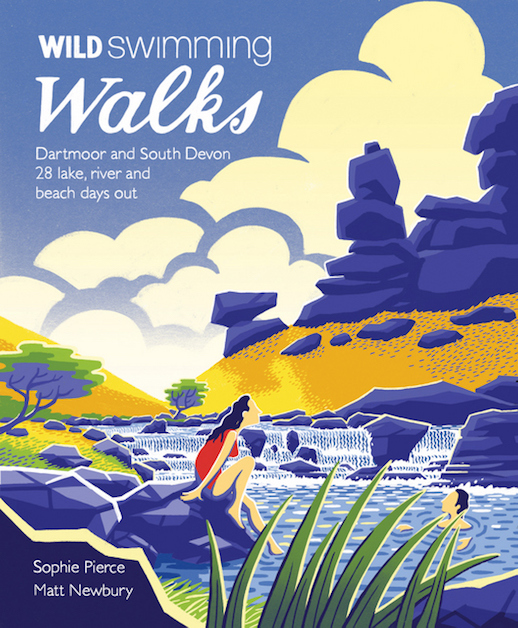
Sophie Pierce & Matt Newbury are the authors of “Wild Swimming Walks. Dartmoor and South Devon. 28 lake, river and beach days out.” The interview was conducted with Sophie Pierce.

OLYMPUS DIGITAL CAMERA

1. How did you come up with the idea of writing a book on wild swimming and walking? Why Dartmoor and South Devon? Are these regions famous for their rivers, lakes and seafronts?
Matt and I have been friends for ages and both love swimming outdoors. Matt is born and bred in Devon, and lives by the sea in Torquay, while I live on Dartmoor with its many beautiful rivers and lakes. A few years ago we wrote our first book, about wild swimming in Torbay, and we wanted to do another book, but broaden it into walks as well. After all, you usually have to walk to the most stunning places! We just wanted to share the joy and fun of outdoor swimming, and show people how easy it was to have an adventure at home. Dartmoor and South Devon are where we live, and contain some of the most exciting and beautiful swimming spots in the world.

2. What were the most challenging and the most rewarding experiences in writing the book?
The most challenging aspect of the book was getting all the fine detail right, such as the distances, the map references, all the detailed information we have included, and being disciplined, taking notes as we researched the routes.   It was also a challenge to fit in the research as we both work full time.  Every weekend when the weather was good we were out there researching routes and trying to find new swims.   The field research though was also extremely rewarding, as well as being fun. We also got quite fit!

Mansands credit Aaron Kitts

3. Being a keen wild swimmer yourself, do you often meet many enthusiasts of wild swimming? Do you belong to a swimming club?
We have made lots of friends through wild swimming.  We meet up on the Devon Wild Swimming page on Facebook and if someone is going for a swim, they generally post the time and the place and people come along.  Generally, wild swimmers seem to be great fun, incredibly relaxed, friendly and non-judgemental. They are also great consumers of cake!

4. The photos in the book are so spontaneous and lively that the reader immediately wants to join you and jump into these wild waters. Why do you want to inspire people to follow your passion of wild swimming? Why is it so special?
We have just had so much fun, and also some truly unusual experiences swimming in natural waters that it’s simply about wanting to share that.   A friend of ours has a phrase “You never regret a swim” and another friend says that when you come out of the water “your factory settings are restored”. Swimming outdoors seems to give you a natural high.

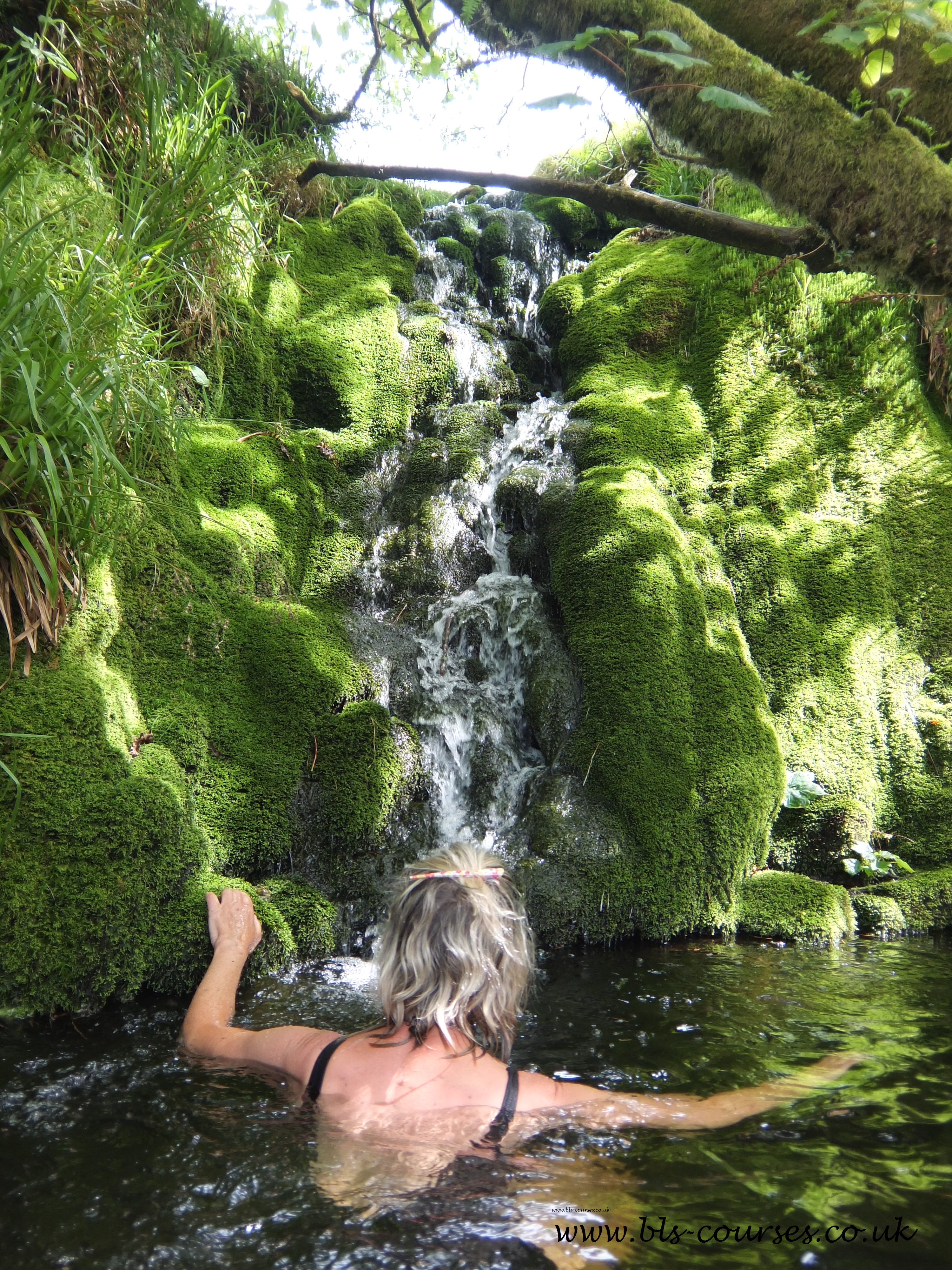
Shavercombe Waterfall credit Sophie Pierce

5. There are many references to local legends (quite dark, sometimes) in the book. How did you become familiar with them? Are they a natural part of the culture of Devon and Dartmoor, or did you come across them when reading books on these regions?
Bodies of water are often associated with legends, particularly on Dartmoor. Many of these legends go back hundreds of years into folklore and nobody really knows where they come from.  But in all cultures water is incredibly significant, it is necessary for life itself, it is used in rituals of course, baptisms etc., so it is not surprising that stories grow up around rivers, lakes and the sea.  Some of them we found out about through reading books, as there is a lot of literature about Dartmoor. Some we just found out about the traditional way – word of mouth.

6. What are your future plans? Do you have any projects you would like to work on?
Matt is working on a book about swims around the world, and is also thinking of working on a book about Cornwall. Sophie has started writing a novel set by the sea in South Devon.

Wild swimming walks 4

Brilliant, thank you, we will follow your writing and travelling projects eagerly.

Interviewed by Bristol Language School  
Photos courtesy of Sophie Pierce
If you would like to purchase a copy of “ Wild Swimming Walks”, you can do so here.

April 27, 2016

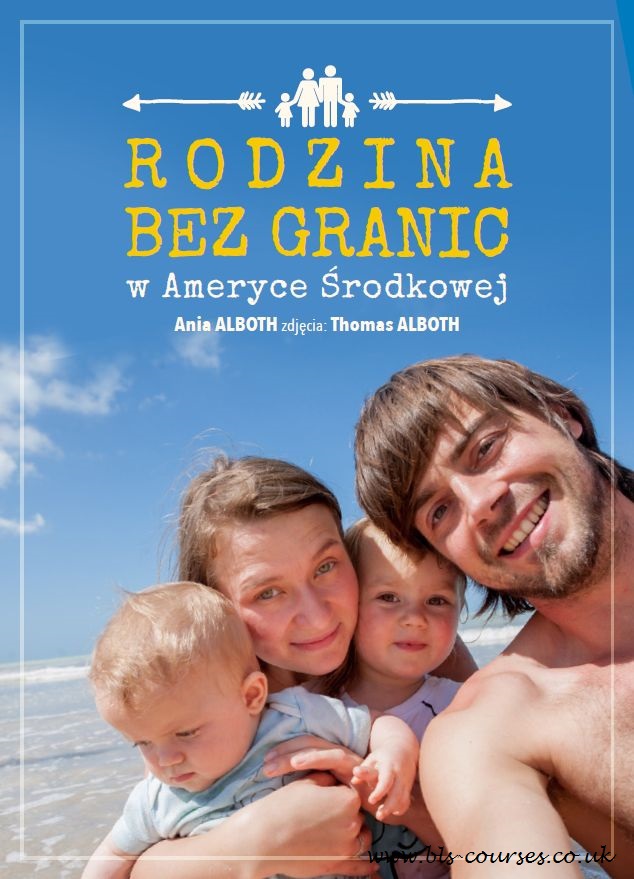
Interview with Family without Borders

1. We are very impressed by your motivation to prove that a nomadic lifestyle and having children don’t have to be mutually exclusive. What advice would you give to new parents who don’t want to give up on travelling?
Just don’t 😉 Just think about anything you would like to do with your life – without the stereotype “if I have kids I can’t…”. Think whether you really can’t. Having kids is a very good excuse for not doing things: going out, developing, taking care of yourself. In our couple we believe that your kids will be happy – if you are happy. Not when you sacrifice yourself to do this or not to do that. With us, it just so happened that what makes us happy – is travelling. So we wanted to check whether our kids liked it too. We took into account that they might not and we had in mind that we would come back home if they were unhappy. But what does a little kid need? To sleep, to eat and to have happy parents!

Family without borders 4

2. You’re a journalist, your husband works as a photographer. Are your travels professionally motivated or are they just for leisure? 
It started with pure family holiday happiness. The time together. Both my pregnancies were risky, both girls were born much too early and with both of them we spent long weeks in the hospital, at the beginning of their lives. Travelling was this “finally, our time together”, non-stop together, kids with mama and papa 24/7. But I am a journalist and my husband loves taking pictures – I was taking notes and he was taking pictures. In the beginning, our blog was just for the grandparents, but then it started to grow, got more popular, we started to have opportunities to publish some of the stories in travel magazines – and this just motivated us to collect notes and pictures in a more professional way.

3. Does travelling with children enhance your travelling experience? Do your daughters offer a different perspective of the places you visit?
Absolutely! Travelling is slower (because based on smaller feet or with little breaks here and there) but also more detailed. They also ask a lot of questions – which motivates me to find the answers. And they help us to get in touch with people immediately. Starting from talking about their names, age and amount of teeth, very quickly we can move on to serious, and also journalistic, topics.

4. Have you had to adapt your travels since the girls were born (for example in terms of safety)? Are there any places you chose not to visit because of this?
Actually, we only started seriously travelling with them. Before they were born, each of us, travelled a bit, separately but it was not far and not for long. What is worse about travelling with kids than without them? What can’t you do (if you would like to)? We do not party too much in the evenings (because we can’t leave them in the car, tent or hostel room alone), like we could at home, having their grandmother or our friends to help with it. And we don’t visit war zones or casinos. All the other things we do: travelling through mountains, visiting refugee camps, hitch-hiking on the yacht. We do believe that for kids everything can be interesting (not only so-called “family friendly” places). Even if it’s only interesting for the parents, they can talk to them about it.

5. In terms of language, how do you find bringing up your girls in a trilingual environment? Do you use any particular strategies? What are the main challenges?
We are a Polish-German couple and it was clear to us from the beginning that I was going to speak Polish with my kids and Tom, German. I can’t imagine not speaking my own language to them, the one I love and feel the best in. It would be artificial somehow. And because Tom and I speak English to each other, they also have passive knowledge of English. That’s what we thought, but during our visit to New Zealand, they also started to speak English. For them, the concept of languages is normal and clear: people in the world speak different languages. It is also easy in Berlin: in our kindergarten most of the kids are bi- or trilingual.
From our perspective: it was very important to make a separation: one person-one language. Tom can also speak Polish for example, but if he sometimes spoke  Polish to the girls, they would code it as German. For them: everything that papa says to them – is one language.

Family without borders 3

6. In your opinion, how does a multicultural childhood affect a child’s development?
I don’t know how it is with other kids, because I was never a mother of non-multicultural kids 😉 I can also look around and compare: they don’t have this “the Other” attitude. They know (because of their languages and because of travelling) that people can be very different and have different behaviours. That very poor people, who speak some strange Mayan language in Guatemala, might give them the best chocolate ever or that black kids in Vanuatu might be better at hide-and-seek. And that it all doesn’t matter and in most cases you do not need a language or even deep knowledge of some culture – you can just stay open, smiling and respectful – and you will be happy everywhere. My girls know that a “stranger” is in the first place a potential friend, not a danger.

Brilliant, thank you, we will follow your travelling projects eagerly.

Interviewed by Bristol Language School  
Photo courtesy of The Family Without Borders
To follow The Family’s travels and life visit their website and FB page.
If you would like to purchase a copy of “Rodzina bez granic”, you can do so here (from mid-May 2016).

March 16, 2016

Interview with Multilingual Matters

Multilingual Matters is an international independent publishing house with lists in the areas of bilingualism, second/foreign language learning, sociolinguistics, translation and books for parents.

Most publishing companies tend to be based in London. Why did you choose Bristol?
The company was originally based in Clevedon where the company’s founders Mike and Marjukka Grover lived. When they retired and their son Tommi Grover became Managing Director we moved our office to Bristol as that’s where the majority of the staff lived.

As your publications are highly specialised, are your staff also experts in the area?
We are not all specialists in applied linguistics and tourism studies, our expertise lies in publishing not the world of academia. All our books are peer reviewed by academics working in the field to ensure that the content is accurate and appropriate.

Are all your publications written by academics or are other professionals also considered?
The majority of our books are written by academics but we do publish a small number of books aimed at parents and teachers, some of which are written by non-academics. These books are usually for a more general audience and are more accessible to the general reader. The most popular of these titles is A Parents’ and Teachers’ Guide to Bilingualism by Colin Baker which is a guide for parents bringing up their children with more than one language or teachers working with multilingual children.

Do you organise any events, such as meetings with authors or discussion forums?
We don’t tend to organise our own events but we attend a number of conferences every year where we meet with authors and often we participate in a publisher session where we advise academics, particularly younger postgraduates, on the process of academic publishing and how to get their research published.

What would you say are the most interesting aspects of working in publishing?
Working for a small independent publisher allows for a lot of variety and flexibility that isn’t always possible in bigger publishers. It’s also great to work with the same people over several years so you can build good relationships – both with colleagues in the office and authors in the academic world.

How has the publishing sector changed in the era of e-books?
People have been saying for decades that the increasing popularity of ebooks will cause the death of the print book but so far that hasn’t happened although we are selling fewer print books and more ebooks all the time. More university libraries are purchasing electronic content for students and many of our customers prefer to read books on a tablet or e-reader rather than in print these days. However, we’re pretty sure that the print book isn’t going to disappear any time soon!

Thank you!

Multilingual Matters -- photo

Interviewed by Bristol Language School  
Photo courtesy of Multilingual Matters

November 24, 2015

Interview with Writer & Illustrator Ella Frances Sanders

As a linguist, I found your book particularly interesting. Was your work linguistically motivated in any way? Do you have an interest in translation?
That’s lovely to hear, thank you! I suppose in retrospect, the book was linguistically motivated without me necessarily realising—but I think Lost in Translation is often picked up by people with no experience in translation, or people who only speak one language, and it was important to me that the book crossed the boundaries and elusiveness that, for a lot of people, sometimes accompany faraway cultures or languages. It was important that people felt able to connect with ideas that came from a place other than the one they grew up in. My own interest in language and translation really grew alongside the book, because everything happened very back-to-front. I wasn’t planning on writing a book, but after a small blog post I wrote on the topic of untranslatable words went viral, it quickly became the plan—when the universe gives you an opportunity that seems far too good to be true, you take it.
ella
 Why did you choose those particular words and languages?
The 52 words in the book were ruthlessly culled from a list of over 200 possibles that I compiled during my frantic research phase (I researched, wrote, and illustrated all the content for the book in less than 3 months). The final words were chosen for various reasons, but most of the time they simply seemed to be universal feelings or emotions, and many had great illustration potential. At one point I wanted to have 52 different languages in the book but ach, German has far too many great ones.


 Do you have a favourite untranslatable word?
I think this depends, and changes. A favourite of mine from the book is the Japanese ‘boketto’, which is to stare vacantly into the distance and not really think of much—I find myself in this position far too frequently. A favourite that isn’t in the book is ‘ayün’, a word from the Mapuche language which literally means ‘dawn’ or ‘rising sun’. It equates to ‘love’ but carries all these nuances about illumination and beauty, and also invokes conscious speaking or action—it’s as complicated as it is beautiful.


 You call yourself a writer out of necessity and an illustrator by accident. Would you like to expand on that?
A long story cut short, my apparent career as an illustrator was not entirely planned, while on the other hand, I have always written things down on paper—stories, life, people. My need to write often feels much more severe than my need to draw, although over time I’ve found that they complement each other wonderfully… more than I had ever hoped. I feel incredibly lucky to be in this position, where I can practice and develop both my great loves together.


 What do you like most about your work? What’s the typical day like for you?
Most of all, I love the flexibility my work gives me in terms of time and location; during the last two years I have lived in Morocco and Switzerland, and have now settled for now in the UK, which is where I grew up. But inks do not travel well on airplanes, and I’ve found this out the hard way, so there are definitely some limitations when it comes to throwing yourself around the globe and keeping your work intact along the way. Sometimes coming and going from the same place is good—I try to note the beauty which lives in the monotony of everyday tasks. As for a typical day, I don’t think there is one. I certainly don’t keep a 9-5 schedule, because some days I want to work late, and other days I want to be up and working before the city has risen. But all days involve some illustration, some writing, some walking, and a lot of tea.


 Can you tell us anything about your second book that you’re currently working on?
Well. I can tell you that it will be a companion of sorts to Lost in Translation, and that they will look splendid together on a bookshelf. It’s different, but in a similar vein linguistically speaking. If things go to plan, the book will go to print at the end of March next year, and then will be out in mid-September. I think I’ll allow myself to start getting excited soon.
Thank you.


To follow Ella’s lovely work visit her website.
If you would like to purchase a copy of Lost in Translation, you can do so here.
Interviewed by Alicja Zajdel
August 19, 2014

Interview with Translator Antonia Lloyd-Jones

Antonia Lloyd-Jones is a full-time translator of Polish literature, and a double winner of the Found in Translation award. She has translated several works by some of Poland’s leading contemporary novelists, including Paweł Huelle and Olga Tokarczuk. Her most recent publications include Kolyma Diaries, a travel book by Jacek Hugo-Bader (Portobello Books) and Gottland: Mostly True Stories from Half of Czechoslovakia by Mariusz Szczygieł (Melville House). Her other translation projects include crime fiction, poetry, essays, and books for children. Besides working as a translator, Antonia is also a mentor for the BCLT’s Emerging Translators’ Mentorship Programme and a Translators Association committee member.

Antonia Lloyds Jones

1. Is it true that the main reason why you learned Polish had dark curly hair and was seven feet tall?
That’s a tall story – the truth is that he was six foot three.

2. The Polish language is considered to be one of the most difficult. How did you manage to master it?
I’m always sceptical when I hear Polish defined as “one of the most difficult languages”. Compared with what, and from whose perspective? In some ways Polish is a very easy language; for instance, once you know what sound each letter represents, the words aren’t difficult to spell, because all the letters are pronounced – unlike in English, where simply the word “enough” is enough to show how fiendishly difficult the spelling can be. Polish tenses are much simpler than English ones too. And those innocent little words “a” and “the” are very challenging to most students of English. So what is a difficult language?
I mainly taught myself Polish, but after studying Russian for ten years, at school and university. I also have a background in Latin and Ancient Greek, which provide a great basis for learning any other Indo-European language. I suspect that an ability to learn languages is partly an animal thing – like being good at music, or drawing – some people are born with it and find it easier than others do. There are plenty of linguists in my family, so perhaps I inherited a talent for languages. I’m sure I chose to study Russian because my father, who was a linguistic genius, didn’t know any, so he could be proud of me without correcting me every second word. Although when I started learning Polish, from my Anglophone perspective Russian seemed similar enough to be very helpful to me, the two languages have long since totally diverged in my mind, and I no longer think of them as having much in common.

3. What place in Poland do you visit most? Have you ever thought about moving there permanently?
As I write this, I am in Warsaw, a city I very much enjoy. Mostly I come here, or to Kraków, occasionally Gdańsk or Wrocław, mainly because those are the places where I know people. But in January for instance I will be in Łódź to help research a book for an American author of Polish-Jewish origin. I wish I had more opportunities to go to the Polish countryside, and the smaller towns, as there are so many fascinating and beautiful places to see. I have never thought of moving to Poland permanently; these days I have family commitments in Britain, but who knows? Perhaps one day I will.

4. Do you have a favourite word? Either in English or Polish.
Not really, though sometimes my favourite word is the very last one in the book I’m translating, simply because reaching it means finishing the project. But of course like many non-Poles, I can’t help liking the word źdźbło, which seems absurdly complicated for something meaning a blade of grass. People who know no Polish at all find it truly alarming. I have a favourite Hungarian word, which is zongora, meaning a piano – it sounds just right.

5. After years of working as a translator, are you able to pinpoint some key differences between the two languages? Perhaps the lack of an equivalent for a certain word or in the vocabulary range for a certain topic.
I could say that Polish uses more impersonal structures than English, or that its word order is much more flexible, but different languages are like different countries, the product of different experiences that result in different mentalities. So in a way everything is untranslatable, and translation is simply our best resort, short of learning the other language. But equally I could say that everything is translatable, there’s no lack of equivalents, or ways of rendering the same thing in another language.

6. The translator’s role is usually not limited to the translation itself, translators often act as cultural ambassadors for the country. What do you find most satisfying about this job?
I like being involved in promotional events with the authors whose work I translate, because it gives me the opportunity to talk to them, and often to have adventures with them. Knowing them in person and spending time with them professionally is highly enjoyable, and also contributes to my better understanding of how they write and how they think about their work. It also gives me the chance to go to inspiring literary festivals and to meet other translators and writers. I think being an advocate for the literature you translate is an important part of a translator’s job – once they’re published, the books need promotion, and it can only be in the translator’s interest to encourage people to read them.

7. How much time per day do you usually dedicate to translation?
Like any self-employed person, I spend most of the day doing my job, from first thing in the morning to late at night. Being freelance means that you have to be disciplined about getting work done, and about generating work too. If you mean every aspect of translation, then I spend my entire working day on it; if you mean actually sitting over a Polish text and putting it into English, it depends on my workload and schedule. If I am working on a particular book, there is usually a set number of pages that I aim to complete each day, but of course as the deadline approaches, and I start to get behind, the number of pages increases.

8. You don’t see much Polish literature on the shelves of British bookstores. Is it difficult to interest publishers and readers in Polish authors?
The first part of your question answers the second. It is very difficult. Publishers and bookshops have to be business-like – they’re not charities, they have to make a profit. Unfortunately Polish literature isn’t at the top of most people’s shopping list. It has to compete with the huge number of books published in English (over ten times as many as in Polish) and also with an increasing number of other translated literatures. I often ask British or American people if they can remember the name of any Polish author whose work they have read in translation, and they look sheepish as they rack their brains to think of one, but I tell them I won’t be surprised if they can’t. Occasionally someone mentions Wisława Szymborska, Czesław Miłosz, Stanisław Lem or Ryszard Kapuściński, but that’s about it. But if I ask myself when I last read a book translated from, let’s say, Greek, I can’t come up with an answer. (And I do read lots of translations.)
In this situation, where Polish literature has very few opportunities to be published in English, I think it is vital to focus on the very best books – there’s no point in trying to promote commercial Polish literature on the English-language market, which is already saturated with its own popular books. Instead it is best to save the few available slots for the best works that make a real contribution to world literature.

9. Literary translation is considered the lowest paid field of translation and it is often a second job, for example for literature professors. Is it possible to make a living from translating books alone?
I suppose I am living proof that it is possible to survive as a literary translator alone, but it is an unreliable source of income. Translation is slow work, paid by the number of words or pages, not by the hour. One of my colleagues once estimated that we’d be better off working at McDonald’s. My income comes from a wide range of jobs, not just book-length translations, but lots of much shorter ones, occasional teaching and writing, public events, book reports and so on. If I hadn’t had a sensible job in the past that earned me a high salary, I would have a much harder life now, but as it is I have my own flat and don’t have to worry about rent. That said, I do have to work hard to pay the bills. Luckily, in Britain the rates paid for literary translation are generally higher than in many other countries.

10. You are a mentor for emerging translators within the project run by the British Centre for Literary Translation. What would be your main advice for a future professional?
Apart from “don’t give up the day job unless you have a rich and generous partner”, my main piece of advice is to read as much good literature written in or translated into English as possible. Read, read, read. And when you’re translating, imagine there are two people in the room with you: the author and the reader. You must never forget either of them.

Thank you for your time and very best of luck with your future plans!
Q. prepared by Joanna Michta
Q. translated by Alicja Zajdel
Photo courtesy of Antonia Lloyd-Jones