Tag Archive: Languages

October 22, 2025

Book review: What we read together bilingually in Polish and English (2025)

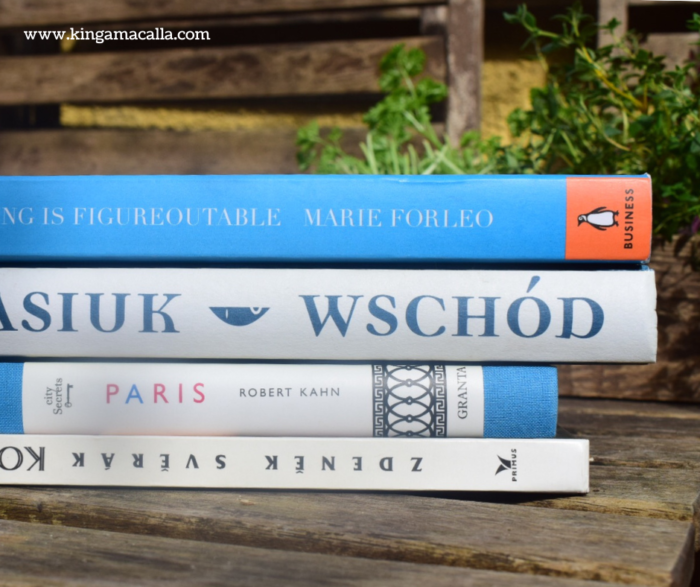
We read books in Polish and English and we have several of the same books in both languages, either because of available translations in those languages, or because we really enjoyed those stories. Sometimes it’s good to read the same story bilingually, to hear it in the languages we speak. For example, as an adult I read Harry Potter in three languages: in Polish, English and Czech. Reading the same book in translation gave me some context for another interpretation and the joy to understand it in more language(s). 

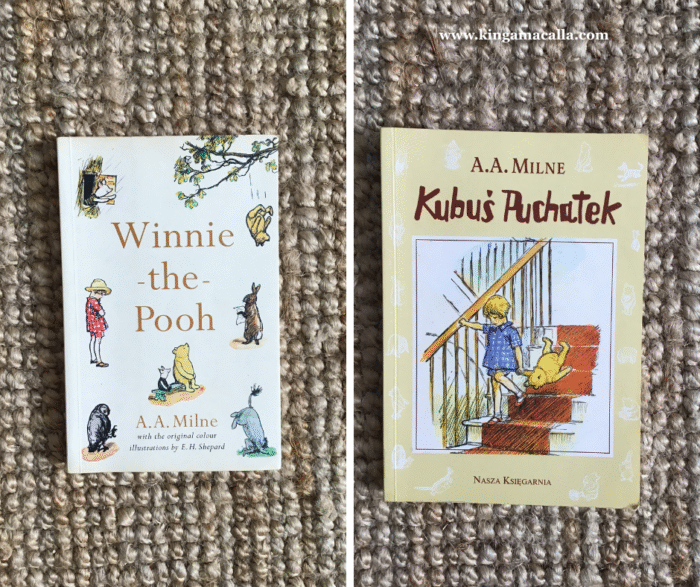
A.A.Milne Winnie-the-Pooh // A.A. Milne Kubuś Puchatek

(originally published in English)

This is a classic and it was one of the first books we had in two languages. We read it chapter after chapter in Polish and then in English. We later found some audio-recordings which we listened to, as well. The stories are charming, as if we’re allowed to enter a magic world of teddy bears.

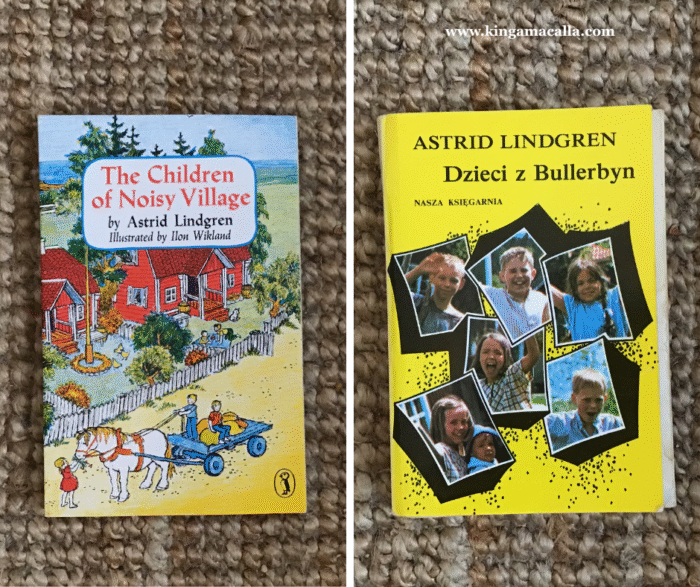
Astrid Lindgren The Children of Noisy Village // Astrid Lindgren Dzieci z Bullerbyn

(originally published in Swedish)

I read Astrid as a child and couldn’t wait to read those stories to my children. We love the noisy, courageous and joyful children who live together in a little village of Bullerby in Sweden.  They have a simple life which is full of little adventures, childhood play and happiness.

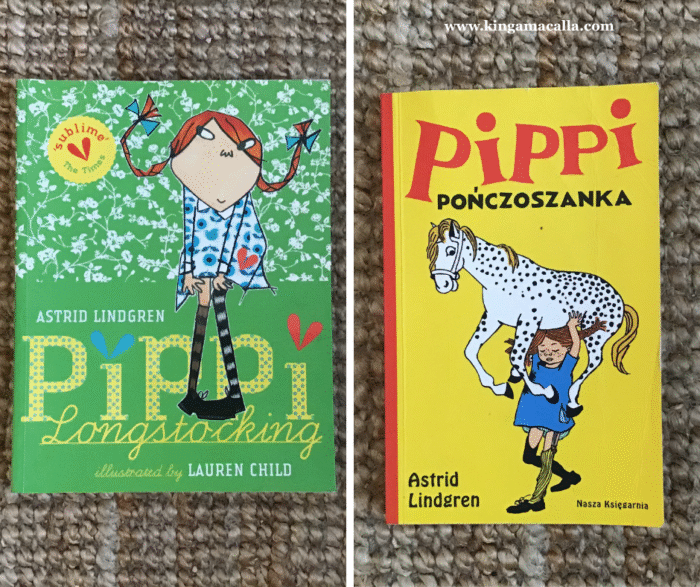
Astrid Lindgren Pipi Longstocking // Astrid Lindgren Pipi Puńczoszanka

(originally published in Swedish)

Pipi is a wonderful character who lives without her parents, with a horse and a monkey. Yes, she leads her life against the agreed way of doing things. Even though Pipi’s life is unusual, it’s also full of her kindness and generosity.

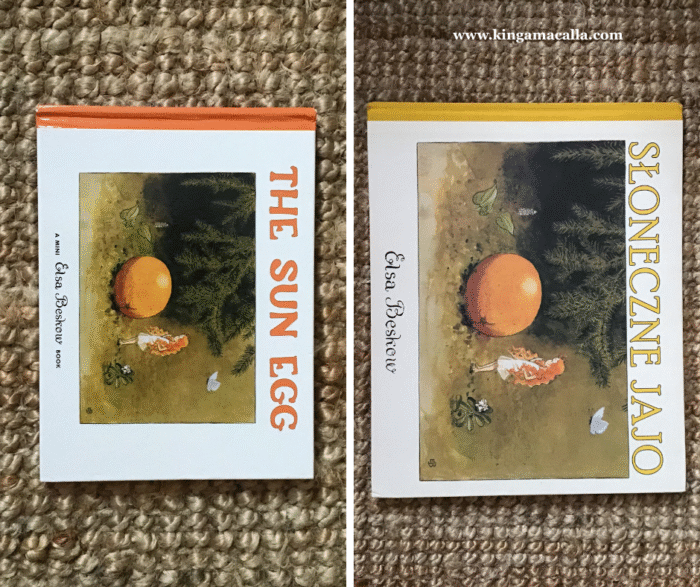
Elsa Beskow The Sun Egg / Elsa Beskow Słoneczne jajo

(originally published in Swedish)

This is one of the first books we read by Elsa Beskow, and we have this publication in Polish and in English. The Sun Egg is our summer read: it’s a short story about an elf who finds a ‘sun’s egg’ and together with forest animals, they try to find out what this round object actually is. Beautifully illustrated.

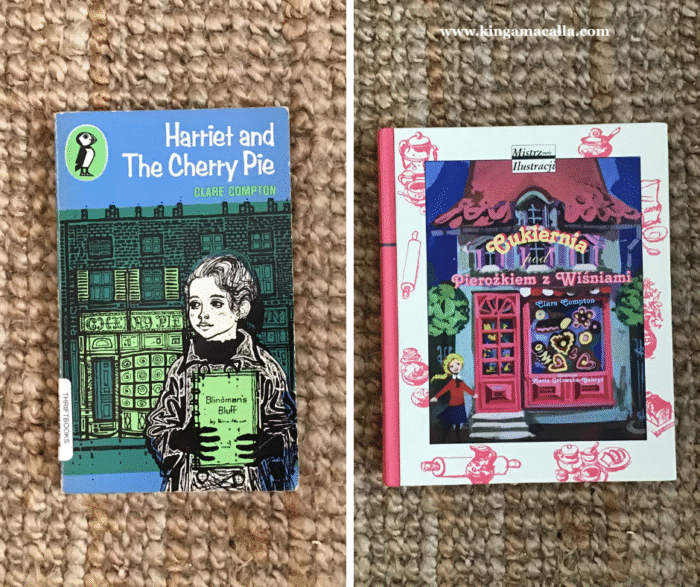
Clare Compton Harriet and the Cherry Pie // Clare Compton Cukiernia pod Pierożkiem z Wiśniami

(originally published in English)

We first found out about this novel as a Polish translation: we listened to an audiobook and then we read a book too. I then started searching for information about the author who actually turned out to be British–Clare’s real name was Hilda Hewett! Harriet and the Cherry Pie is a heart-warming story about an 11-year-old, Harriet, and her 6-year-old sister, Kitten. It’s a beautiful read, with some delicious recipes, like peppermint creams and chocolate crispies. It’s a shame that the book hasn’t been re-printed in English since 1968, and it’s only available second-hand.

Just to add that the Polish translation is absolutely scrumptious, as is the audio-recoding of the book.

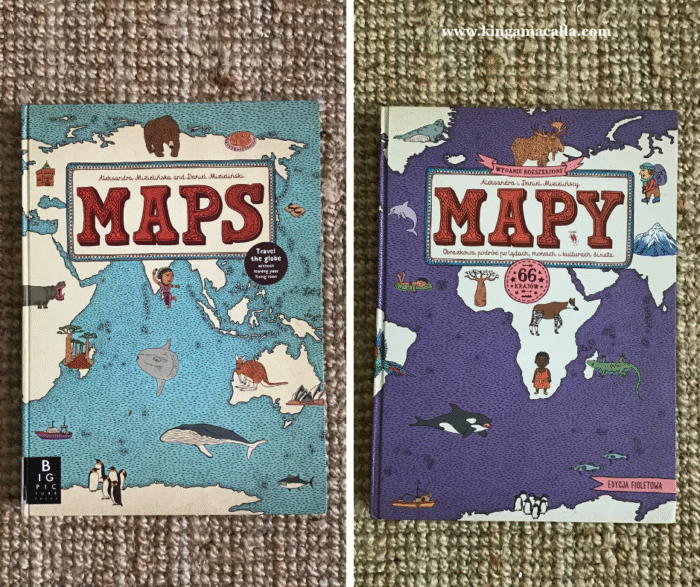
Aleksandra & Daniel Mizielińscy Maps // Aleksandra & Daniel Mizielińscy Mapy

(originally published in Polish)

This is a treat for children and adults. It’s beautifully illustrated and contains many useful and interesting facts about each country. You can go from country to country and your interest only grows, as you learn more about different countries, their food, nature, literature, sports, customs etc. Maps is a simple idea, but it is so cleverly executed!

I hope you’ll find some inspiration in the above reading list. Please comment below if you have read any of the above with your children and let me know about you or your children’s favourite bilingual books.

February 13, 2025

Spring timetable at Bristol Language School is ready

Our spring timetable is ready! Please click the link to enrol on our spring language courses or see our current offer below:

SPRING LANGUAGE TERM 2026

Arabic 

Beginner Level 1 Course: Course programme

Beginner Level 2 Course: Course programme

Elementary Level 2 Course: Course programme

Elementary Level 7 Course: Course programme

Please click the link to enrol on our autumn language course.

By booking our language course, you agree with our T&C.

Chinese (Mandarin)

Beginner Level 1 Course: Course programme

Beginner Level 2 Course: Course programme

Beginner Level 3 Course: Course programme

Elementary Level 2 Course: Course programme

Please click the link to enrol on our autumn language course.

By booking our language course, you agree with our T&C.

French

Beginner Level 1 Course: Course programme

Beginner Level 2 Course: Course programme

Please click the link to enrol on our autumn language course.

By booking our language course, you agree with our T&C.

German

Beginner Level 1 Course: Course programme

Beginner Level 3 Course: Course programme

Elementary Level 3 Course: Course programme

Intermediate Level 1 Course: Course programme

Intermediate Level 4 Course: Course programme

Upper-Intermediate Course: Course programme

Advanced Course: Course programme

Please click the link to enrol on our autumn language course.

By booking our language course, you agree with our T&C.

Italian

Beginner Level 1 Course: Course programme

Beginner Level 3 Course: Course programme

Please click the link to enrol on our autumn language course.

By booking our language course, you agree with our T&C.

Japanese 

Beginner Level 1 Course: Course programme

Please click the link to enrol on our autumn language course.

By booking our language course, you agree with our T&C.

Polish

Beginner Level 1 Course: Course programme

Beginner Level 2 Course: Course programme

Please click the link to enrol on our autumn language course.

By booking our language course, you agree with our T&C.

Portuguese

Beginner Level 1 Course: Course programme

Elementary Level 2 Course: Course programme

Intermediate Level 6 Course: Course programme

Please click the link to enrol on our autumn language course.

By booking our language course, you agree with our T&C.

Russian

Beginner Level 1 Course: Course programme

Beginner Level 2 Course: Course programme

Intermediate Level 3 Course: Course programme

Please click the link to enrol on our autumn language course.

By booking our language course, you agree with our T&C.

Spanish

Beginner Level 1 course: Course programme

Please click the link to enrol on our autumn language course.

By booking our language course, you agree with our T&C.

Please get in touch if you need your level assessed or you need more information about our language courses: office@bls-courses.co.uk & +44 (0)7938038875.

If you’re interested in individual tuition (general, business or exam preparation), please follow the link.

Thank you for learning languages with Bristol Language School.

BLS Team

April 14, 2021

Language learning: What works when you organise your language learning

Today, I want to share with you some reflections on language learning. Through speaking with our school’s students and language tutors, I have some language learning tips which may help you organise your language study and achieve your desired outcomes quicker (and better!).

Whether you attend a language course, individual tuition or are a self-learner, you may think about following all / some of the tips mentioned below. Studying regularly is an important factor when learning / improving / maintaining language skills, so how to do it the way it works for you and your lifestyle.

End goal

Why do you study this language? What’s your end goal (be specific)? What exactly do you want to be able to do in this language? Write down your learning goal.

Weekly schedule

Look at your life and see how much time you can daily / weekly devote to your study. Are there any gaps you can fill with some language learning (e.g. commuting, house chores, free evenings). Mark all those gaps / slots and see how much time you want to put aside for language learning every day / week. Make a note of these. 

Interests

That’s really important. When planning your language learning, try to follow your interests even above all the grammar and all the recommended vocab. Why? Because, you’ll then find the whole idea of language study more fun, interesting and worth your (free) time. You can also swap the language of your regular free time habits to the language you currently learn.  

Flexibility

I think to have a more flexible attitude to the idea of self-study is crucial. Why? Because, if something doesn’t work, be prepared to drop or amend this activity, move on and to try out something else. It doesn’t mean to stop learning altogether, you just adjust your learning style so that it suits your life, personality and interests.

I think these are the points I wanted to share with you today. Below you’ll find my learning schedule, just for some inspiration or guidance.

I currently learn French and maintain my language skills in three other languages: Czech, English and Polish.

MY GOALS: To finish a French textbook from my secondary school (A1 level), to read Czech novels (C1 level), to have a better pronunciation in English (C1 level) and to be more familiar with education-related vocabulary (C2 level).

FRENCH: I follow my secondary-school textbook, it’s one chapter per week with some quick revision of the previous chapters. I’d like to listen to a good learning podcast in French, any recommendations?

CZECH: I like reading novels in Czech, watching stand-up comedy shows and I sometimes listen to a podcast on healthy lifestyle and food.

ENGLISH: I watch videos to improve my pronunciation in English. I also enjoy reading books on language, travelling and education.

POLISH:  I listen to a Polish podcast on education and read a magazine on home-schooling.

Now I’d like to know how you organise your language study. Please leave your comment down below. 

September 23, 2020

Book review: The Bilingual Brain by Albert Costa

“(…) bilingualism is the rule rather than the exception in the sense that the majority of the world’s population can communicate in more than one language.” Albert Costa

What a fascinating read! To be honest with you, I didn’t expect to be taken on a such an interesting journey learning about the science of language! While reading it, I was laughing, putting exclamation marks, taking side-notes, discussing it with my friends. I completely and entirely immersed myself into reading this wonderful publication.

Why is it so fascinating? I think mainly because, on one hand, we have a truly profound knowledge about bilingualism and, on the other, there are so many unanswered questions. So if there are any uni students or researchers reading my review: there is definitely some potential in the subject of bilingualism / multilingualism.

The book covers topics such as bilingual development in babies, bilingual brain vs monolingual brain, bilingualism and other cognitive skills, bilingualism in the social context, etc. What hides under those academic topics are some most interesting experiments, research and discussions about language and bilingualism.

Let me now share with you some of the most interesting findings (in my opinion!). Do you know that babies as young as six months of age, can have already developed a complex (!) knowledge of a language, including some words?! What is more, babies as young as 2 days (yes, days!) can differentiate between two different languages. Those findings only confirm that language development and the bilingual journey starts as early as in pregnancy.

Another fascinating topic is language attrition: the loss of the native language. What?! Can one forget their native language? Actually, yes. One can completely ‘forget’ their native language and swap it with the new one. I think learning a language is a truly complex phenomenon which as you can see from the above starts prenatally and requires our constant work (whether we’re aware of it or not). Hence, if you know more languages, the importance of maintaining the foreign / native language skills on a regular basis.

And finally decision-making and bilingualism: “(…) moral judgements do change according to language.” (p. 143), when facing a problem in a foreign language, we make better decisions (p. 137) and finally language can also influence how we’re seen by others (social marker, p. 144).  For example, we can be seen less trustworthy when speaking a language with a foreign language. This might be one of the reasons why people don’t want to have a foreign accent and are after accent reduction lessons. On the other hand, does trust increase, if there are more people speaking with foreign accents and this becomes a norm? Interesting, huh?!

One final point, the research brings as many questions as answers and it seems that there is a long way to verify and objectivise some of the findings and research. There is most certainly a huge potential in the subject of bilingualism and multilingualism, so am hopeful for more passionate and fascinating books to be published in the future!

What’s your current read on language or bilingualism? Please let me know in the comments below.

Kinga Macalla

December 4, 2019

Interview with Cate Hamilton, co-founder of Babel Babies

Cate Hamilton is a linguist, teacher, mum, entrepreneur and co-founder of the popular Babel Babies. Hello Cate, thank you for being our interview guest today. You’re a great advocate for learning languages. What’s your educational background? When was your passion for languages born?

I learned French and German at school, and went to Oxford University to study English and French. I remember being on a ferry to France with my parents as a young child and thinking that my brother and I had discovered a secret language when we heard French for the first time. I must have been about six! I have always loved words and collected dictionaries. My parents actively encouraged reading and exploring new languages, and their attitude was just to have a go. I enjoyed my school exchanges in France and Germany and really just like talking to people. It’s great to be able to make new friends and see the world from different perspectives. My pen-friends from 22 years ago are still good friends and it’s amazing to see our children playing together across their different languages.

Have you always professionally worked with languages? What are your current language-related projects?

I trained as a secondary French and English teacher, working in inner city Glasgow schools. I then moved to Cheltenham when we started our family and I co-founded Babel Babies with my friend Ruth Kemp. Since 2011 I’ve been working with local families and early years settings, encouraging them to sing languages together. We now have classes running in Bristol too, and have helped thousands of families discover languages from all around the world. We sing songs in French, German, Spanish, Italian, Portuguese, Arabic, Russian, Norwegian, Japanese, Korean, Welsh and English. It’s multilingual music, and I love introducing people to linguistics through music. It’s Languages with a Capital L. I’ve now got a podcast, The Language Revolution, where I talk about talking with guests ranging from neuroscientist Dr Thomas Bak to linguist Professor David Crystal. Language is the thread through all of human experience, and I’d love to help weave it back into the fabric of the school curriculum, especially in primary and early years. I also help coordinate the International Day of Multilingualism on 27th March, the date on the Rosetta Stone. If you’d like to get involved, check out the #multilingualisnormal hashtag on Twitter and join the conversation.

How did you discover your entrepreneurial talent? Have you always known you had it? How did you come up with the idea to start a business? What inspired/motivated you?

I’ve always admired entrepreneurs and free thinkers. I guess I’m a revolutionary at heart! I’ve worked on lots of start-ups from my teenage years onwards, from magazines to companies (I now run three of them). I had a stint organising networking events for entrepreneurs before I started teacher training. I remember thinking ‘I could do that’ and just needed an idea. The idea came when I had my first baby and realised that language is a process that starts even before birth. I’ve married up my love of the research and education side of linguistics with my entrepreneurial spirit to create novel solutions to the UK languages crisis. I’m on a mission to change UK attitudes to foreign languages, and all my projects are working towards that in some way.

You inspire families to introduce foreign languages to their children at a very young age. Why is it beneficial to be exposed to languages as babies/toddlers?

Someone once told me I was silly for doing languages before babies could speak, but the speaking part is really just the icing on the cake: the two years before that (including the last few months of pregnancy) are when babies are absorbing language rapidly and getting ready to say their first words. They have it all in their heads and have absorbed the grammar (just listen to a baby’s intonation – they know how to form sentences!) before they utter those magic first words.

Babies are natural linguists because they need to communicate with their caregivers and communities. It’s a survival mechanism really, and part of how we have evolved as a species. Far from birth being ‘too early’ to introduce languages, the UK actually starts language education far too late. Babies can recognise their mother tongue at birth, notice when a new language is introduced even when they are just hours old, and they can hear any sound in any language for most of their first year. They are processing new things at light speed, with billions of new synaptic connections per second. Whether they hear one, two, three or even more languages around them, babies are not confused. They simply process what they are exposed to, learn who will respond to which language, and soon enough they will work out how to get what they want from the people around them by communicating in the language that is most effective for their purpose. So if that means they need Italian to speak to papà, Japanese for mummy, and English at school to do so, they will learn them all. Multilingual is normal for most children around the world. It’s more unusual to speak only one language, and English monolingualism is the exception rather than the rule. Attitudes to languages are cemented in the early years – I think it’s vital to give children a positive first foray into foreign languages, whatever their backgrounds.

I know you’re a mum to three children, how do you balance your professional and family life?

Babel Babies is my second of four babies! My children have grown up with it, and they are the inspiration for it. It’s far more flexible to be my own boss than to work full time in school environment. I can pick up the children every day and go to all their school activities, and if that means I need to do some work in the evenings then I do. Being an entrepreneur means I’m passionate to the point of obsessive about my work – it’s not work really, since I love it and think about it all the time. The children are my testers of new songs and books, and new ideas. I discovered bullet journalling in 2017 and am so passionate about it that I run occasional workshops on how to get started. It’s a life-changing organisational technique and a bit like having a PA. Have a look at my Instagram @cateh_inc if you’d like to know more about it.

Do you raise your children multilingually? Do you encourage them to learn foreign languages?

The children are my inspiration for the whole idea of Babel Babies, and when my first son was born I immediately knew that I wanted to encourage him to love languages, and maybe skip the hard work of trying to learn to roll his Rs in French. However, as a new mum, I had lots to figure out and speaking French all the time felt strangely not like me. We settled on singing and reading lots of books in French, but also in Italian and Portuguese, and any other languages that take our fancy. I then had two more children, and over time we have turned them into keen linguists. My eldest son is fascinated with languages and how they are similar/different to each other, and loves code-breaking new alphabets like Arabic and Russian; my middle child is amazing at accents and loves connecting with people – she’s amazing; and my youngest has probably had the most exposure to French as I was far more confident speaking to him in French with five years of Babel Babies already under my belt when he was born. Now he’s four and says, ‘No Mummy, don’t say it in French, say it in Normal!’ so we have a period of resistance, but he still knows how to respond when I say something in French. They all love exploring new languages. I’m excited to see where they go with it as they grow! I used to think that not having raised bilingual kids was a failure, but actually I’m super proud of their positive attitudes towards languages and they are genuinely interested. They make up new languages in their games all the time.

How many foreign languages do you know? How do you maintain your language skills?

I know French, bien sûr, and then probably Italian is my next most fluent. I tend to translate from French into Italian rather than English to Italian when I’m speaking, so I sometimes wade into the middle of a sentence before I’ve really got a clue what the verb is going to be! It’s often quite amusing to see what my brain does. I did two years of night school in Portuguese with my husband and we travelled around Portugal for a month, so my Portuguese is okay. I also have German to a reasonable level, and my best friend’s mother is German so I’ve heard quite a lot of it. I read stories and sing songs in at least ten languages, and I just have languages on the brain all the time. I always study languages together, rather than monolingually, so I’m currently learning Spanish, Portuguese and Italian all at once. I sometimes use Duolingo, but mostly it’s reading aloud, and always singing. I get myself an ohrwurm and stick with it until I have mastered the words.

We’re a language school, do you remember your favourite language teacher? What was so special about their teaching?

Mr Harrison was my German teacher at secondary and he was legendary. He was so passionate and enthusiastic, and hilarious sometimes (oh those modal verbs lessons!) He made languages come to life. I am eternally grateful for his encouragement and would love to see what he thinks of Babel Babies and The Language Revolution. Danke schön, Herr Harrison!

Thank you, Cate, it was great to have you as our interview guest. We want to wish you success in all your professional and language adventures.

Photos courtesy of Cate Hamilton

November 6, 2019

Learning a language: Learn Dutch with BLS online & FREE!

As you remember, we introduced a new series of blog posts (see Spanish, French, German, Russian, Italian, Portuguese, Mandarin Chinese, Arabic & Polish) where we teach you some useful phrases in different languages. Sounds amazing? And it’s DUTCH today!

Do you travel frequently to Brussels or Amsterdam? Are you planning to learn more about the Flemish painters? Do you dream of going for a weekend-away in the Netherlands? If so, we would like you to taste & learn some essential Dutch first. Below you’ll find a list of useful phrases in Dutch (greetings, polite phrases, closed question words, numerals and simple questions & sentences). We also video recorded Victoria, our Dutch tutor, to help you with reading, pronunciation and accent (also available on YouTube). We hope you enjoy this series and that you’ll come and learn Dutch with us! Good luck!

Which language would like you like to learn next? Let us know in the comments below.

Kinga Macalla

September 4, 2019

Getting back to learning languages

Where do you start with language learning when you’ve had a break? Yes, returning to language study is exciting, but can be confusing as we don’t know how much we remember, if we have the right resources or enough motivation. I’ve prepared some ideas to inspire you to get back to language learning at basic level and more advanced levels. I’ll refer to all four skills, listening, speaking, reading and writing.

Basic level

I think I would start really simple. Going through the alphabet, numbers, colours, simple verbs, and greetings. I would try to find simple videos (even for kids) where you can listen to the basics. I would read loudly some simple stories or phrases. To refresh vocabulary, I would prepare or buy  flash cards or a memory game. Then, try to imagine a conversation and use those phrases/words again. A good idea to practise writing is to write down the already memorised words/phrases, e.g. to practise writing months, days of the week, seasons. What sources should I use? I would useonline or self-made materials, unless you have some printed textbooks which you enjoy using. I wanted to refresh my French and use my secondary school textbook, but it didn’t work as it was too childish. I still enjoyed reading some texts from it, though. I have a friend who is raising her child bilingually (French and English) and when she speaks French I listen carefully and occasionally repeat what she says. I bought a book of French phrases which I read out loud, re-write and memorise (the book review is available here).

More advanced level

If your understanding is fairly good, then you have many options for how to refresh your language skills. My main advice would be to follow your interests. Let’s start with reading. I would choose a novel (maybe a translated novel, as usually it’s an easier read or maybe one you’ve already read in your first language), a scientific publication in the area of your expertise, or a magazine. I would try to read as much as possible without a dictionary (unless to check 1-2 words). Now listening. I would try to find a YouTube channel that provides some interesting videos or interviews, or you can follow your favourite sitcom/series if they have dubbing in the language you are learning. When listening, take notes of the phrases/words you found useful or didn’t understand. Once you’ve checked them in the dictionary, re-listen to the video to have a better understanding of them. Writing: Join a FB group or follow someone on FB/Twitter/Instagram and try to read their feeds and publish comments. If that sounds like too difficult a task, maybe consider writing an email or a text message to a person who speaks the language you are trying to learn. Now speaking. Join a conversation club or create one. Ideally you would have at least one native speaker to correct your speaking and provide some valuable feedback. If that doesn’t sound too appealing, then consider repeating loudly somebody’s speech in the language you’re learning (sentence after sentence).

How do you get back to learning a language? How do you maintain your language skills? Please share your comments below.

Kinga Macalla

June 5, 2019

Breaking the ice: greetings in 12 different languages

What’s the first thing you say to someone in any language? It’s usually “hello” – but do you know the deeper meanings behind the ways to say “hello” in your chosen language?  And how do you say “goodbye”?  It’s not always that straightforward and sometimes it is quite poetic!  Here is a list of greetings in the languages you can study at BLS.  You might want to learn another – now you have the first word!

Arabic

In Arabic, there is a way to say “hello” or “hi”, which is مرحبا  (marhaban),[i] but the most common greeting in Arabic, which also has a religious connotation, is السلام عليكم (as-salāmu ʿalaykum), which is commonly translated as “peace be upon you” or “peace unto you” (“peace be with you” would be ok too but literally “upon” is correct because على (’ala) is “on”).  The response to this is وعليكم السلام (wa ʿalaykumu as-salām), “and upon you, peace”.  This can also be used for “goodbye”.  You can also say “good morning” صباح الخير (sabah alkhyr), “good afternoon/evening” مساء الخير (masa’a alkhayr) and “good night” الخير تصبح (tsbah alkhayr).  The replies are صباح النور  (sabah an-noor) and النور مساء (masa’a an-noor) (“morning/evening of light”).

There are several ways to say “goodbye” in Arabic.  The most common one is مع السلامة (ma’a s-salama) – “(go) with peace/(go) without fear”.  At night, you can say تصبح على خير (tsbah ’ala khayr, literally “(may you) awake to goodness (or health)”).  Another way isوداعا   (wada’an), which is like “farewell” (the reply is the same).   إلى اللقاء (illa al-liq’a), literally means “to/until the encounter,” but is used like “so long” or “until next time”.

Chinese

The informal way of saying “hello” in Mandarin Chinese is 你好 (nǐ hǎo), literally “you good”.  You should reply with 你好 (nǐ hǎo) to be polite.  The formal way to say “hello” is 您好 (nín hǎo) and is used with strangers, older people or people in authority.  On the telephone, you can say 喂 (wèi).

There are many ways to say “goodbye”, most of which are detailed in this blog post.  We will give you a few of them here.  The most common phrase you’ll encounter is the transliteration of “bye”, 拜拜 (bài bài), which is a very casual phrase.  再见 (zài jiàn) is a more formal way to say “goodbye” but is used less frequently than 拜拜 (bài bài).  It literally translates as “again to see”, so its meaning is closer to “see you again”.  再会 (zài huì) is similar to 再见 (zài jiàn), but is often used in business situations. You can also say 下次见 (xià cì jiàn), which means “see you next time”, 回头见 (huí tóu jiàn), “see you soon”, 明天见 (míng tiān jiàn), “see you tomorrow” and 慢走 (màn zǒu), which is translated as “take care” but the literal translation is more like “slowly leave” or “take your time”.

Czech

“Ahoj” is the Czech equivalent of “hi”.  Commentators think it came from English seafarers’ use of “ahoy” as a greeting, and see it as a sign of Czech humour that this word became popular in a landlocked country!  Another word for “hi” is “čau”, which comes from the Italian “ciao” (see below). “Hi” for use with closer friends is “nazdar”, which comes from the phrase “na zdar”, meaning “for luck/success”.  “Zdravím” or “zdravím vás” is a more formal way of saying hello, and it literally means “I greet you”.  “Dobrý den” is also a formal greeting, meaning “good day”.  To say “hello” on the phone, you would use “halo”.

There are a few ways to say “goodbye” as well.  The phrase “Na shledanou”, means “until we see each other again” and is shortened to “nashle” as an informal farewell.  Quite common amongst friends is “měj se”, which is close to “take care” in English.  If you want to say “goodbye” to someone you don’t expect to see again, you could use “sbohem”, literally meaning “with God”.  This may be used ironically.

Dutch

Dutch has many greetings that often start with “good”.  “Goede(n)dag” is like “good day” in English.  Also used are “goedemorgen” (“good morning”), “goedemiddag” (“good afternoon”) and “goedenavond” (“good evening”).  These are all formal greetings.  They can be made less formal by changing the pronunciation by substituting the “d” for and “i”, making “goeie(n)dag”, “goeiemorgen”, “goeiemiddag” and “goeienavond”.  Other informal greetings are “hallo”, “dag” and “hey”.

Words for “goodbye” differ depending on region.  A shared word is “dag”, which is pronounced with a long “a”.  Belgians often say “da da” or “jo” (“yo”).  “Doei” is used in the Netherlands.  Dutch speakers also have a number of ways of saying “see you again”, which also depend on region.  Belgians may say “tot sebiet” (“see you very shortly”), “tot zo” (“see you then”), “tot binnenkort” (“see you soon”), “tot de volgende (keer)” (“see you next time”), “tot snel”, see you soon (“snel” = “quickly”), “tot ziens” (“until we see each other again”), “tot later” (“see you later”).  Dutch readers please correct me if I’m wrong, but it’s my understanding that “tot sebiet”, “tot zo” and “tot snel” are only used in Belgium but the other expressions are used in the Netherlands.  Another word starting with “goed”, is “goedenacht” or “goeienacht”, and is mainly used to say “goodbye” at night time, or “goodnight”.

French

“Hello” in French is “bonjour” (“good day”) or “bonsoir” (“good evening”).  “Hi” is “salut”, which is also the word for “salvation” and probably comes from the same root as the Italian “salve” (see below) or the Italian “salute”, meaning “health”.

“Bon après-midi” means “have a nice afternoon” and is used when saying “goodbye”, as is “bonne nuit” (“goodnight”).  “Bonne journée” means “have a nice day” and “bonne fin de journée” means “have a nice rest of your day”.  “Bonne soirée” is “have a nice evening”.  These expressions are not technically “goodbyes” but they are commonly used when taking leave of someone.  French speakers also commonly make reference to the next time you will see the person you are speaking to when saying “goodbye”: “au revoir”, the most common way of saying “goodbye” means “until the seeing again”.  Also commonly used is “à la prochaine”, “until next time” (it refers to the “prochaine fois” (“next time”).  “Salut” is also used to say “bye”.  Some people will say “ciao”, like in Italian, but it is not as common as the other expressions.  If you say “adieu” (literally “to God”, this means that you don’t expect to see the person again but is really reserved for poetry or irony.

German

In German, “hello” can be “Guten Morgen” (“good morning”), “Guten Tag” (“good day”), “Guten Abend” (“good evening”) or “hallo”.  In northern Germany, “moin” is used.  In southern Germany and Austria, people say “grüß Gott” (literally “greet God”).

To say “bye” “tschüß” is used, which comes from the earlier for “adjüs”, from the French “adieu”.  A more formal farewell is “aufwiedersehen” (“until the seeing again”).  On the telephone, “auf wiederhören” is used, and means “until the hearing again”.

Italian

In Italian, “hello” is “buongiorno” (“good morning/good day”) or “buonasera” (good afternoon/evening” (used from 12pm onwards!))  “Hi” is “ciao”, which originates from the Venetian word “s-ciào”, meaning “slave”: speakers would say that they were their interlocutor’s “slave”, to say that they were “at their service” – a gesture of goodwill rather than a literal statement.  (See “Servus” in Polish).

To say “goodbye”, you can also use “ciao” (or “ciao ciao”), or “arrivederci” (“to see each other again”).  Italians also make reference to the next time you will see each other, such as “alla prossima” (until next time (“la prossima volta”), “ci vediamo” (“we (will) see each other”), “a dopo” (“see you later”), “a più tardi” (“see you later”), “a presto” (“see you soon”), “a tra poco” (“see you shortly”). “Buonanotte” means “goodnight” or “goodbye” at night time.

Japanese

To say “good morning” in Japanese, you would say お早うございます(ohaio gozaimasu), which literally translates as “it’s early”.  The most common greeting in Japanese is 今日は(konnichiwa), used like “good day” or “good afternoon” and short for今日(こんにち)はご機嫌いかがですか (konnnichi wa gokigen ikaga desuka), which means “how do you do today?”.  Good evening is 今晩は (konbanwa) which is like (今日は) but asks “how do you do this evening?”

On the phone, people say申し申し (moshi moshi) when they pick it up. It’s the humble form of 言います(imasu), which is one of the Japanese verbs meaning “to say”.  People often say 失礼します (shitsurei shimasu) at the end of the conversation, which means “sorry for disturbing you”.

To say “goodnight” when you’re going to bed, you would say おやすみなさい (oyasumi nasai).  “Goodbye” is さようなら (sayonara), which literally means “if that’s the way it is”.

Polish

In Polish, “hi” and “bye” are “cześć”, which comes from a proto-Slavic word for “honour”.   “Hello” is “dzień dobry” (“good day”) “dobry wieczór” (“good evening”) or “dobranoc” (“hello” at night) or “Servus” (from the Latin for “servant”, used to mean that the speaker is “at your service” and used in other parts of central and eastern Europe too (see Italian “ciao”). “Witam” (“(I) welcome (you)”) can also be used.

To say goodbye, you can say “Do widzenia” (formal) or “Do zobaczenia” (informal) (literally “until the seeing”).  On the phone, “do usłyszenia” is used (literally “until the hearing”).  “Do zobaczenia wkrótce” is an informal way of saying “see you soon”, “Do jutra” is “see you tomorrow”, “na razie” is “bye for now” (literally “until/to the time”) and “pa pa” or “pa” are like “bye bye”.  “Dobranoc” can also be used like “goodnight”.

Portuguese

In Portuguese, “hello” is “olá” (its etymology is disputed but if you are interested you can look it up and make up your own mind).  “Bom dia” is “good morning”/”good day” and “boa tarde” is “good afternoon”/”good evening”.

To say “goodbye”, you could use “boa noite” (“goodnight”) or a number of expressions meaning “see you again”: “até logo” (literally “until later”), “até mais” (literally “until more”), “até mais tarde” (“until later”), “até logo mais” (“until later more”), “até breve” (“until brief” (“see you shortly/very soon”)), “vejo você de novo” (“I will see you again”), “a gente se vê” (literally “people see each other” and used to say you will see someone at an agreed event).  An informal goodbye is “tchau” (from the Italian “ciao”) and a formal one is “adeus” (literally “to God”).

Russian

Здравствуйте (zdravstvujte) is the most common way to say “hello” in Russian.  It is used in formal situations.  Здравствуй (zdravstvuj) is the informal version of the same word, used with friends or with children.  Both words come from the verb здравствовать (zdravstvovat’), which means “to be healthy” or “to live long”.  Привет (priviet) (“greeting”) is a common informal greeting, equivalent to “hi”.  There are also “hellos” based on the time of day: доброе утро (dobroye utro) “good morning” (used until noon), добрый день (dobryy den’) “good day”/”good afternoon” (used throughout the day) and добрый вечер (dobryy vecher] “good evening”.  There are a lot of other greetings too, which can be found in this blog post. Most people know до свидания (dasvidaniya), but there are other ways of saying “goodbye” in Russian too.  An informal “goodbye” is прощай (proshchaj).  To make this formal or to use it with more than one person, you would say проща́йте (proshchajte).  You can also say до скорого (do skorogo) (“see you soon”) or всего хорошего (voego horosego) (“all the best”), similar to “take care”.

Spanish

“Hello” in Spanish is “hola”, and like the Portuguese “olá”, its etymology is disputed.  “Buenos días” is “good day”, “buenas tardes” is “good afternoon”/”good evening” and “buenas noches” is “hello” at night time, and “goodnight”.  You can also say “buenas” as a catch-all word for all of these.

Spanish speakers like to make reference to the next time you will see each other and if you say “adios” (literally “to God”), they will tell you not to use it, because it means that you will never see each other again!  Instead, used “hasta luego” (literally “until later” but translated as “see you later”), “hasta pronto” (“see you soon”), “hasta prontito” (jokingly “see you very soon”), “hasta más tarde” (“see you later”), “hasta la próxima” (“until next time”).  You can actually say “see you later” with “nos vemos luego” (“we will see each other later”) or simply “nos vemos”, “we will see each other”.

Do you have any more to add?  Please put them in the comments!

Suzannah Young

[i] This word comes from the root ب – ح -ر – RHB (“wide”), and so means something like “welcome to a wide/open place”, implying that “there’s room for everyone” or “you are welcome here”.
May 8, 2019

On Languages: Greek

This blog post is about Modern Greek, its background, grammar and alphabet.  The Greek language has an important place in Western literature, science and religion, with Western canonical texts like the Iliad and the Odyssey, many foundational texts in science and Western philosophy and the New Testament of the Bible being written in Greek.  Many Greek words have been borrowed by other languages, including English: “mathematics”, “physics”, “astronomy”, “democracy”, “philosophy”, “athletics”, “theatre”, “rhetoric”, “baptism”, “evangelist”, etc.  Greek words are also used to invent new words, mainly for use in science: “anthropology”, “photography”, “telephony”, “biomechanics”, etc.  Lots of English words are of Greek origin.

Background

Greek (ελληνικά (elliniká)) is an independent branch of the Indo-European language family.  It has the longest history of any living Indo-European language, with written records going back 3000 years.  The Greek alphabet, itself derived from the Phoenician alphabet, became the basis for the Latin, Cyrillic, Armenian, Coptic, Gothic and other writing systems.

Modern Greek is the official language of two countries, Greece and Cyprus, a recognised minority language in seven other countries and is one of the 24 official languages of the European Union. Greek is spoken by at least 13.2 million people in the world, in Greece, Cyprus, Italy, Albania, Turkey, Romania, Ukraine, the United States, Canada and Australia.  Varieties of Modern Greek include Demotic (Standard Modern Greek), Katharevousa, Pontic, Cappadocian, Mariupolitan, Southern Italian, Yevanic and Tsakonian.

Grammar

This is a very brief selection of some aspects of Greek grammar.  A more complete summary can be found here.

Pronouns denote person (1st (I), 2nd (you) and 3rd (s/he)), number (singular and plural) and gender (masculine, feminine, and neuter).  Pronouns can be dropped if it is clear who or what is being talked about.

Modern Greek has four cases: Nominative (Ονομαστική), for the subject of sentences; Genitive (Γενική), to mark possession; Accusative (Αιτιατική), for objects (direct and indirect) of sentences and Vocative (Κλητική), for calling (usually people, but every object has a vocative case).

The most commonly used word order is subject-verb-object, but word order is quite free and so verb-subject-object and other orders can be used too.  Adjectives describing the noun go before the noun (e.g. το μεγάλο σπίτι, (to meˈɣalo ˈspiti), “the big house”), but possessive adjectives follow the noun (e.g. το σπίτι μου, (to ˈspiti mu), “my house”).

Verbs agree with their subject.  There is no infinitive; a type of infinitive is formed using subjunctive verb forms (e.g. θέλω να πάω, (ˈθelo na ˈpao), literally “I want that I go”, i.e. “I want to go”).

Modern Greek has stressed and unstressed syllables, similar to English.  Where the stress falls is indicated by a stroke (΄) over the vowel to be stressed.

Alphabet

Greek has been written in the Greek alphabet since the 9th century BC.  The word “alphabet” itself comes from the first two letters of the Greek alphabet: άλφα (alpha) and βήτα (beta).  The Greek alphabet has 24 letters, each with an uppercase and lowercase form. The letter sigma has an additional lowercase form (ς) used at the end of words.  Words are pronounced as they are written.

Here is the alphabet with the name and  pronunciation of each letter:

Α α = alpha = “a”

Β β = vita (beta) = “v”

Γ γ = gamma = “y” / “gh”

Δ δ = thelta (delta) = “th” (as in “there”)

Ε ε = epsilon = “e”

Ζ ζ = zita = “z”

Η η = ita = “ee”

Θ θ = thita = “th” (as in “through”)

Ι ι = iota = “ee”

Κ κ = kappa = “k”

Λ λ = lamtha (lambda) “l”

Μ μ = mu = “m”

Ν ν = nu = “n”

Ξ ξ = xee = “x” / “ks”

Ο ο = omicron = “oh”

Π π = pi = “p”

Ρ ρ = ro = rolled “r”

Σ σ / ς = sigma = “s”

Τ τ = tau = “t”

Υ υ = upsilon = “ee”

Φ φ = phi = “f”

Χ χ = chi = “ch” (like the sound an annoyed cat might make, but softer)

Ψ ψ = psi = “ps”

Ω ω = omega = “or”

Where Can I Learn More?

The BBC website and the Turquoise Collection have some useful phrases that you can use on holiday but if you want to go deeper, there are extensive guides here and here.  Wikipedia has a fairly comprehensive guide to Modern Greek grammar.  For a comprehensive overview of the Greek language, including its history, you can read this very informative webpage.  You might also want to book a language course in a Greek-speaking country.

Suzannah Young

April 3, 2019

Where can I practise my language-speaking skills in Bristol?

So you have been learning a new language for a while now and you are making a lot of progress, but you feel like something is missing.  You can practise reading and writing and listening… but where can you practise speaking?  This post looks at where you can practise speaking your chosen language with native speakers and other language enthusiasts in Bristol.  You may also find conversation opportunities online, such as Skype-type language exchanges, but this post focuses on what you can find on your doorstep and encourages you to get out there and meet people – because that remains the best way to practise your language skills!  It is arranged by language.

I have personally tried and tested the Dutch and French Meet Up groups and am hoping to start the Arabic group soon.  The Dutch group especially is very active.  The French group is looking for new organisers so you could put yourself forward if you are interested.   I found out about the others through the recommendations from other people and research.  If you have any others to add, please let us know!

Arabic

Bridges for Communities is a Bristol-based organisation that connects people from different cultures and faiths, enabling them to build friendships and grow in their understanding of one another.  They have a project called RefuLingua that links Arabic speakers with other Bristolians wanting to learn Arabic.  They run a conversation club in Easton on a Monday night.  Please get in touch with Bridges for Communities if you want to know more.

There isn’t currently an Arabic “Meetup” group in Bristol but if you would like to create one, a skeleton group already exists.

The Bristol Erasmus Student Network holds regular Language Tandem events at Zerodegrees bar in central Bristol.  Check their Facebook page for details of the next event.

Chinese

Bristol Mandarin Chinese Meetup group gives you an opportunity to meet Mandarin Chinese speakers and practise your speaking skills.

The Bristol Erasmus Student Network holds regular Language Tandem events at Zerodegrees bar in central Bristol.  Check their Facebook page for details of the next event.

Dutch

There is a Facebook group for Dutch speakers in Bristol: Dutch in Bristol/Nederlanders in Bristol.  You can access conversation opportunities through this group – you will find more information on the group’s page.

There is a Dutch language Meetup group in Bristol that meets on Tuesday nights in central Bristol.

The Bristol Erasmus Student Network holds regular Language Tandem events at Zerodegrees bar in central Bristol.  Check their Facebook page for details of the next event.

French

You can join the two Facebook pages for French speakers in Bristol: Français à Bristol and Alliance Française de Bristol to access conversation opportunities in French.

There is a very active French language Meetup Group which meets in various locations across Bristol, so French speakers from all over the city can practise their language skills.

The Bristol French Circle/Cercle français de Bristol offers an opportunity to meet and speak French every other Thursday from October to May.  The meetings start at 7.30pm at BAWA health and Leisure club in Filton.  The Circle also organises other activities such as trips to French restaurants or to the cinema to see French-language films.

There are a lot of French conversation groups in many different locations organised by U3A (University of the Third Age) – have a look on the website for a location near you.  Joining U3A comes with an annual membership fee of £20.

The Bristol Erasmus Student Network holds regular Language Tandem events at Zerodegrees bar in central Bristol.  Check their Facebook page for details of the next event.

German

Conversation tables are a very German tradition and Bristol has its very own “Stammtisch” too, every first Tuesday of the month at the Bavarian Beer House in central Bristol.

There is a Facebook group for German speakers in Bristol, “Deutsche in Bristol”, where you can access conversation opportunities.

The Bristol Anglo-German Society offers conversation groups too.

There is also a German conversation group that meets twice monthly on Monday afternoons from 2-3.30pm at the Harbourside, organised by U3A (University of the Third Age).  Joining U3A comes with an annual membership fee of £20.

The Bristol Erasmus Student Network holds regular Language Tandem events at Zerodegrees bar in central Bristol.  Check their Facebook page for details of the next event.

Italian

There is an Italian conversation group on Wednesday afternoons and another one in the evening in Fishponds organised by U3A (University of the Third Age). Joining U3A comes with an annual membership fee of £20.

There is a Meetup group for people wanting to practise Italian.

Internations offers an opportunity to meet native speakers of Italian and converse with them.

The Hunter Language Exchange group on Meetup offers Italian among its languages.

The Bristol Erasmus Student Network holds regular Language Tandem events at Zerodegrees bar in central Bristol.  Check their Facebook page for details of the next event.

Japanese

The Bristol Japanese Language Meetup Facebook group offers an opportunity to practise your Japanese language skills.

There is also a Japanese language group on Meetup.

The Bristol Erasmus Student Network holds regular Language Tandem events at Zerodegrees bar in central Bristol.  Check their Facebook page for details of the next event.

Polish

You could join the Facebook group “Polacy w Bristolu, Bath I okolicach” for Polish speakers in Bristol, Bath and surrounding areas, to give you an opportunity to meet Polish speakers and practise your language skills.

The Hunter Language Exchange group on Meetup offers Polish among its languages.

The Bristol Erasmus Student Network holds regular Language Tandem events at Zerodegrees bar in central Bristol.  Check their Facebook page for details of the next event.

Portuguese

To find Portuguese speakers to speak to, you could look at the Facebook groups “Brasileiros em Bristol”, “Let’s Speak Portuguese Bristol” and “Portugueses em Bristol UK”.

Internations also offers an opportunity to meet native speakers of Portuguese.

The Bristol Erasmus Student Network holds regular Language Tandem events at Zerodegrees bar in central Bristol.  Check their Facebook page for details of the next event.

Russian

UWE and Bristol University have Russian language-exchange Facebook Groups.

There isn’t currently a Russian language Meetup group in Bristol but if you would like to create one, a skeleton group already exists.

The Bristol Erasmus Student Network holds regular Language Tandem events at Zerodegrees bar in central Bristol.  Check their Facebook page for details of the next event.

Spanish

There are lots of Spanish-language Meetup groups in Bristol so you can take your pick.

North Bristol Community Project holds a conversation club in Bishopston on a Thursday from 7-9pm.  It comes with a cost of £10 per session or £80 for 10 sessions, which includes soft and hot drinks.

U3A (University of the Third Age) organises a Spanish conversation group on Wednesday mornings in North Bristol.  Joining U3A comes with an annual membership fee of £20.

There are many Bristol-based Spanish-language Facebook groups, such as “Argentinos en Bristol”, “Chilenos en Bristol”, “Ecuatorianos en Bristol”, “Españoles en Bristol”, “Bristoleños” and “Mexicanos en Bristol”, where you can access conversation opportunities.

The Bristol Erasmus Student Network holds regular Language Tandem events at Zerodegrees bar in central Bristol.  Check their Facebook page for details of the next event.

And finally…

Don’t forget to check Gumtree and My Language Exchange for individual language exchange opportunities as well.

Suzannah Young