Tag Archive: Learning techniques

May 24, 2017

Learning a Language: Learn Spanish with BLS online & FREE!

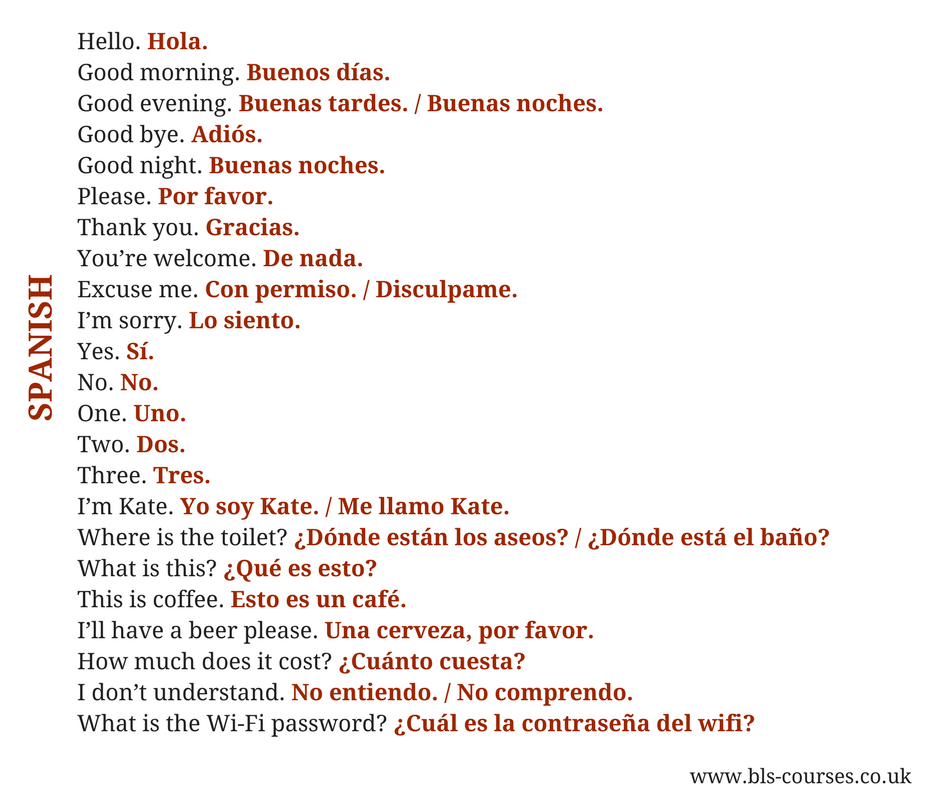
We would like to introduce a new series of blog posts/videos where we teach you some useful phrases in different languages. Sounds amazing? Let’s start with Spanish!


Learning a language -- useful phrases in Spanish 2

Are you planning your summer holiday in Spain? Do you travel frequently to Madrid? Do you dream of exploring South America?

If so, we would like you to taste & learn some essential Spanish first. Below you’ll find a list of useful phrases in Spanish (greetings, polite phrases, closed question words, numerals & simple questions and sentences).

We also video recorded Noelia, our Spanish tutor to help you with reading, pronunciation and accent (available on YouTube).

We hope you’re going to enjoy this series and that you’ll come and learn Spanish with us! Good luck!

learning a language -- useful phrases in Spanish 1

Which language would like you like to learn next? Let us know in the comments below.

Written by Kinga Macalla

July 27, 2016

Language Learning Techniques: Develop your Speaking Skills in Another Language

We hope you found our post on writing skills useful.  This is the last post in the skills development series – and it talks about the most active skill of all, speaking.  Speaking is what most people want to do when they learn a language – it is how you interact with people, and it is the most natural mode of communication. It takes practice but it is very rewarding when you start to speak well in your new language. Here are a few tips to get you speaking fluently.

Speaking 2

Be Patient and Practise
Like babies, when we learn a new language, we start to understand the language we are learning before we start to be able to speak it, and long before we are able to speak it well. It will probably take you longer to master speaking, an active skill, than it does to master the other, receptive (or passive) skills. So remember that speaking takes practice, and the more you do it, the easier it will get.  Don’t be discouraged, and speak as much as you can, to as many people as you can! Don’t be afraid to make mistakes – people do that when speaking their own language, so it is perfectly fine to do it in a language you are learning. You can correct yourself just as you do in your first language.

Read Aloud and Get Active
If you are reading a text in the language you are learning, try reading it aloud.  You will get used to making the sounds and how the language works without having to think about the words first – this is good practice for when you have to speak. This is an exercise children do at school too – but you can make it less daunting by doing it in the comfort of your own home!  You don’t need an audience, unless you are a fan of theatre or slam poetry!  In fact, joining a theatre club that performs in foreign languages is a good way to practice speaking in a fun environment. Joining a multilingual choir is another idea.

Copy What People Say
We learn by imitation, and you can put this into practice in the language you are learning.  Listen to the radio or, better, an online broadcast that you can pause and play back and repeat what you hear people say. This works even better if you have a transcript of what is being said. Then you can hear the word, repeat it and check what it is if you didn’t quite catch the meaning. Time how long it takes you to read the whole transcript and see if it takes the same amount of time as the presenters.

Think of a Topic to Talk About
We speak better when we know what we are talking about, so choose a topic you are familiar with, such as your hobbies or what you did at the weekend, and practice talking about it, gradually saying more each time.  You can look up vocabulary first or draw a mind map to get your brain ready and then speak for a minute to start with and then gradually build up the time you talk for. Try this with different topics until you have built up a good conversation repertoire.

Written by Suzannah Young

June 29, 2016

Language Learning Techniques: Develop your Writing Skills in Another Language

We hope you enjoyed our post on how to improve your reading skills in another language. Now we are back with tips on how to work on another skill – writing.  Each language has its own writing conventions for different genres. Practice these and you can write letters to your friends, write business emails, publish an article in a newspaper, keep a blog or even write novels in your new language. Here are a few tips for working on your writing skills.

machine-writing-2

Writing is an Active Skill
Unlike listening and reading, the skills we have looked at already, writing is not just about understanding what is being said to you or the text you have in front of you, it is about producing your own meaning.  Writing is an active skill. This means that you are using your brain actively, using grammar and making sentences.  You will need to practice writing to be able to do it effectively, but it is not impossible to learn!  One tip is to try to think and write in the target language rather than translating in your head or from a first draft.  This will come more naturally with practice.  Improving your writing will also have a knock-on effect on your other skills, as you will learn and remember (even complex) vocabulary better, understand grammatical constructions and become more creative in your chosen language. If you combine your learning tools (reading, listening, writing and speaking), you will engage all your senses in the learning process and therefore learn faster.

Don’t Forget to Read
Reading in your chosen language is a great way to get used to different writing styles that you can bring over into your own writing.  It will help you with sentence construction and spelling, and give you an idea of different writing conventions.  Think about how the texts you are reading are structured and which types of phrases or vocabulary are used in different situations and for different purposes – such as introducing a topic, description, comparisons, conclusions, etc.  Some people also recommend copying out texts to help yourself get better at writing in the language you are learning – it will help you get used to writing those letters in that order and those words in that order.  If you choose to do this, make sure the texts are interesting and you have a relaxing space to do it in and, ideally, a notebook dedicated to this exercise.

Close the Textbook
When you are practising writing, try to write long texts, rather than simply completing gap-filling or translation exercises in your textbook.  Make it personal to you, so it becomes more than answering questions and checking the answers.  Try writing a diary in your new language – write creatively about things you have seen that day, thoughts you have had, perhaps with illustrations.  If you do this you will automatically make the writing a part of you.  Remember, writing is expressive – so use it to write about how you feel.  Don’t worry if you don’t write everything correctly the first time, you can write and re-write your text as much as you like.  Having the diary will also let you see how much progress you have made – compare early entries to later ones to see how far you have come.  You don’t have to show anyone your diary if you don’t want to, but it will have helped you get down what you want to say in the language you are learning.  Of course, if you want to ask a native speaker to check your writing, you can do that too!

Have the Right Tools
If you want to write grammatically correct texts with creative use of vocabulary, remember to have a good dictionary (a monolingual one as well as a bilingual one if you can get your hands on it), a thesaurus to help you develop your knowledge of synonyms and a grammar reference if there is one available in the language you are learning.

Written by Susannah Young

May 25, 2016

Language Learning Techniques: Develop your Reading Skills in Another Language

You may remember our blog post from a few weeks ago on how to improve your listening comprehension skills in a new language.  This week we give you more tips on how to optimise your language learning – this time with advice on how to develop your reading in another language.  Whether you’re choosing what to eat at a restaurant, poring over a newspaper, or following directions on a map, reading is a big part of using your target language.  Working on your reading skills can also help you develop your writing as you learn about written constructions.  Here are a few ideas to help you learn.

Reading skills 2

Read a Lot
Read anything you can get your hands on in your chosen language. Try to read at least one thing in the language you are learning every day. The more you read it, the more familiar the language will become and the easier reading will be.  Reading will help you develop background knowledge about the culture you are studying too, which will help your understanding as well.  You can also read about the culture in your own language, so it becomes familiar to you.

Choose Materials You Find Interesting
You can choose a text type you are familiar with, through your work or hobbies, and read an example in your chosen language, such as a magazine article on motorbikes or a recipe for a typical dish from the country where they speak the language you are learning.  You will know what kind of words will be used, so you will be comfortable with the task.  Choose things you would like to read in your native language. Don’t read things that are boring just because you think you should – it will put you off!  Pick your favourite novel and read the translation in the language you are learning.  You might like to try graded readers as well, as the structures are adapted to learners of the language but they pitch the story to adults rather than children so it is not boring for adult learners.  Reading for pleasure can help your learning immensely – it is not the same as using a textbook which (let’s be honest) can be a bit dry sometimes.

Develop Your Vocabulary – Gradually
The good thing about reading is that you can control how fast you learn.  You can give yourself time to think.
When you first approach a text, read for the gist – identify words you know and work out the general subject.  Look up a few words if you are really stuck on them but don’t dwell on how many words you don’t know and don’t look up all the unfamiliar words you read – it will slow you down.  Instead, underline them to look up later.  Remember, you will be able to understand a lot of the text even if you don’t understand every word.  You can look up the words you underlined when you finish reading.  You can always read the text again once you’ve done that.  As you look up words, build lists of vocabulary by theme.  For example, list everything you find about cooking, sports, the weather or politics.  If you find a verb, look up nouns that go with it, and adjectives.  For example: ‘compter’ in French means ‘to count’, ‘comptable’ is ‘accountant’ and ‘comptabilité’ means ‘accounting’.  In Italian, ‘rabbia’ is ‘anger’, ‘arrabbiarsi’ is ‘to get angry’ and ‘arrabiato’ is ‘angry’.  Most languages will allow you to do this exercise!  You can also find lists of vocabulary to learn on the internet, such as the 1000 words challenge (http://www.speaktothefuture.org/1000-words-challenge/).  Look up synonyms and antonyms of the words you learn to build your vocabulary even more.  If you are a visual learner, draw pictures associated with the words you are learning to help you remember them.  Repeat the words as much as you can so they stick in your head.
Of course, one thing to remember is that you don’t read just in order to learn words. If you read a book you are interested in, you will learn words in context and be more likely to remember them anyway.

Give Yourself Different Reading Tasks
Try different reading tasks to build your ease of reading.  You can time how long it takes you to read a text a few times – you will see how you get faster as your fluency increases.  You can decide to read fast or slow.  You can read a text aloud (this will also help with your pronunciation), in a reading group or in a pair (meet up with someone from your class!)  Come back to texts you have already read to see how much more you understand the second time round!  Listen to the text you are reading – an audiobook or a radio show with a transcript, for example – to hear how native speakers pronounce the words and what the reading aloud style is like in your chosen language.

Bonne lecture! Veel leesplezier! Miłego czytania!

Written by Suzannah Young

March 30, 2016

Language Learning Techniques – How to Develop your Listening Comprehension

We hope you enjoyed our Language Learning experience posts over the past few weeks.

In the posts that follow, we are going to look at different techniques to develop your skills in your chosen language in four different areas: listening, speaking, reading and writing.

This posts gives you a few tips on how to develop your listening comprehension skills. Like any other skill, listening can be developed with practice. Good listening skills also help you improve your speaking skills.

Remember that there are only a few situations when you need to listen hard to and understand every word – like an announcement telling you when your flight is at the airport. Most of the time it’s not necessary to understand everything, so don’t worry if you don’t catch every word.

Another thing to remember is that if you are speaking to someone, you can ask them to repeat something. This is a normal part of speech so will not disrupt the conversation. The important thing to do when listening is…relax (but be active)!

listening skills

Learn Listening By…Listening

A few posts ago, we recommended you immerse yourself in the language you are learning in order to become more familiar with it. So the first thing to do to develop your listening skills is to listen to your chosen language as much as you possibly can. You will be surprised how much you pick up.

You can chose to have the sound on in the background while you are doing something else so as to get used to how the language sounds or you can take part in active listening. The two tasks have different goals.

You can find material to help you develop your listening skills on the radio, on TV or in audio books.

Preparing for Listening

In most conversations you have or situations you experience, you usually know more or less what is going to be talked about, so you know what kinds of words are going to be used. Approach listening exercises by preparing for what you are about to hear: make decisions about what to listen for and what to focus attention on while listening.

Ambient Listening

Listen to the radio thorough your headphones while you are walking or listen to music in your chosen language while you are cooking, doing the housework or relaxing. This will mean you get used to hearing the sounds of the language. It also means that you will not feel stressed when it comes to active listening because you will already be familiar with the sounds of the language.

It is important that this is not your only listening activity. The trick is to combine different types of listening so that you make progress.

Active Listening

There are a number of tasks you can do to practice listening actively – that means listening with a purpose, focusing your attention and listening out for specific details. Active listening requires you to take action based on what you have heard.

  1. Listen for one element in speech patterns rather than listening for meaning: listen for sounds, for tones, for melody, for stress and so on. You can then practise applying these patterns to your speaking.
  2. Pick out as many words as you can without worrying about understanding everything. The more you do this, the more words you will understand each time.
  3. Decide on a topic and try to pick out key words to do with that topic. Write them down so you have a list of topic-specific vocabulary to refer to.
  4. Try to transcribe what you hear. You can pause the audio and go back if you miss something or need to listen to it again. Many online radio programmes have transcripts that you can check yours against.
  5. Read the transcript whilst listening to a radio programme. That way you will be able to hear exactly what the speakers are saying.
  6. Listen to music and read the lyrics. There are lots of music videos online with lyrics that you can read along to.
  7. Listen to the same segment again and again to see how much more you understand each time.

Resources

You can find a lot of listening resources on the internet. If you search for the name of the language you are learning + ‘radio’, you will more than likely be given a list of radio stations you can choose from. Some of the online radio stations have tailored listening exercises for language learners, such as Radio France Internationale (scroll down to ‘Apprendre le français’ or see the Journal en français facile (News Report in Easy French) or Deutsche Welle.

A Word on Vocabulary

In order to develop your listening skills, it is also important that you keep up your on-paper study of vocabulary and grammar too. This will mean you will recognise more of the words in the audio you are listening to.

And, most importantly, have fun!

Written by Suzannah Young

February 17, 2016

Learning Languages – My Story

My name is Suzannah I am a PhD student in Translation Studies.  I speak five languages (English, French, Italian, Dutch and Spanish) and am learning a sixth (Polish).  You may ask how or why I have learnt/am learning them and what I use them for.  What I will say is that I use them all regularly and they are all a big part of my life.  Actually, I don’t know what I would do without them.  It may surprise you to know, though, that it wasn’t always like this.  There was a time when I thought I wasn’t going to carry on learning any languages at all.  In the end, my circumstances changed and I did carry on – and I’m very glad I did because it changed my life!  This is my story.

Learning a Language -- My story 2

Beginnings
I started learning French when I was little, thanks to my parents having got me to watch a bilingual video about an alien who comes to Earth and learns about human life…  This video was the same story in French and English.  It was easy to follow in French if you had watched the English version (and even if you hadn’t) and the storyline and learning material was very clearly presented.  The best thing about it was that it was fun – it didn’t feel like a chore and I enjoyed watching it again and again.  I was learning without even realising it!
Another early memory is that whenever we went on holiday, my parents always tried to learn a few words of the local language and encouraged my sister and me to try the food and appreciate the places we visited.  I am very grateful to them for having done this because I believe they gave me a positive attitude to new languages and cultures and made learning about new people and places a fun thing to do.  Of course, being on holiday helped make it fun!  This attitude has definitely stuck with me.

School Time
We had French lessons at school from when I was 11 but I feel we only learnt a few set phrases and weren’t really given a love for the language.  Nevertheless, I found I understood things quite quickly and did receive some encouragement from the teacher.  The problem was, learning a language was not seen as ‘cool’ at my school and I actually hid my talent from my peers and pretended I found it as difficult and boring as they did!
I got a good mark for GCSE French and luckily decided to carry on to AS Level.  I thought I was only going to do a year but, thankfully I had a very dedicated and enthusiastic teacher who encouraged us to nurture our talent and used interesting learning material like films and newspaper articles – real life material that real French people used.  That made it more relevant to us and made us see that it was a living language.  I carried on to A-Level and did well in it.
As A-Level students, we had the opportunity to go and stay with a family in France.  My host mother was a wonderful lady, she was very supportive and was really interested in everything we did.  She introduced me to literature and a theatre group she was involved in.  We are still in touch today (almost 15 years later) and I have visited her numerous times.
I still didn’t think I was going to carry on with French and thought I was going to do English Literature at university.  In the end I didn’t get the grades I needed to do English and decided to defer my university entry for a year and reapply.  That meant I needed something to do for a year. A friend of my sister’s had just done a placement in France and suggested I do the same.  She gave me the details of a language school and I contacted them.  They signed me up for a three-month language course and a work experience placement.  I enjoyed the life at my host family’s house less than the time before but I made some really good friends at the language school.  A lot of them were Chinese and it was fun to learn about their country as well as learning French together.  They even taught me a few words of Mandarin!  At the time it was funny for me to think that we were able to communicate with each other through a language that was neither of our first languages.

University Life
Thanks to this placement, which improved my French a lot, I applied to do French and English Literature at a different University.  I was accepted and spent three years there.  The language learning experience depended on how committed you were to learning – there were resources available but you had to use them on your own initiative – but we did learn a lot about French culture and society, which helped us to understand the background to the language we were learning.
I spent my Erasmus year in Paris, France.  Initially, I started a work placement but didn’t enjoy it so enrolled in a university.  That was one of the best decisions I have ever made.  If I had stayed on the work placement, I may have got disheartened but as I went to university I met a lot of people my age and made life-long friends.  I was lucky enough to meet a group of friends who I spent every day with – you can say I was really immersed in French culture!  It was a bit difficult following lectures in French at first but I had a trusty electronic dictionary which gave me the definitions of words I didn’t know and I soon got up to speed.  My friends and I started a Spanish class together as well, which was a fun experience – learning a language through a language that was not my mother tongue!  In the summer after my Erasmus year, I went to stay with a friend in Madrid and did a language course – for fun.  That was great too because of the amazing people I met from all over the world.  We had to use Spanish to communicate with each other so it really helped us learn.

After Graduation
When I graduated, I wanted to get a job using my languages so I applied for internships in Brussels, Belgium.  I started an internship at a European NGO, where I would be speaking French and English.  It turned out that they needed my Spanish too.  Initially, I thought I was going to stay there for six months (you can see that this is a recurring theme!) but then I was offered a full-time job and ended up staying for six years!
Belgium has three official languages, Dutch, French and German (and an unofficial one, which is English!)  I was curious to know what the signs I could see in Brussels said, so I enrolled on a Dutch course.  I complemented my learning by listening to the radio and reading newspapers that were readily available.
After a few years in Brussels, I met a person who ran a theatre group in Antwerp.  I started going to the theatre group every week, and it was there that I met my partner, who is Italian.  I moved to Antwerp to live with him, which meant that I could practice Dutch all the time.  I also learnt Italian through my partner and with his family.  I had to speak Italian if I wanted to speak to them, and I did want to speak to them, so that was useful!  I found I learnt Italian fairly quickly because it is similar to French and Spanish so I could already understand quite a lot.  We have a lot of Italian friends and I speak to them all in Italian.
While still in Brussels, I met a few Polish people through work.  We became friends and I realised I was interested in learning their language.  When I moved to Antwerp, I decided to enrol on a Polish course, not least because I wanted to meet people in my new town.  I also wanted to see whether I was capable of learning a Slavic language.  I had learnt three Romance languages and a Germanic language so learning Polish was (and still is) a new challenge for me.

Back in the UK
I recently moved back to the UK and have carried on learning Polish.  I am finding it a bit more difficult to learn than it was to learn the other languages I speak.  This may be because I don’t have many people to practice with.  Learning my other languages went quite quickly because I was able to practice with people around me and, in some cases, I had to speak because there was no other option!  I think it is important not to be afraid of making mistakes and just speaking – but I am finding it a bit hard to follow my own advice in Polish at the moment!!

The Last Word
As you can see, my reasons for learning languages have been enthusiastic teachers and a positive attitude to language learning on the one hand and friendships and a desire to have new experiences on the other.  Being in an environment that has allowed me to be exposed to the languages on a regular basis has definitely been beneficial to my learning.  Speaking other languages has allowed me to meet lots of wonderful people but it has also been useful professionally.  For example, I do translation work sent to me through people I have met abroad.  The most important part of language learning for me, though, is by far the friends I have made.
I hope you can have a similarly positive experience with learning languages!

Written by Suzannah Young

February 9, 2016

Learning a Language: Online and Mobile Language-Learning Tools

With the advent of widespread access to technology, it has never been easier to find resources to help you learn a new language.  If you use the internet, you can find a wealth of tools to support your learning that are fun and interactive and don’t break the bank.  It is also easy to take these study aids with you.  You can use online tools to supplement your learning when you have a bit of free time, on your commute, when you’re having lunch or waiting for the bus, or when you are at home in the evening.
Here are some examples of what the web can offer you.

On Multilingualism and Bilingualism Magazines 1

Online Language Exchange Platforms

Traditionally, it has been hard to find ways to practice speaking the language you are learning outside the classroom.  Luckily, video conference tools like Skype have now made it easier to talk to people all over the world.  The online platforms below give you the chance to practice your speaking skills by either putting you in touch with a teacher you can have lessons with online or letting you meet native speakers in a more informal setting.  You can also teach the language you speak via the online platforms.  You might even make friends!
Here are a few examples:

Busuu
The most popular language exchange platform
Price: Mostly free, $17 to unlock all features
Good for: Interactive learning, meeting people
Learning style: Read, write, interact, Speak on Skype, Peer-to-peer corrections
Pros: Community, Practice with native speakers and be a tutor yourself, also a language-learning app (see below)
Languages: Arabic, English, French, German, Italian, Japanese, Mandarin Chinese, Polish, Portuguese, Russian, Spanish, Turkish

My Language Exchange
Practice your second language with a native speaker who is learning your language
Price: Free
Learning style: Meet people from the online community, practise with a native speaker, membership required
Pros: MLE hosts your online practice with lesson plans, text chat rooms
Languages: 115+

Italki
Choose a teacher online and schedule a lesson
Price: Pay by lesson
Good for: Interactive learning
Learning style: Live online lessons with professional teachers
Pros: You can define search variables
Languages: 70+

Easy Language Exchange
You can save your learning material with this platform
Price: Free
Good for: Interactive learning, meeting people
Learning style: Speaking to people online
Pros: You can save conversations and refer back to them
Languages: Several

HelloTalk
A language exchange app you can use like a messaging service
Price: Free to download, charges for extra features
Good for: Interactive learning, conversations on the go
Learning style: Chat by text or through short audio clips (like Whatsapp)
Pros: Conversation time divided equally, conversations are stored on your phone, translation and correction feature
Cons: Finding active partners can take time (depending on time of day and target language)
Languages: Over 100

Language Learning Apps

Language Learning Apps give you language exercises in an entertaining, bite-size format.  They help you learn by using games and memory exercises, and you can set yourself targets and test yourself.  They use a variety of learning styles, which can help you remember your newly-acquired knowledge.
Here are some examples of language learning apps, with a rundown of each one’s vital statistics.

MindSnacks
MindSnacks makes mobile learning games for iPhone, iPod Touch and iPad
Price: Free
Good for: Learning vocab
Learning style: Games, puzzles
Languages: Spanish, French, Italian, Japanese, German, Mandarin Chinese, Portuguese

Brainscape
Flash card-based learning with a free version or the option to pay
Price: Free to download, all lessons for $19.99
Learning style: Flash cards, writing tips
Languages: Spanish, Mandarin Chinese

Memrise
The Memrise community uses images and science to support your learning
Price: Free
Good for: Learning vocab
Learning style: Mnemonics, pronunciation guide, images
Languages: French, German, Mandarin Chinese, Russian

Babbel
Playing games will help you learn vocabulary with this free app
Price: Free to download, then $11 monthly
Good for: Learning vocab
Learning style: Games, puzzles
Pros: Wide selection of languages, saves your learning on your online account
Languages: Danish, Dutch, English, French, German, Indonesian, Italian, Norwegian, Polish, Portuguese, Russian, Spanish, Swedish, Turkish

AnkiApp
A flash card app for iPhone
Price: $24.99
Good for: Learning vocab
Learning style: Flash cards, memory activities, beat the clock challenges
Pros: Create your own flashcards
Languages: Several

Flash Sticks
Create your own flash cards
Price: The app is free to download; ‘flashsticks’ can be bought from £4.99
Good for: Learning vocab and pronunciation
Learning style: Either buy ‘post-it note’ style flashcards or make your own with your phone camera
Pros: Fun and playful style, language newsletter sent to you if you sign up
Cons: Just vocabulary
Languages: British Sign Language, English, French, German, Italian, Spanish

Duolingo
The most popular gamification-based language learning app
Price: Free
Good for: Learning vocab
Learning style: Games, earn points for correct answers, beat the clock
Pros: Bite-size lessons, progressive learning
Cons: No explanations, no grammar content, not natural conversation
Languages: French, Spanish

LingQ
An app that also links you to a community of speakers
Price: Free version with 5 lessons and 20 word lists or full version from $10/month
Good for: Learning vocab, practicing with speakers
Learning style: Games, intuitive learning, community of speakers
Pros: A lot of languages offered, interactive
Languages: English, French, German, Italian, Japanese, Korean, Mandarin Chinese, Portuguese, Russian, Spanish, Swedish and other languages in Beta

YouTube Videos

You can find a lot of video tutorials on YouTube just by searching ‘learn’ plus the name of the language you are learning.  There are also educational channels dedicated to specific languages.  Video tutorials can help you go over a grammar point, practice speaking and listening, get used to pronunciation and learn new words and phrases.  The good thing about videos is that you can pause or go back if you need more time or want to hear something again.  Most channels host several videos.  It can be tempting to watch them all at once but try to limit yourself to learning one video a day, to make sure it is all going in!
Here is a taster of some videos to learn different languages:

Hindi
Korean
Mandarin Chinese
Turkish

Try Them Out

Now you have a few tools to keep you busy and which will hopefully make your learning more effective.  Expanding the number of different ways you practice your new language will help you remember more and will make the process more stimulating.  Good luck!

Written by Suzannah Young
February 1, 2016

Learning a Language – A Few Tips

Learning a new language is an enriching experience – it introduces you to new ways of doing things, thinking about things and talking about things.  It widens your horizons: it can make you attractive to a potential employer at home – or help you get that dream job abroad! Learning a language is useful if you want to travel, it can help keep your brain active and it improves your social life by letting you meet new, interesting people.  If you learn a language, you will have access to new places, new sights and new sounds. And it doesn’t have to be difficult to do, if you make it into an enjoyable and intuitive experience.  There are strategies you can use to help you remember what you have learned more easily.  Here are a few tips to help your learning stick!

Language in diff languages

Realise how much you already know
Unless you are an ostrich, it is likely that you will hear and process lots of information every day, without even realising you are doing it.  This includes words in other languages that are used all around you – just think of your local French restaurant, “Bon Appétit”, or the beauty parlour down the road called “Bella Donna”.  You will be surprised how many words you already know in the language you wish to learn.  Make a list of all of them – and you will see that you are not starting from scratch!
If you speak English and are learning a European language, and even if you are not, the chances are that there will be words that look like words in English – after all, the languages we speak evolved together from shared roots.  An example of this is words ending in –ion(s) in English that have their equivalents in many European languages: congratulazione, imaginación, démonstration, Konversation.  If you look for words you recognise, you will see that you already understand part of the text you are reading.

Relate it to things you like
Language learning is meant to be fun!  So try finding out vocabulary that can help you talk about your hobbies or interests.  You will remember these because they are relevant to you.
For example, if you like cycling, find out all the words for the parts of your bike and the words you will need if you want to talk about a race.  If you like cooking, look up the words for the most common ingredients and cooking methods. If you like music, find artists who sing in the language you are learning and look up the lyrics online so you can sing along.  If you like cinema, find your favourite film in your new language.  Put the subtitles on if you need them – but in the language, not in English.  That way you will know what they are actually saying and will pick up phrases.  Read your favourite novel in another language.  If you like keeping informed by reading the news, find the article you have just read in another language (European news websites like euronews are a good place to do this).  You will understand as you already know the story – and you will learn new vocabulary.

Context is important
It is easier to learn and remember new words and grammatical constructions when you know why you are using them. Use the new words you have learned in context if you can.  Making sentences about yourself with what you have learned will help the new grammar stick in your head.
A news article about a certain subject is a good way to pick up vocabulary about that subject.  You will find you don’t even need to look up some of the words because you will recognise the ones that are similar to ones you have already learned.
You know that when you are watching a news item about farming or reading a novel, a particular style and vocabulary will be used, so you can work out some of what is being said.

Focus on what you know rather than on your mistakes
When you are reading or listening to a text, even if you don’t understand everything, you will be able to pick out words you do know.  Focus on those and you will have the gist of what the text is about.  In time you will build up your knowledge and the ratio of words you understand to those you don’t understand will increase.
If you are reading a novel, you will enjoy it less if you stop to look up every unknown word.  Try to avoid this temptation and just keep reading and let the words sink in.  You will still understand a lot of what is happening and you will find the experience more pleasant and less frustrating, which will make you want to learn more.  Again, your understanding will improve with time.
When you are speaking, the most important thing is to communicate.  You don’t need to worry about your mistakes as long as the message is there.  The way to fluency is not being afraid to make mistakes.  We all do it, even in our mother tongue, so it is nothing to be embarrassed about!

Look for patterns
Most languages are logical and have fairly regular grammatical rules.  The language is not trying to catch you unawares!  You will start to recognise the way words behave in specific situations and be able to predict what a conjugation will be, which case you need to use or what kind prefix you will need to use with which verb.  Learning to spot patterns will help you feel at home in the language.

Immerse yourself in the language
You often hear that the best way to learn a language is by being in the country where it is spoken.  But you don’t necessarily have to travel to be able to come into contact with your chosen language – sometimes you can even do it from the comfort of your own home!  These days it is very easy to find radio, newspapers and even television in different languages online.  Listen to the radio and watch videos to get used to hearing the language you are learning and read the news to get quicker at deciphering it.  Find a conversation group in your town and go along – it is a way to meet people as well as perfect your speaking skills.  Change the language on your phone and on your Facebook account – then you will feel like the language is really part of your life (and it is an easy way to learn without really trying).  Use every chance you get to practise your new language!

Go with the flow
Learning a new language is fun.  Do your homework but practise in unconventional ways too – ways that are adapted to your learning style.  Use your newly-acquired skills anywhere you can!

Written by Suzannah Young