Tag Archive: Polish

October 22, 2025

Book review: What we read together bilingually in Polish and English (2025)

We read books in Polish and English and we have several of the same books in both languages, either because of available translations in those languages, or because we really enjoyed those stories. Sometimes it’s good to read the same story bilingually, to hear it in the languages we speak. For example, as an adult I read Harry Potter in three languages: in Polish, English and Czech. Reading the same book in translation gave me some context for another interpretation and the joy to understand it in more language(s). 

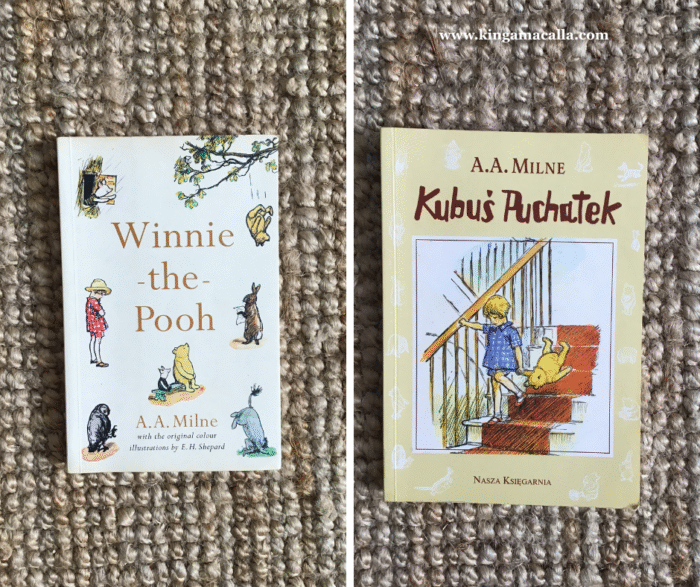
A.A.Milne Winnie-the-Pooh // A.A. Milne Kubuś Puchatek

(originally published in English)

This is a classic and it was one of the first books we had in two languages. We read it chapter after chapter in Polish and then in English. We later found some audio-recordings which we listened to, as well. The stories are charming, as if we’re allowed to enter a magic world of teddy bears.
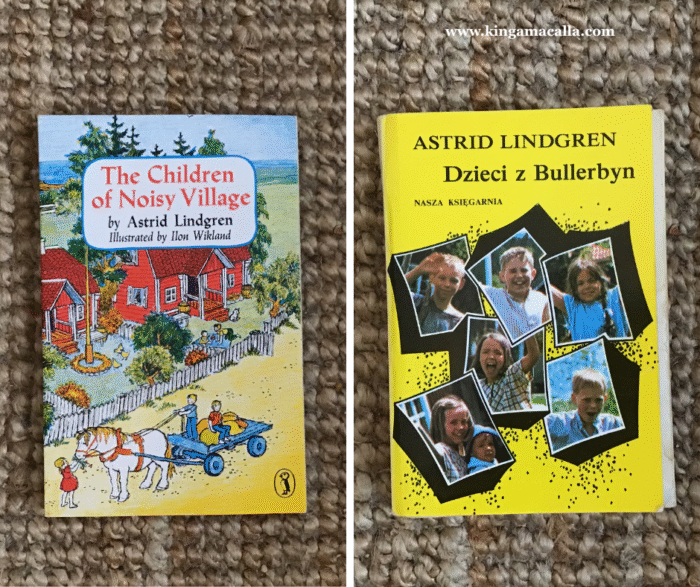
Astrid Lindgren The Children of Noisy Village // Astrid Lindgren Dzieci z Bullerbyn

(originally published in Swedish)

I read Astrid as a child and couldn’t wait to read those stories to my children. We love the noisy, courageous and joyful children who live together in a little village of Bullerby in Sweden.  They have a simple life which is full of little adventures, childhood play and happiness.
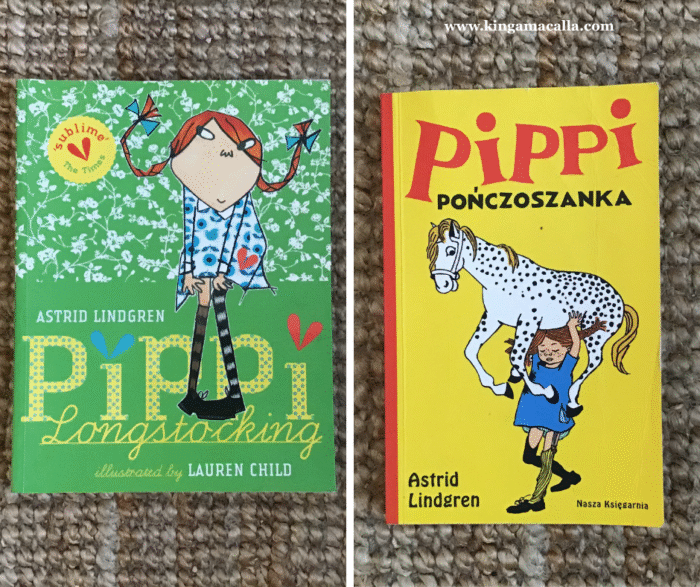
Astrid Lindgren Pipi Longstocking // Astrid Lindgren Pipi Puńczoszanka

(originally published in Swedish)

Pipi is a wonderful character who lives without her parents, with a horse and a monkey. Yes, she leads her life against the agreed way of doing things. Even though Pipi’s life is unusual, it’s also full of her kindness and generosity.
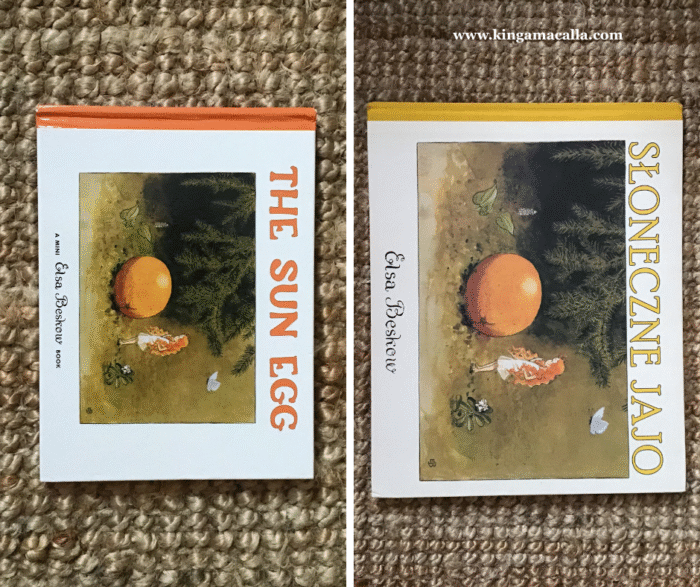
Elsa Beskow The Sun Egg / Elsa Beskow Słoneczne jajo

(originally published in Swedish)

This is one of the first books we read by Elsa Beskow, and we have this publication in Polish and in English. The Sun Egg is our summer read: it’s a short story about an elf who finds a ‘sun’s egg’ and together with forest animals, they try to find out what this round object actually is. Beautifully illustrated.
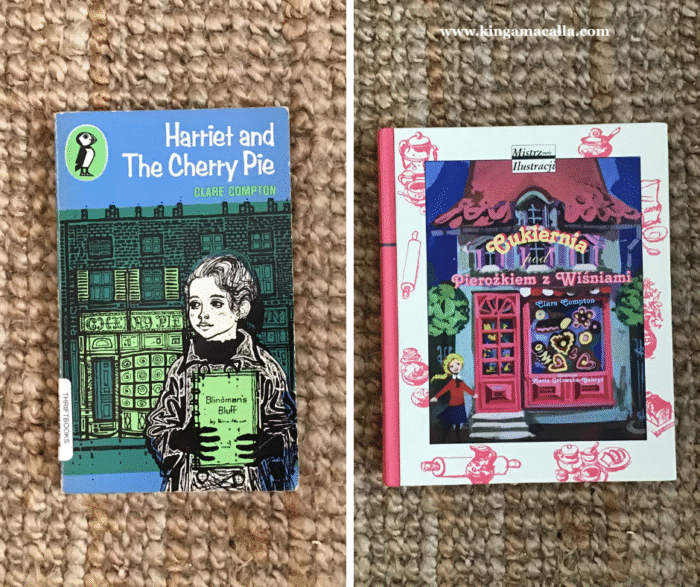
Clare Compton Harriet and the Cherry Pie // Clare Compton Cukiernia pod Pierożkiem z Wiśniami

(originally published in English)

We first found out about this novel as a Polish translation: we listened to an audiobook and then we read a book too. I then started searching for information about the author who actually turned out to be British–Clare’s real name was Hilda Hewett! Harriet and the Cherry Pie is a heart-warming story about an 11-year-old, Harriet, and her 6-year-old sister, Kitten. It’s a beautiful read, with some delicious recipes, like peppermint creams and chocolate crispies. It’s a shame that the book hasn’t been re-printed in English since 1968, and it’s only available second-hand.

Just to add that the Polish translation is absolutely scrumptious, as is the audio-recoding of the book.
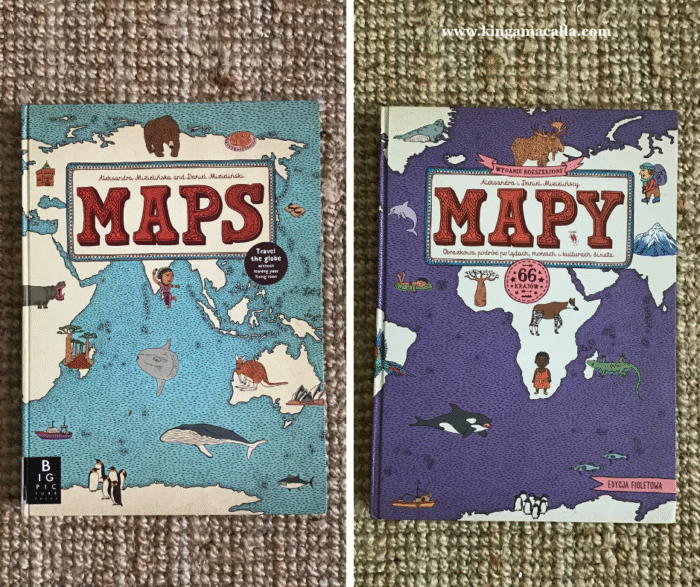
Aleksandra & Daniel Mizielińscy Maps // Aleksandra & Daniel Mizielińscy Mapy

(originally published in Polish)

This is a treat for children and adults. It’s beautifully illustrated and contains many useful and interesting facts about each country. You can go from country to country and your interest only grows, as you learn more about different countries, their food, nature, literature, sports, customs etc. Maps is a simple idea, but it is so cleverly executed!
I hope you’ll find some inspiration in the above reading list. Please comment below if you have read any of the above with your children and let me know about you or your children’s favourite bilingual books.
October 21, 2020

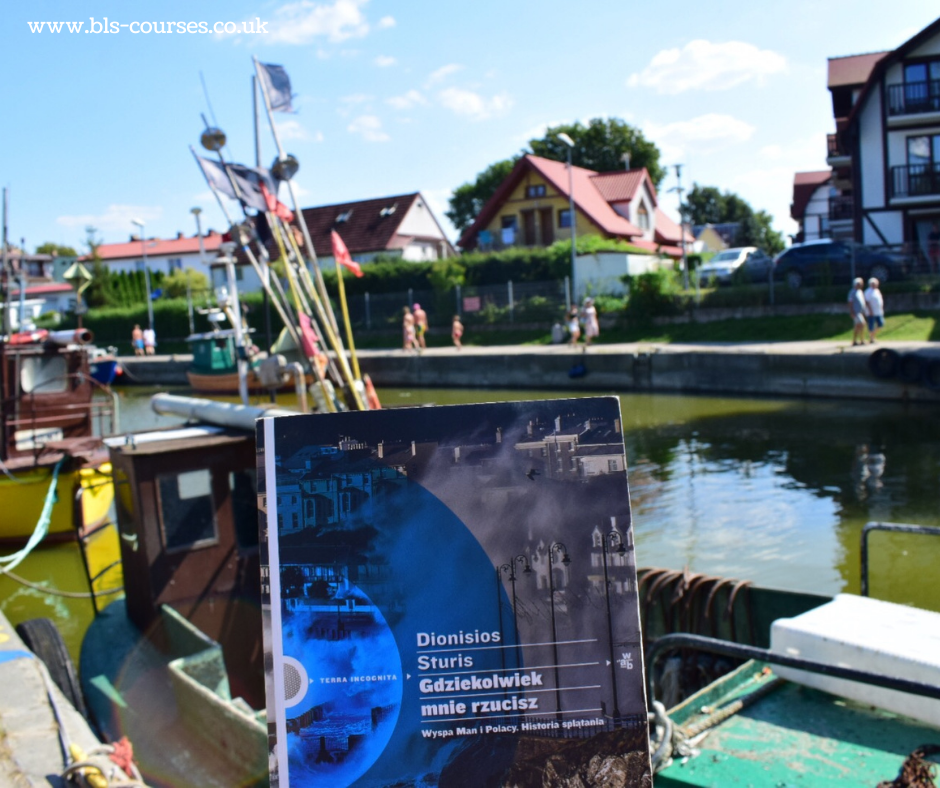
Book review: Gdziekolwiek mnie rzucisz by Dionisios Sturis

Dionisios Sturis was born in Greece, but grew up in Poland. He’s a documentary writer. After graduating from university, he moved to the Isle of Man to work in a shellfish factory, as many other Poles did back then. However, his story is different, because after a few years he left the island, returning to it regularly to work as a writer. This is when the book was born, a story about war, politics, Polish migration, ordinary everyday life, love, and death. It’s like reading about a big world being shrank into a tiny island. Fascinating. It somehow reminds me about Central Europe, where geopolitical, economic, and cultural ideas influence each other to create a pot of different flavours: important and trivial, grande and petit, global and local. It’s all so mixed up that it’s sometimes difficult to distinguish what’s important. Does it feel the same or similar on the Isle of Man? I don’t know. It’s probably a good question to be answered by the author himself.

Do you read books in other languages? In which language(s)? Let me know in the comments below.

Kinga Macalla

February 26, 2020

Learn a language: Can I learn Polish, Czech, French, Russian & Portuguese on YouTube?

Today, I’d like to see if we can improve our language skills via YouTube channels.  I hope to inspire you to use some free resources that are available online. I’ll first focus on the languages that I’m familiar with (Polish, Czech, French and Russian) or plan to learn (Portuguese). Yes, I’m giving myself a new language challenge for the coming 8-12 months: to learn some basic Portuguese. I’ll write a new blog post on my progress soon! Today, I’ll focus on YouTube channels and will provide one or two online resources per language to inspire you to practise your language skills more:

Czech: Basic greetings & Americans speaking Czech

Polish: A smiling intro to Polish greetings and Japanese uni students learning & speaking Polish

French: To listen and learn more street French

Portuguese: Students tend to have a preference whether they wish to study European Portuguese (that one that’s spoken in Portugal) or Brazilian Portuguese (spoken in Brazil).

European Portuguese: Basic Portuguese from the Portuguese

Brazilian Portuguese: To start from scratch & for the joy of listening to the melodic Brazilian Portuguese

Russian: A short & fun intro to basic Russian

These are my findings. What YT channels / podcasts / online resources do you use to improve your language skills in Polish, Czech, French, Portuguese or Russian? Let me know in the comments below.

Kinga Macalla

October 16, 2019

Learning a language: Learn Polish with BLS online & FREE!

As you remember, we introduced a new series of blog posts (see Spanish, French, German, Russian, Italian, Portuguese, Mandarin ChineseArabic) where we teach you some useful phrases in different languages. Sounds amazing? And it’s POLISH today!

Do you want to be able to talk with your Polish family? Do you travel frequently to Warszawa, Kraków or Wrocław? Are you planning your summer holiday in Hel or Zakopane? Do you dream of exploring the Polish countryside? If so, we would like you to taste & learn some essential Polish first. Below you’ll find a list of useful phrases in Polish (greetings, polite phrases, closed question words, numerals and simple questions & sentences). We also video recorded Lucja, our Polish tutor, to help you with reading, pronunciation and accent (also available on YouTube). We hope you enjoy this series and that you’ll come and learn Polish with us! Good luck!

Which language would like you like to learn next? Let us know in the comments below.

Written by Kinga Macalla

February 21, 2018

The Language Journey – Suzannah’s Story (in 6 Languages)

Hello, my name is Suzannah and I’m a linguist and freelance translator.  In this video, I answer questions about my journey to speaking 6 languages. I give one answer in each of the languages I speak: French, Dutch, English, Polish, Italian and Spanish. Firstly, in French, I talk about how I discovered I had a talent for the language and almost accidentally ended up spending some time in France and eventually studying French at university, which opened the door to me learning other languages – something I never imagined I would be able to do when I was a shy, quiet teenager. Then, in Dutch, I talk about the story behind why I started to learn other languages – mainly out of curiosity and thanks to friendships I made, as well as having the opportunity to live and work abroad.  I then give away a few tips on how to learn a language – or at least I explain what works best for me and how I have gone about learning each language – in English. After that I explain (in Polish) why I chose to learn Polish, my latest language: it came down to friendships again; plus, it was/is a fun challenge for me.  Then, in Italian, I talk about the advantages of speaking and learning different languages and what I like best about being able to speak other languages. Finally, in Spanish I reveal how I keep up my language skills and what I do to practise every day so I don’t forget them!  Bon visionnement! Veel kijkplezier! Happy watching! Bawcie się dobrze! Buona visione! Disfrutéis de la película!

Suzannah Young

We need your help! Suzannah, our multilingual student speaks 6 languages and we’ve recorded an interview with her speaking them (available on YouTube). But, we need your help with translations from Dutch, French, Italian, Spanish and Polish into English.

Leave your translations here below our blog post and we’ll then add them to our video as subtitles! Good luck 🙂

January 31, 2018

A Day in the Life of an Interpreter – An Interview with Agnieszka Teixera-Vaz

Agnieszka teaches Polish at BLS. She is also a Polish-English interpreter, working in various settings: the police, the courts, hospitals, etc.  We caught up with her after a long day in the field to ask her what a typical day looks like for her.

Please tell us a bit about yourself

I am Polish, I have been in the UK for almost 7 years and I am a mum of 2 boys.  I have a BA and MA in Sociology/Social Sciences, an English College Diploma in Translation and Interpreting, and a Postgraduate Diploma in Training and Teaching.

How long have you been a translator/interpreter?

I qualified in 2009 and have worked since then, first translating online and then moving on to interpreting.

What type of translation/interpreting do you do?  What types of situations do you interpret in?

At the moment, I do mainly court work, where I assist a non-English speaking person throughout the court process. Other places include prisons, police stations, probation, social service meetings, hospitals, etc.

Do you work full time as an interpreter or do you combine it with another job?

There is no such thing as “full time” – sometimes you work 60 hours a week, and sometimes you have a few days off….

Do you have to travel to do your job?  What’s the furthest you have had to go?

Yes, I travel to all the courts in South-West England and South Wales. The longest time I had to commute was about 3 hours one-way.

Do you always interpret face-to-face or have you done telephone interpreting too?

I have done telephone interpreting too. But face to face interpreting is much more my cup of tea as I believe a message is conveyed better when you can see somebody’s facial expressions, other body language, and you can hear tone of a voice clearer than on the phone.

How to you keep up-to-date with the fields you are interpreting for and the language related to them?

That is absolutely crucial. I learn every day and update my vocabulary range constantly. This is actually one of the perks of the job – you never stop learning.

Please can you describe a typical day when you have an interpreting assignment?

I normally prepare for my working day the day before – I need to make sure I know where I am going and what is expected of me.  I print out the documents and read any additional documentation.  If it is a hospital appointment I try and refresh the specific vocabulary I might need to use. To check location, I use Google Maps to make sure I know what the building I am going to looks like, to make it easier to find.  I check the time of commute and plan my travel accordingly.  I buy tickets online if I have to catch a train.  In the city, I cycle everywhere so I am independent of traffic, which is amazing in a busy city like Bristol.

Where did you learn to be an interpreter?  How did you get into translation/interpreting?

Having obtained my qualifications in English, I went on to study interpreting and translation. It was a 1-year course which involved lots of practical classes where you train your brain to think quickly, to store long utterances, to remember many details at the same time, etc.  We were also taught some specific techniques for note-taking, common symbols, etc.  I had to pass 4 exams in translating and interpreting both ways (Polish into English and vice versa).

Online translation offers great flexibility – that tempted me in the first place.  I worked as a manager of a busy educational institution but when I got pregnant I knew I would have to slow down. Translation allowed me to work around my child’s routine; I could stay at home with my son while earning and being professionally active.

What do you like best about being an interpreter/translator?

At the moment, with court work, I mostly enjoy knowing that I can help a fellow citizen in difficulty. Interpreting sometimes borders on support work where you are somebody’s first point of reference in a stressful situation.  The job also offers flexibility.

What is your least favourite thing about your job as an interpreter?

Defendants you are supposed to support changing their plea in the first half an hour of a 5-day trial you were booked on. Your whole week gets cancelled and you have to make sure you get other projects quickly to ensure you actually work!

What is your favourite thing to translate?

Scientific publications on subjects related to psychology, sociology, childhood studies, etc. Being personally interested in a subject definitely helps when translating.

Do you have any tips for anyone who is considering a career in translation/interpreting?

Make sure you work with more than one agency to build your calendar – you are technically self-employed and you are responsible for ensuring you have enough work.

Don’t get frustrated when things don’t go as planned – there are a lot of cancellations or, on the other hand, last minute bookings when you are on your day off. Be prepared for that and just accept it as part of your work dynamic. If you get stressed by every cancellation or change, you will not enjoy your professional life.

If you struggle with a specific term, be it in hospital or in court – simply ask for clarification. We are only human, and it is not possible to know everything about everything!  It is much better to admit that we are not familiar with a term and get an explanation than to translate incorrectly!

If you are more interested in written translation, become part of translation boards like ProZ and invest your time in building your profile there – this will result in more job offers.  Always be realistic about the amount of work you can do in specific time-scales – bad quality translation might lead to negative comments on your profile and long-term loss of income.  Make sure your work is proofread if you translate into a foreign language – you might feel the text is perfect, but a native speaker can always “polish it”, making it feel as if it was originally written in the target language.

Invest in good software – it will speed up your work, correct your mistakes, remember all previous projects and so on.  Also, get some training in how to use said software – there is no point in spending hundreds of pounds on a programme that you don’t fully exploit.

How do you relax when you are not working as an interpreter?

I teach Polish! 🙂  And spend time with my family and friends.

What are your ambitions for the future?

To be happy 🙂 And for my boys to be good people 🙂

Thank you!

Agnieszka Teixera-Vaz was interviewed by her student, Suzannah Young

September 27, 2017

Interview with Polish & English Singer Katy Carr

Even though you only lived in Poland for the first few years of your life, this experience has obviously had a great impact on you. Do you think of yourself as Polish?

🙂 I am very proud to have Polish blood and so pleased that my Polish heritage has become a huge inspiration for my music and creativity. Poland and Polish people worldwide are my inspiration and I never want to be separated from them for such a long period ever again. I loved writing my albums Paszport and Polonia and I look forward to more Polish inspired musical projects.


In what ways, do you think this dual identity has enriched you? Are there any disadvantages?

🙂 I love being British and Polish and I see only happiness from being enriched by two nations. I have two sets of heritage to draw upon for my musical creativity and this only adds not only to the richness of my own life experience but also to my audiences. Sharing the wealth of knowledge and the friendship between Great Britain and Poland is my huge passion. I look forward to meeting many more people through my music in the forthcoming years.


You sing in both languages, but do you use Polish in your everyday life? Is it difficult to maintain it?

🙂 I love speaking in the Polish language. It is a beautiful yet very difficult language to master with 7 cases and many declensions. I still have a lot to learn! I speak to the Polish Veterans of WWII and the Siberian Survivors in Polish but also to the younger Polish generations who have either just arrived in the UK or who are making their lives here. I am fascinated by how strong and resilient the Polish community is and this only adds to my fascination and love of the Polish language and her history.
Listen to my song Wojtek for the two languages in harmony together 🙂 Official music video for Wojtek (the Soldier Bear) by Katy Carr – YouTube


Where did the idea of singing in Polish come from? Does it help you reconnect with your heritage?
🙂 I started my rediscovery of Poland through writing a song called Kommander’s Car about the infamous escape of Kazik Piechowski, Polish boy scout from Auschwitz on June 20th 1942. When I wrote my song, I was desperate to make links with my Polish heritage but it was very difficult to make a connection. It is only through my music that I came to gain access to the Polish People and Poland that I know today. I owe everything to my music and songs that helped me carve a route to discover and share the rich and diverse history of Poland which is a wonderful and glorious nation.
Listen to Kommander’s Car: 
20th June 1942 – 20th June 2017 marks Kazik’s 75th Anniversary of his escape.


You tour both in the UK and in Poland. Do you notice a difference between the audiences? Do you have a preference? 😉
🙂 I love performing to all audiences worldwide. Recently I have visited the countries that gave refuge to the exiled Polish community after WWII. Poland was the only Allied nation to fall behind the Iron Curtain. Poles in these circumstances were not given access to Poland and were known as ‘Aliens’ – exempt from ever entering Poland again – mainly because Poland had been given over to Totalitarian Communist Rule after the Yalta Conference meeting of Hitler, Stalin and Churchill in February 1945- known as the Western Betrayal of Poland. The outcomes of the conference were kept secret but it meant many hundreds of thousands of Allied Polish military troops were left without homes after WWII. I named my recent album after the brave people of Polonia – the Latin name for Poland and dedicated it to friendship between Polish pianist and composer (later President of Poland 1919) Ignacy Paderewski and Sir Edward Elgar – the English composer who wrote a Symphonic Prelude called ‘Polonia’ dedicated to raising money for the Poles who were without a country in 1915. (Poland was erased off the map of Europe between 1795 and 1918).


We are very impressed with your knowledge of Polish history! Would you say that being away from your country of origin has actually made you more patriotic and interested in the nation’s past?
🙂 History does matter as learning about it can hopefully help future generations learn from the mistakes of the past. Unfortunately history does repeat itself and we as human beings on this little water planet continue to engage in wars and gross cruelty and suffering today which in my opinion is completely unacceptable especially during the 21st Century, which is supposed to be the age of Light. I weep at the idea that children and families are starving from hunger everyday or who are enslaved in cruelty across the planet. I would say that learning about Poland’s past has encouraged me to make connections with other communities and nations to help people worldwide raise their confidence and realise their dreams. My dream is to make people happy through my music and I hope I continue to do so for many years to come.
Interviewed by Alicja Zajdel & Bristol Language School


September 7, 2016

Language learning: Which exam should I take to prove my level?

When you are learning a language, sometimes you want to have something official to show for it, to demonstrate which level you have got up to according to recognised examination bodies.  This can be useful if you are applying for a place at a university, which often require proof of level in the language in which programmes will be taught, if you are applying for a job, if you want to emigrate to a country of acquire citizenship of a country, if you want to teach the language, to add to your CV for later, or just to give yourself the reassurance that you have reached a certain level.  But which exams should you take?  Here is a list of recognised exams and qualifications for a few of the languages we teach at Bristol Language School.

IMG_7453 ready

One good place to start is looking at the list of European Language Certificates, or telc language tests, which are international standardised tests of ten languages, which offers over 70 tests, including general language and vocational examinations and tests for students. All telc language examinations correspond to the Common European Framework of Reference for Languages (CEFR) for listening, reading, speaking and writing. Your BLS teacher can also advise you on which exam to choose.

Arabic – In the UK, you can take a number of GCSEs and iGCSEs (International GCSEs) in Arabic, and the Cambridge International Examinations.  In Europe, you can take the telc in Arabic, or alternatively the European Arabic Language Test, which is based on Level A2 of the Common European Framework of Reference (lower than the telc).  Internationally, there is the Arabic Language Proficiency Test.

French – FLE is the acronym for the Français langue étrangère or “French as a foreign language” test, which is intended for learners of French for cultural or tourism purposes. There is no single test but instead a variety of possible tests used to measure language proficiency of non-francophones in non-francophone countries.  If you wish to study at a French-speaking university, you can take the DELF/DALF, which gives a certificate of your level, and the TCF (Knowledge of French Test), which is required by universities.  There is also the DELF PRO for people wishing to work in French.  People who want to teach French will need to take a different diploma.  More information is available on the French Institute website.  The exams can be taken in Belfast, Birmingham, Cambridge, Cardiff, Edinburgh, Exeter, Glasgow, Jersey, Manchester and York.  There is also the telc in French.

IMG_7454 ready

German – The Zertifikat Deutsch is a test of general German proficiency. The Zertifikat Deutsch für den Beruf (Certificate in German for Professionals) is an internationally recognised examination which tests German language ability for business and professional purposes.  The DSH (Deutsche Sprachprüfung für den Hochschulzugang) is a language proficiency test required for entry to a German university. There is also a German telc.  The Goethe Institut will have all the information you need about German proficiency exams.

Italian – The Certificate of Italian as a Foreign Language (Certificazione di Italiano come Lingua Straniera or CILS) is recognised by the Italian Ministry of Foreign Affairs and is often used to grant acceptance in any Italian university or higher education institution in Italy. There is also an Italian telc.  The Italian cultural institute in London can tell you more.

Japanese – In the UK you can do either GCSE, the International Baccalaureate qualification, a practical language test or the Japanese language proficiency test.  There is also an aptitude test in the Japanese writing system, kanji.  The Japan Foundation has more information.

Mandarin – The Hanyu Shuiping Kaoshi (HSK) is an official examination designed to assess the Chinese language proficiency of non-native speakers from beginners to advanced Level (divided in levels 1-6).  It consists of reading, writing, listening and comprehension.  The London Confucius Institute has more information.

IMG_7498ready

Polish – In the UK, you can take GCSE & A-Level Polish or the Certificate in Polish as a Foreign Language (Polish: Egzaminy Certyfikatowe z Języka Polskiego jako Obcego), are standardised tests of Polish language proficiency for non-native Polish speakers that are currently available in CEFR levels B1-C2.  There is also a Polish telc.

Portuguese – The CAPLE (Centro de Avaliação de Português Língua Estrangeira or Centre for Evaluation of Portuguese as a Foreign Language) issues certificates of proficiency in European Portuguese as a Second language developed by the University of Lisbon.  The test is offered at CEFR levels A1 – C2.  It can be taken in London.  There is also a Portuguese telc.

Russian – The Test of Russian as a Foreign Language (TORFL) is a standardised test supervised by the Russian Ministry of Education and Science.  There is also a Russian telc. The Russian Language Centre has more information.

Spanish – The Diplomas de Español como Lengua Extranjera (English: Diplomas of Spanish as a Foreign Language), or DELE, are official diplomas issued by the Spanish Instituto Cervantes to participants who have passed a standardised test indicating their European Spanish language proficiency. The exam can be taken at the Cervantes Institute in London.  There is also a Spanish telc.

Written by Suzannah Young

August 31, 2016

Language learning: Which language to choose? With helpful videos in six languages

Estimates say that there are up to 7,000 languages spoken in the world today (in around 200 states!).  Some languages have millions of speakers and some have just a few thousand speakers.  But with so many languages to choose from, how do you decide which one to learn?  This blog post gives you a few ideas on how to make the decision.

Does it match your interests?

Have you heard a song that you like in another language and you want to know what it says?  Do you enjoy books by Sándor Márai or Milan Kundera?  Do you like Italian food?  Do you like going on holiday in a particular location?  If you learn a language that is linked to something you enjoy, you are likely to get more out of it and remember it better. If the language has relevance to your life, what you learn will stay with you.

Do you know people who speak it?

Some people are inspired to learn a language because they have friends or partners who speak it.  If you have a partner whose first language is different from your own, think about whether you need to learn it to speak to their family, their parents and siblings, or their friends.  If you go and visit their family, do you want to be able to speak to the people they grew up with? Do you want to be able to go out and interact with local people?  It is also a way to get to know a person better if you understand the language they think in, the language they spent their childhood years speaking.  You can show how much you care about them by learning the language that is dear to them and learning about their culture.  Your partner is also a good person to practice your new-found skills with – they can teach you and correct you and will want to help.

Will it be useful for your work?

Has the company you work for just signed a deal with a German business?  Have you just started importing products from Japan?  Is it going to give you the opportunity to work with your new colleagues if you learn their language?  Could you get new tasks and responsibilitites or even a promotion if you learn it?  Or do you want to look for a new, exciting job? What about one that gives you the opportunity to travel?  If you are looking for a change or a challenge in your career, learning a new language could be the perfect thing for you.

Do you want to move to a new country?

In today’s world, more and more people are emigrating and making a new life in a new country – for work or to have a new experience.  If you want to integrate in the country you wish to move to it is a good idea to learn the language spoken there, and you can give yourself a head start by learning some of it before you leave.  Learning the language will also help you get to know the country, understand the way things work, its politics and its culture.  The transition to life there will be smoother if you already understand some of the language when you get there.

Will it be useful in the future?

Some countries, like India, Bolivia, Morocco or Brazil, have economies that are developing fast and countries that are likely to become politically important on the global stage in the not-too-distant future, like Turkey.  It can be beneficial to learn the languages of those countries to be able to find employment working in or with them in the future.

Do you want to have fun?

Some people just enjoy learning languages, out of intellectual interest or as a challenge.  If you are one of these people, you can pick any language you like – because you like the way it sounds, because you like the look of the alphabet, because you like how logical it is…you name it!
BLS wishes you good luck in your learning, whichever language you choose!

Written by Suzannah Young

March 2, 2016

On Languages: Polish

What makes Polish SO hard?

It seems that Polish grammar is the one responsible for these rumours! Many people are led to believe that Polish grammar is impossibly complex and simply un-learnable, but truth be told, it follows a set of logical and regular rules.

Warszawa

Let us explain a few of the reasons why some people are put off learning Polish:
• Nouns can have three genders: masculine, female and neuter
• There are seven grammatical cases, which means that each noun and adjective can have seven different endings
• Verbs come in two aspects (English doesn’t have grammatical aspects)
• The pronunciation is just impossible!

Okay, this might sound like a difficult language to learn, but don’t worry. While some things may appear harder, some things are definitely easier. For example:

There are no articles – people who learn English often struggle with when to use “a”, “an”, “the” or nothing at all. In Polish, however, you don’t have to worry about this, you just say the word as it is with no article.
Word order is flexible – the case system means that syntax (that is, the word order within a sentence) is more flexible than in English. You therefore don’t have to worry as much about how to structure your sentences.
Fewer verb tenses – English has 16 grammatical tenses! This is extremely difficult for most non-native speakers. Polish, on the other hand, has only 5 tenses (or 3 tenses and 2 aspects, depends on how you count). This means that what in English can be expressed in three different ways: “I read”, “I am reading” and “I have been reading” in Polish is reduced to a simple “Czytam”.
Lots of vocabulary with Latin roots – you might be surprised by the amount of vocabulary that will be very familiar to you, for example:
Situation – sytuacja
Motivation – motywacja
Conversation – konwersacja etc.
Phonetic alphabet – unlike in English, once you learn the rules, you can look up any word and know how to pronounce it based on its spelling.

As you can see, there are lots of areas where Polish is not so difficult (and perhaps even easier than English!). Yes, it may seem strange and difficult at first due to its phonology (i.e. the system of sounds) and grammatical structures that simply don’t exist in English, such as the case system or verb aspects. However, any language can be learnt with motivation and perseverance, and there will always be elements that won’t have an equivalent in your native language.

Written by Alicja Zajdel