Tag Archive: bilingual children

October 22, 2025

Book review: What we read together bilingually in Polish and English (2025)

We read books in Polish and English and we have several of the same books in both languages, either because of available translations in those languages, or because we really enjoyed those stories. Sometimes it’s good to read the same story bilingually, to hear it in the languages we speak. For example, as an adult I read Harry Potter in three languages: in Polish, English and Czech. Reading the same book in translation gave me some context for another interpretation and the joy to understand it in more language(s). 

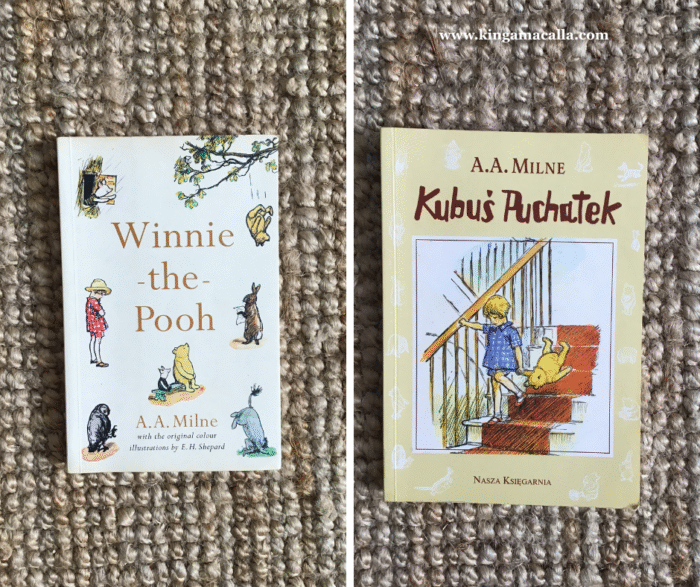
A.A.Milne Winnie-the-Pooh // A.A. Milne Kubuś Puchatek

(originally published in English)

This is a classic and it was one of the first books we had in two languages. We read it chapter after chapter in Polish and then in English. We later found some audio-recordings which we listened to, as well. The stories are charming, as if we’re allowed to enter a magic world of teddy bears.
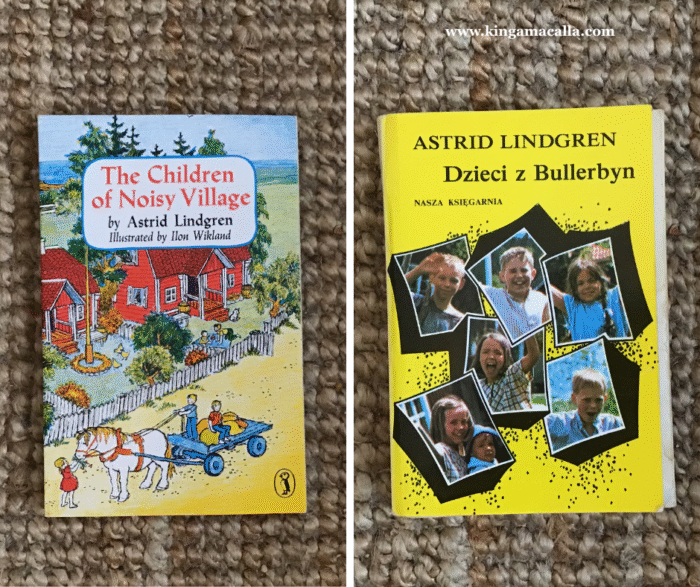
Astrid Lindgren The Children of Noisy Village // Astrid Lindgren Dzieci z Bullerbyn

(originally published in Swedish)

I read Astrid as a child and couldn’t wait to read those stories to my children. We love the noisy, courageous and joyful children who live together in a little village of Bullerby in Sweden.  They have a simple life which is full of little adventures, childhood play and happiness.
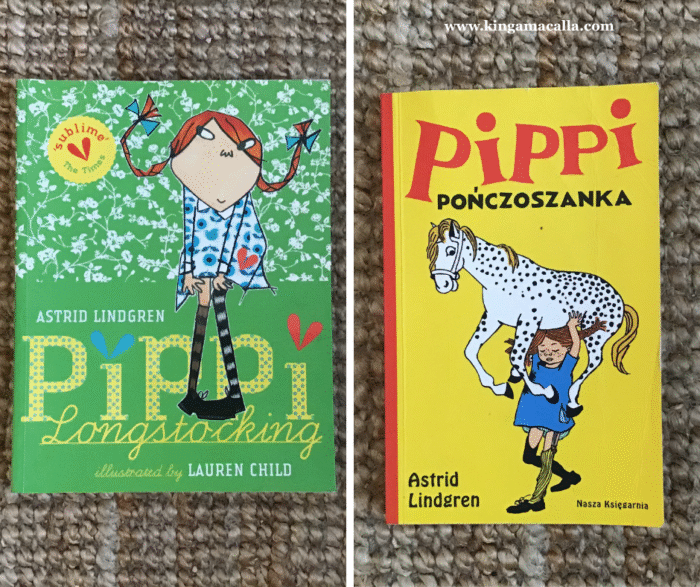
Astrid Lindgren Pipi Longstocking // Astrid Lindgren Pipi Puńczoszanka

(originally published in Swedish)

Pipi is a wonderful character who lives without her parents, with a horse and a monkey. Yes, she leads her life against the agreed way of doing things. Even though Pipi’s life is unusual, it’s also full of her kindness and generosity.
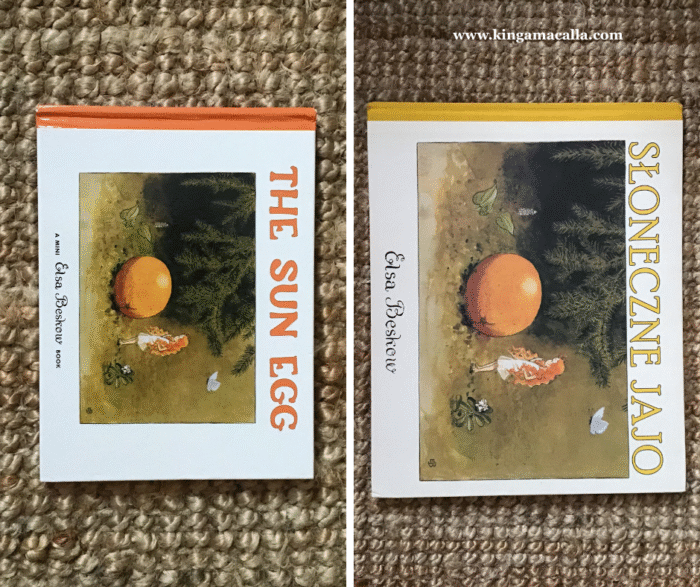
Elsa Beskow The Sun Egg / Elsa Beskow Słoneczne jajo

(originally published in Swedish)

This is one of the first books we read by Elsa Beskow, and we have this publication in Polish and in English. The Sun Egg is our summer read: it’s a short story about an elf who finds a ‘sun’s egg’ and together with forest animals, they try to find out what this round object actually is. Beautifully illustrated.
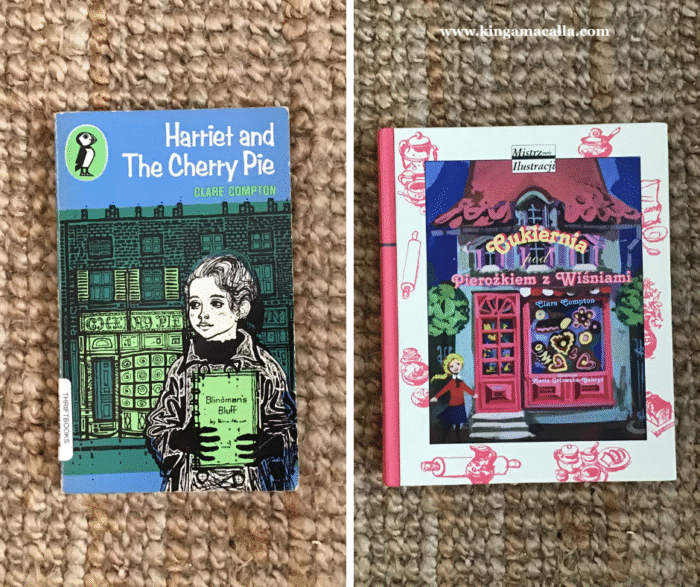
Clare Compton Harriet and the Cherry Pie // Clare Compton Cukiernia pod Pierożkiem z Wiśniami

(originally published in English)

We first found out about this novel as a Polish translation: we listened to an audiobook and then we read a book too. I then started searching for information about the author who actually turned out to be British–Clare’s real name was Hilda Hewett! Harriet and the Cherry Pie is a heart-warming story about an 11-year-old, Harriet, and her 6-year-old sister, Kitten. It’s a beautiful read, with some delicious recipes, like peppermint creams and chocolate crispies. It’s a shame that the book hasn’t been re-printed in English since 1968, and it’s only available second-hand.

Just to add that the Polish translation is absolutely scrumptious, as is the audio-recoding of the book.
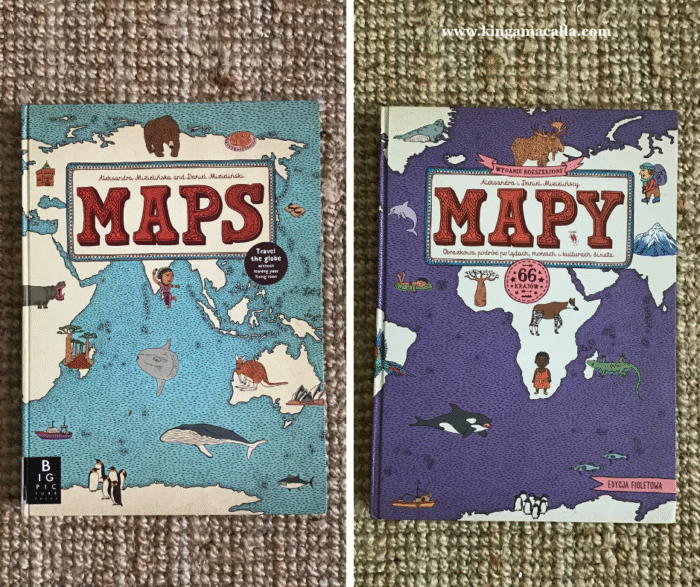
Aleksandra & Daniel Mizielińscy Maps // Aleksandra & Daniel Mizielińscy Mapy

(originally published in Polish)

This is a treat for children and adults. It’s beautifully illustrated and contains many useful and interesting facts about each country. You can go from country to country and your interest only grows, as you learn more about different countries, their food, nature, literature, sports, customs etc. Maps is a simple idea, but it is so cleverly executed!
I hope you’ll find some inspiration in the above reading list. Please comment below if you have read any of the above with your children and let me know about you or your children’s favourite bilingual books.
March 22, 2023

Bilingualism: the sensitive part of it

You know I’m a huge enthusiast of bilingualism. All three of my children are raised bilingually (Polish and English). I read many books and publications on bilingualism and I feel I am a confident advocate for this phenomenon. However, what struck my attention recently were two stories where bilingualism became a struggle and I wanted to look at those examples to see first, if we can understand bilingualism better, and second, how we can implement bilingualism without sacrificing a child’s overall wellbeing.

Stories

Both stories had the same effect: the introduction of the second language affected the child’s speech. In one case, the child stopped speaking all together (in any language) and in the other example, the child started stuttering (mostly in the second language). They both were raised mostly monolingually, started nursery (second example) and then went to school in England (both examples). They were both sensitive children.

Observation

So now I’d like to analyse a few points here. The first one is an observation. When we want to raise our child bilingually, we need to be sensitive to their language development in two languages. If there are any amber / red lights flashing that something is not right, we need to analyse this deeper. If needed, we need to first speak with close family about it, then the nursery’s or school’s professionals or seek professional help. This is important to act upon any abnormalities as promptly as possible to avoid more stress for the child and also a worsening of the circumstances. 

Child’s personality

Every child is different. For some children, starting school with no language skills in the second language is absolutely not a problem, and after a few months, they’re nearly fluent, with many friends. However, other children may not react like that. If they’re shy, introverted or perfectionists, they may find it difficult to express themselves in the second language, to make new friends, or speak when knowing they may make mistakes. Also, we know that from around the age of 3-4, children are more prompted to make friends; if they lack language skills, this may impact their social interactions and make them feel worse or lonely.

Flexibility

When I started my bilingual journey, I was certain how I wanted to have it organised. We spoke mostly Polish at home and English was the language of formal education. However, when we started home-schooling two years ago, this whole philosophy was turned upside down, because suddenly, I needed to speak to them both in Polish and English. I did that (although, our bilingual system is still a bit chaotic; I need to rethink it!). I adapted and I’m glad I did that, because I could observe my middle daughter gaining language skills in two languages, and being more and more confident in using both of them. I could see her struggles and victories and I could comfort her or celebrate with her at the time. With a multilingual family, it’s important to remember flexibility when it comes to plans / routines / goals; we’re humans and we need to adapt our visions to the given reality. I’m not speaking here about giving up, but more about finding ways to accommodate new circumstances or adapting our plans to our children’s actual language needs.

How do you find your child’s bilingualism? What’s your language routine (especially if you’re home-schooling)? Please let me know in the comments below.

January 9, 2019

Important questions about children’s bilingualism

With globalisation and the ease of travel, more often than ever people find themselves living abroad and living a multilingual and multicultural life. That is why raising my daughter bilingually was more a natural consequence of my life trajectory than a thought-through process. I read some guidebooks on bilingualism to have a general idea on how to organise our bilingual life, but that was it. It was a natural decision which I thought all parents would follow, but since having met some parents who decided not to raise their children bilingually, I started to think about why we might want to raise our children bilingually and why we decide in favour of or against our children’s bilingualism. We as parents are the main people who are responsible for our children’s bilingualism and it is true that it can be overwhelming to learn, implement and follow the principles of bilingual parenting. Moreover, as immigrants we want to fit into society; through speaking two languages we may stand out on the monolingual landscape. At the same time, a bilingual upbringing can generate many advantages for people, economically, socially and culturally. What to choose and why? Parents’ decisions on bilingualism may be based on their personal beliefs, but they might also be influenced by others, for example, medical or educational professionals.

If you’re a bilingual family or planning to become one, you may want to think and form your own definitions/answers to the below questions (I added a short commentary to each question, please treat it as some form of inspiration to your further research and study of bilingualism):

What is bilingualism?

Because of the complexity of the term, you may want to create your own definition of bilingualism. Your understanding of the notion might be influenced by the fact that bilingualism is created and functions in various environments, family settings and countries/regions and may impact individuals with different talents and skills differently.

Is Bristol a good place to raise bilingual children (if you’re from Bristol)?

I think it’s important to have a better understanding of the local perception of bilingualism. If your children go to nursery/school, ask staff members some questions about bilingualism and see their approach to bilingualism. You can also check if there are extra-curricular language or cultural classes organised by the local council, schools or private people.

What influences parents’ decision-making on family bilingualism?

Here, we can think whether society and medical, educational or governmental authorities can influence our decisions on the bilingual upbringing of our children. Parental choice for or against bilingualism will influence a child’s life in many different aspects, e.g. their identity, cultural bonding or linguistic skills, among others. If parents decide not to form a bilingual family, they may make this decision based on the disadvantages linked with bilingualism, e.g. hard work, not being a ‘normal’ family, worries about language development and potential misunderstandings. (see Barron-Hauwaert) Through choosing monolingualism and full linguistic assimilation, immigrant parents can deprive their children of certain experiences, e.g. a bond with their linguistic, family or cultural heritage.

How do stereotypes around multilingualism influence our decisions on bilingualism?

To be honest with you I didn’t know any stereotypes around multilingualism until I started reading more literature on bilingualism. One of the stereotypes around bilingualism is that bilingualism can be linked with underachievement at school (see Marzán), but the most recent research suggests the opposite, that actually bilingualism “is now associated with a mild degree of intellectual superiority.” (Baker 2014: 54)

What are the advantages of bilingualism?

Bilingualism can be associated with many different benefits, in the form of communication (being able to communicate more effectively with others) and practical and social value (facilitating cultural exchanges and promoting multi-cultural understanding). Colin Baker also mentions cognitive advantages (creativity), character advantages (increased self-esteem), curricular advantages (easier to learn a third language) and economic advantages (employment benefits). (see Baker) We can add the following benefits to the list: more freedom to be mobile, an increased tolerance towards other languages and cultures and an understanding of other foreigners’ needs. (see Barron-Hauwaert)

Can you think of any other benefits of bilingual upbringing of your children? Please let me know in the comment below.


References:

Baker, C. 2014. A Parents’ and Teachers’ Guide to Bilingualism. Bristol: Multilingual Matters

Barron-Hauwaert, S. 2014. Language Strategies for Bilingual Families. The One-Parent-One-Language Approach. Bristol: Multilingual Matters

Marzán, J. 2003. Found in Translation. Reflections of a Bilingual American. In: Sommer D. (ed) Bilingual Games. Some Literary Investigations. New York: Palgrave Macmillan

Kinga Macalla