Tag Archive: Bilingualism

October 22, 2025

Book review: What we read together bilingually in Polish and English (2025)

We read books in Polish and English and we have several of the same books in both languages, either because of available translations in those languages, or because we really enjoyed those stories. Sometimes it’s good to read the same story bilingually, to hear it in the languages we speak. For example, as an adult I read Harry Potter in three languages: in Polish, English and Czech. Reading the same book in translation gave me some context for another interpretation and the joy to understand it in more language(s). 

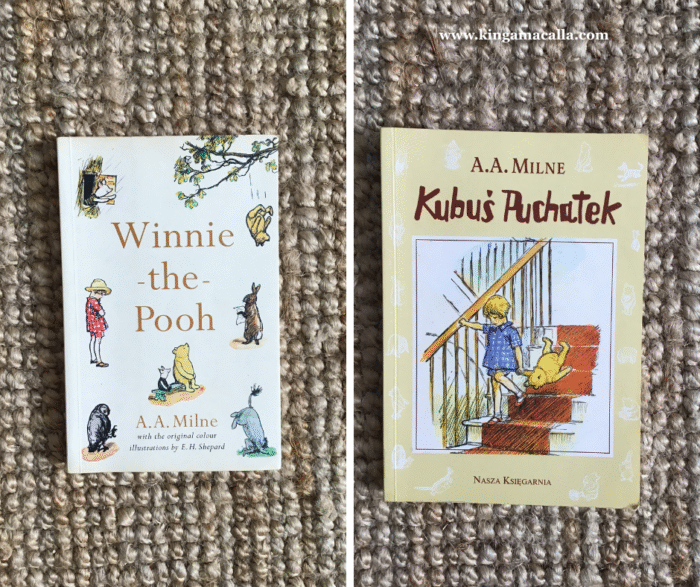
A.A.Milne Winnie-the-Pooh // A.A. Milne Kubuś Puchatek

(originally published in English)

This is a classic and it was one of the first books we had in two languages. We read it chapter after chapter in Polish and then in English. We later found some audio-recordings which we listened to, as well. The stories are charming, as if we’re allowed to enter a magic world of teddy bears.
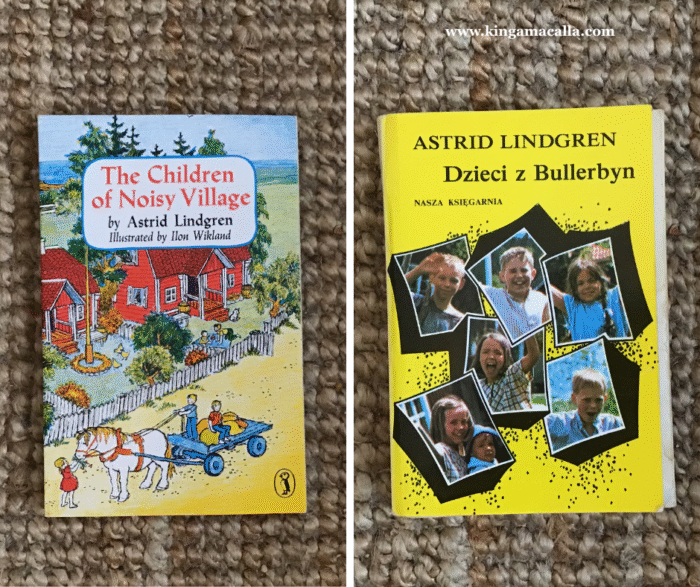
Astrid Lindgren The Children of Noisy Village // Astrid Lindgren Dzieci z Bullerbyn

(originally published in Swedish)

I read Astrid as a child and couldn’t wait to read those stories to my children. We love the noisy, courageous and joyful children who live together in a little village of Bullerby in Sweden.  They have a simple life which is full of little adventures, childhood play and happiness.
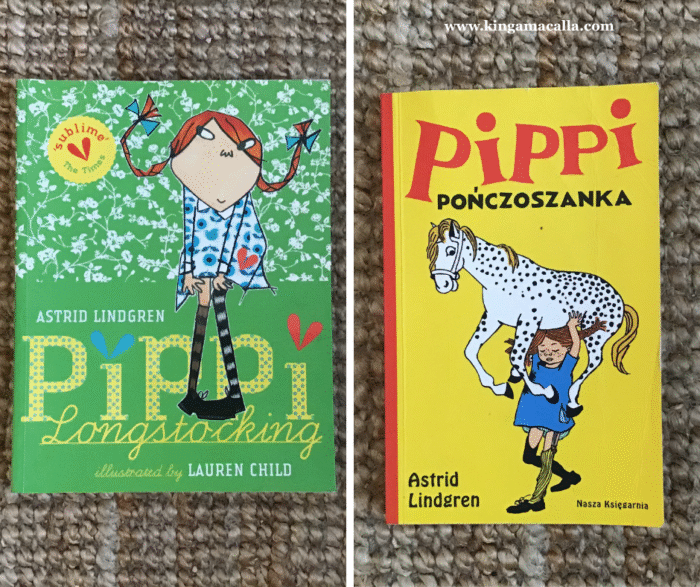
Astrid Lindgren Pipi Longstocking // Astrid Lindgren Pipi Puńczoszanka

(originally published in Swedish)

Pipi is a wonderful character who lives without her parents, with a horse and a monkey. Yes, she leads her life against the agreed way of doing things. Even though Pipi’s life is unusual, it’s also full of her kindness and generosity.
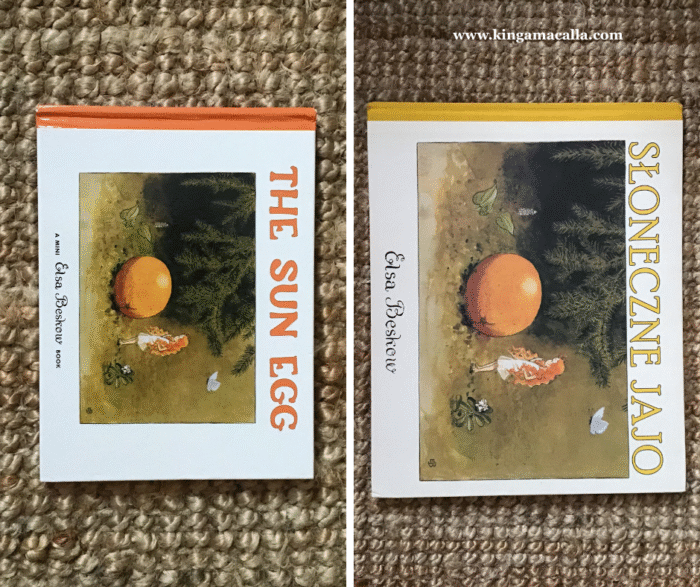
Elsa Beskow The Sun Egg / Elsa Beskow Słoneczne jajo

(originally published in Swedish)

This is one of the first books we read by Elsa Beskow, and we have this publication in Polish and in English. The Sun Egg is our summer read: it’s a short story about an elf who finds a ‘sun’s egg’ and together with forest animals, they try to find out what this round object actually is. Beautifully illustrated.
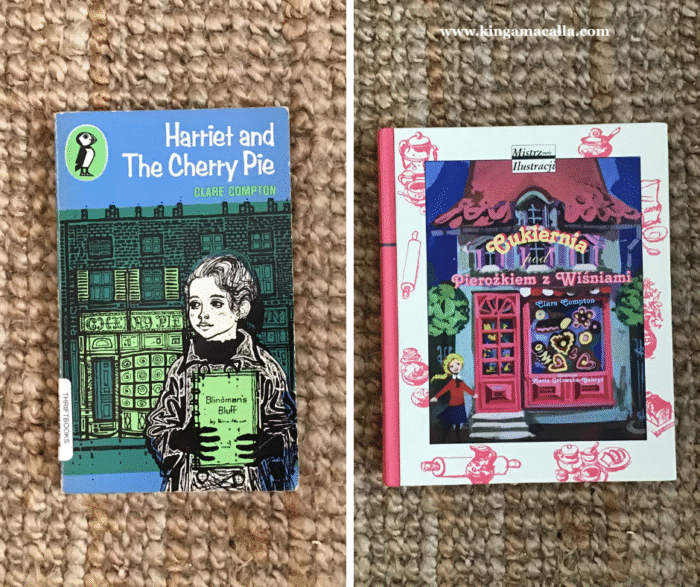
Clare Compton Harriet and the Cherry Pie // Clare Compton Cukiernia pod Pierożkiem z Wiśniami

(originally published in English)

We first found out about this novel as a Polish translation: we listened to an audiobook and then we read a book too. I then started searching for information about the author who actually turned out to be British–Clare’s real name was Hilda Hewett! Harriet and the Cherry Pie is a heart-warming story about an 11-year-old, Harriet, and her 6-year-old sister, Kitten. It’s a beautiful read, with some delicious recipes, like peppermint creams and chocolate crispies. It’s a shame that the book hasn’t been re-printed in English since 1968, and it’s only available second-hand.

Just to add that the Polish translation is absolutely scrumptious, as is the audio-recoding of the book.
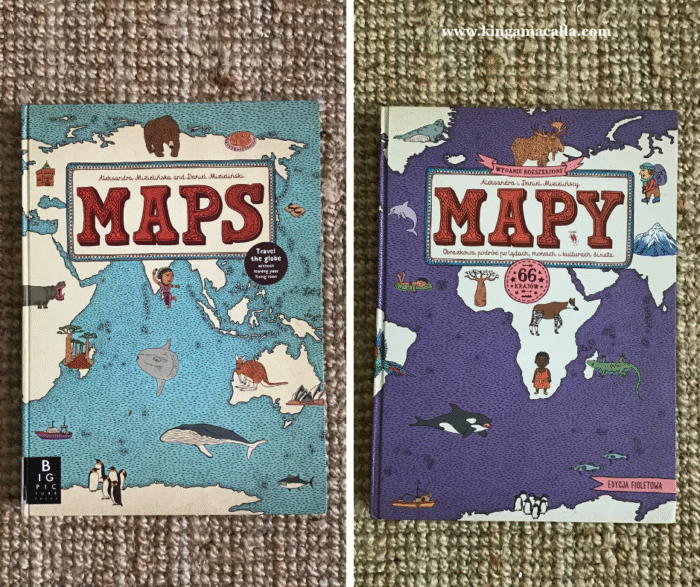
Aleksandra & Daniel Mizielińscy Maps // Aleksandra & Daniel Mizielińscy Mapy

(originally published in Polish)

This is a treat for children and adults. It’s beautifully illustrated and contains many useful and interesting facts about each country. You can go from country to country and your interest only grows, as you learn more about different countries, their food, nature, literature, sports, customs etc. Maps is a simple idea, but it is so cleverly executed!
I hope you’ll find some inspiration in the above reading list. Please comment below if you have read any of the above with your children and let me know about you or your children’s favourite bilingual books.
October 18, 2023

My home-schooling journey with 3 children in Bristol, UK

When I speak with my friends, many of them (especially those who don’t home-school!) ask me about our home-schooling routine. It makes me think that perhaps more parents might be interested in reading about our home-schooling life, hence today’s post.

We started home-schooling 2.5 years ago. We’re a family of 5: one set of parents and three children aged 8, 4 and 1. The first year was quite difficult, as we didn’t know many other home-schooling families, and our home-schooling life felt a bit lonely. But, it all changed when we joined the first group.

Groups

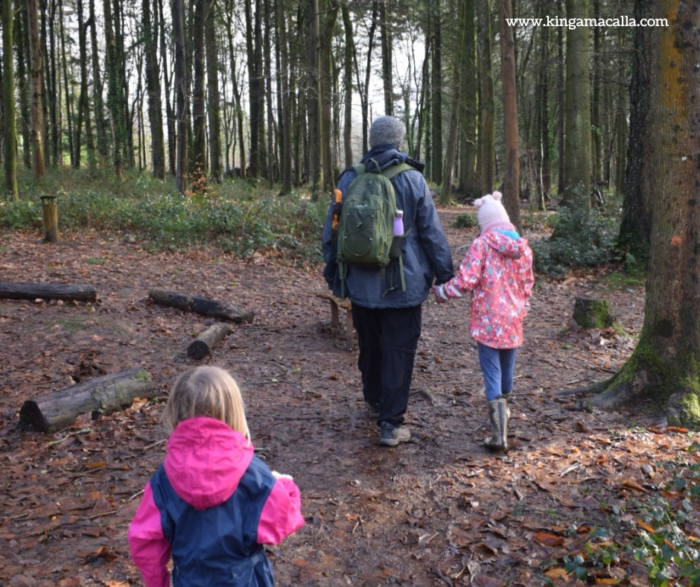
The very first group we joined was a forest school and our daughter has loved going there from day one. We made some friends through it and it became a core social activity of the week. The second one was gymnastics: all my children are full of energy, so I was looking for some physical activity and gymnastics was a great choice. Then we started attending piano lessons, as music is an important part of our curriculum. Lastly, we joined (even though a bit irregularly), a drama club which is a wonderful way to awaken children’s imagination.  We attend it irregularly, because as I don’t drive, it takes us around 1.5-2 hours to get there, one way!

Nature, reading, music and art

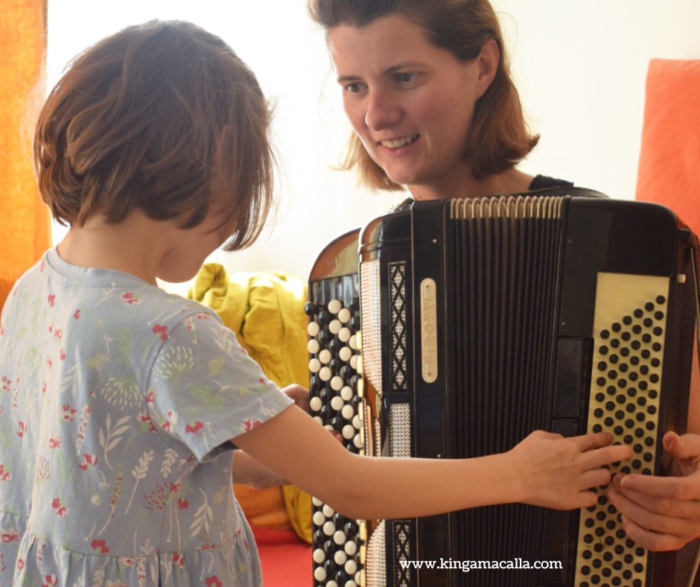
If I needed to describe the key elements of our home-schooling life, it would be: nature, reading, music and art. Nature is present in my children’s lives via forest school, our garden, nature walks and weekend trips. On fine days, we can read a story sitting on our garden’s bench. We read books in two languages every day and go to the library at least once a week. On top of that, we enjoy playing and improvising on different instruments, listening to classical music, children’s tunes or singing songs. It sounds very simple, but I trust it gives them the foundations for an amazing memory, good music taste and awakening their creativity. Music is closely related to art. We all enjoy hands-on crafts, like painting, drawing or postcard making. We also read about painters, analyse their paintings in the albums, visit museums and galleries. My children like playing pretend games and occasionally I overhear them calling themselves van Gogh or Monet (!).

Free play

I feel from the bottom of my heart that free-play is important. I love to quietly observe my children, especially in their free play. I only wish they could have more free play in nature; that’s something I’d like to include more in this academic year.

Bilingualism

Yes, my children are home-schooled and raised bilingually: Polish and English. Even though we’re both Polish, my husband mostly reads in Polish and I mostly read in English. I also use English when our home-schooling context is mainly in English. I think our bilingual routine works well now, but when we started our home-schooling journey, it felt a bit chaotic and confusing, mainly because we all needed to adjust to some language changes.

Books on education

I like reading myself and I’ll be posting a series of short reviews on the books on education that inspired me most. That’s going to be next month!

I think these are my core ideas around home-schooling right now. Would you like to read more about home-schooling here? Please let me know in the comments below if you’d like more content like this, e.g. reading more about our daily routine or how we navigate two languages in our home-schooling life.

March 22, 2023

Bilingualism: the sensitive part of it

You know I’m a huge enthusiast of bilingualism. All three of my children are raised bilingually (Polish and English). I read many books and publications on bilingualism and I feel I am a confident advocate for this phenomenon. However, what struck my attention recently were two stories where bilingualism became a struggle and I wanted to look at those examples to see first, if we can understand bilingualism better, and second, how we can implement bilingualism without sacrificing a child’s overall wellbeing.

Stories

Both stories had the same effect: the introduction of the second language affected the child’s speech. In one case, the child stopped speaking all together (in any language) and in the other example, the child started stuttering (mostly in the second language). They both were raised mostly monolingually, started nursery (second example) and then went to school in England (both examples). They were both sensitive children.

Observation

So now I’d like to analyse a few points here. The first one is an observation. When we want to raise our child bilingually, we need to be sensitive to their language development in two languages. If there are any amber / red lights flashing that something is not right, we need to analyse this deeper. If needed, we need to first speak with close family about it, then the nursery’s or school’s professionals or seek professional help. This is important to act upon any abnormalities as promptly as possible to avoid more stress for the child and also a worsening of the circumstances. 

Child’s personality

Every child is different. For some children, starting school with no language skills in the second language is absolutely not a problem, and after a few months, they’re nearly fluent, with many friends. However, other children may not react like that. If they’re shy, introverted or perfectionists, they may find it difficult to express themselves in the second language, to make new friends, or speak when knowing they may make mistakes. Also, we know that from around the age of 3-4, children are more prompted to make friends; if they lack language skills, this may impact their social interactions and make them feel worse or lonely.

Flexibility

When I started my bilingual journey, I was certain how I wanted to have it organised. We spoke mostly Polish at home and English was the language of formal education. However, when we started home-schooling two years ago, this whole philosophy was turned upside down, because suddenly, I needed to speak to them both in Polish and English. I did that (although, our bilingual system is still a bit chaotic; I need to rethink it!). I adapted and I’m glad I did that, because I could observe my middle daughter gaining language skills in two languages, and being more and more confident in using both of them. I could see her struggles and victories and I could comfort her or celebrate with her at the time. With a multilingual family, it’s important to remember flexibility when it comes to plans / routines / goals; we’re humans and we need to adapt our visions to the given reality. I’m not speaking here about giving up, but more about finding ways to accommodate new circumstances or adapting our plans to our children’s actual language needs.

How do you find your child’s bilingualism? What’s your language routine (especially if you’re home-schooling)? Please let me know in the comments below.

September 23, 2020

Book review: The Bilingual Brain by Albert Costa

“(…) bilingualism is the rule rather than the exception in the sense that the majority of the world’s population can communicate in more than one language.” Albert Costa

What a fascinating read! To be honest with you, I didn’t expect to be taken on a such an interesting journey learning about the science of language! While reading it, I was laughing, putting exclamation marks, taking side-notes, discussing it with my friends. I completely and entirely immersed myself into reading this wonderful publication.

Why is it so fascinating? I think mainly because, on one hand, we have a truly profound knowledge about bilingualism and, on the other, there are so many unanswered questions. So if there are any uni students or researchers reading my review: there is definitely some potential in the subject of bilingualism / multilingualism.

The book covers topics such as bilingual development in babies, bilingual brain vs monolingual brain, bilingualism and other cognitive skills, bilingualism in the social context, etc. What hides under those academic topics are some most interesting experiments, research and discussions about language and bilingualism.

Let me now share with you some of the most interesting findings (in my opinion!). Do you know that babies as young as six months of age, can have already developed a complex (!) knowledge of a language, including some words?! What is more, babies as young as 2 days (yes, days!) can differentiate between two different languages. Those findings only confirm that language development and the bilingual journey starts as early as in pregnancy.

Another fascinating topic is language attrition: the loss of the native language. What?! Can one forget their native language? Actually, yes. One can completely ‘forget’ their native language and swap it with the new one. I think learning a language is a truly complex phenomenon which as you can see from the above starts prenatally and requires our constant work (whether we’re aware of it or not). Hence, if you know more languages, the importance of maintaining the foreign / native language skills on a regular basis.

And finally decision-making and bilingualism: “(…) moral judgements do change according to language.” (p. 143), when facing a problem in a foreign language, we make better decisions (p. 137) and finally language can also influence how we’re seen by others (social marker, p. 144).  For example, we can be seen less trustworthy when speaking a language with a foreign language. This might be one of the reasons why people don’t want to have a foreign accent and are after accent reduction lessons. On the other hand, does trust increase, if there are more people speaking with foreign accents and this becomes a norm? Interesting, huh?!

One final point, the research brings as many questions as answers and it seems that there is a long way to verify and objectivise some of the findings and research. There is most certainly a huge potential in the subject of bilingualism and multilingualism, so am hopeful for more passionate and fascinating books to be published in the future!

What’s your current read on language or bilingualism? Please let me know in the comments below.

Kinga Macalla

May 13, 2020

Book review: Maximize your child bilingual ability by Adam Beck

Read, read, read. William Faulkner

An essential guidebook to children’s bilingualism. It’s a practical handbook for parents wishing to get a grasp of bilingual upbringing, it answers many questions and provides a step-by-step guide to having a bilingual family.

Adam Beck, the author of the book is an American living in Japan who is raising two bilingual children. He is also the founder of the blog Bilingual Monkey and the forum The Bilingual Zoo.

I think the main message I will take from this book is: read aloud daily (adapt reading to your child’s age, tell stories using picture books, use walls to display messages to your children), have a minority-language routine (important!), follow your children’s natural passions in the minority language (what do they like doing /talking about?), talk to your children in the minority language as often as possible (story-telling), listen to and sing songs (e.g. when cycling—this is what we often do!), be firm with your schedule, but play it through the activities (have fun!) and bilingualism is a long-term project (be patient and consistent).

I like how the book is organised, that it has short chapters, which makes the reading easy to follow and allows reading in short spans of time (important when having kids). Each chapter starts with a quotation which I found really inspirational.

To sum up, I think I would mostly recommend the publication to families who wish to raise their kids bilingually but don’t know how to start, what resources to use, or what strategies to follow. For existing bilingual families, it’s an interesting read which reminds us of the importance of regular input in the minority language and which gives some inspirational tips on resources, activities and the day-to-day routine of the bilingual family.

What books on bilingualism do you recommend? Do let me know in the comments below.

Kinga Macalla

April 15, 2020

Bilingualism: How can you home-school children bilingually?

The limits of my language are the limits of my world. Ludwig Wittgenstein

Today, I’m bringing up a subject very relevant to our family: bilingual home-schooling. As schools remain closed, we parents need to educate our children, and those bringing their children up bilingually have an even harder task: to prepare content in two or more languages. Below, I’ll share my tips on how to organise bilingual learning for your children and I’ll also share some inspiring blogs which helped me navigate through this unknown territory of bilingual home-education. I have two children: our older daughter is 5 and a half and our younger is 17 months old, so the below mostly refers to our older daughter.

Where to start?

First, I’d start with the aims. What do you want to achieve in your home-schooling? What are your goals? In our case, we primarily speak Polish at home and we knew English would be the minority language and that we’d use it to accomplish some specific tasks / activities rather than to be used for a prolonged period of time. We receive a weekly timetable from our daughter’s school, so we follow the main points of the agenda and also add some extra-curricular activities. I’ll specify our daily routine below.

How to organise daily routine

We start our day with a healthy breakfast J and then we have some quiet time, e.g. quiet reading or playing. Then we listen to some literacy exercises or do some reading in English before switching to Polish and listening to and singing some songs in Polish. After a short break, we have some creative activities; painting, drawing, Lego model building, etc. During this time we can include numeracy / vocabulary in Polish and English. Then we have a healthy lunch J and playtime with some yoga / exercises, going for a walk or staying in the garden and having some fun together. In the late afternoon, we read aloud in English and Polish or look through some big books to learn some interesting facts about geography, nature, animals (we try to focus on different subjects either periodically or daily). In the evening, we try to encourage our daughter to help with dinner where we can ask our daughter to name some vegetables or do some counting in two languages. As you can see, our daily routine is quite simple and not over-scheduled, there is plenty of room to negotiate some elements (e.g. playing in the garden longer if the weather is nice, etc.) and we don’t always stick to it every day, but it’s good to have it in place as a frame.

How to organise resources

I check the school’s website to see the timetable and self-prepare resources and download audio-recordings. In the UK, Audible have made their stories free of charge, and the phonics website is now available to all. As for creative activities, we re-use some paper/plastic boxes, jars, etc. or use colour paper, play-dough, clay, etc. Spring time is also a good time to introduce some gardening (as we try to do, too!). Our daughter is super-excited to see how her little plants / herbs grow.

Where to find inspiration?

Fortunately, there are many blogs with inspiring content!I found it really useful to get familiar with the ten tips on bilingual home-schooling from Catalina. Here, there are many interesting insights on home-schooling from Virginia Some important questions regarding bilingual home-schooling are answered here. You can find a bilingual daily routine with four children & their mum, Michele Cherie, here. I also recommend this blog for some everyday activities that you may want to include in your daily home-schooling routine (not about bilingual schooling, but I found it so relevant!).

Bonus: Don’t forget about your daily rituals, like lighting a candle before meals or playing some tunes on xylophone before reading time. It makes every day a bit more special.

Please do let me know how you organise your daily routine of bilingual home-schooling and what resources you use. Please leave your comments below.

Kinga Macalla

November 27, 2019

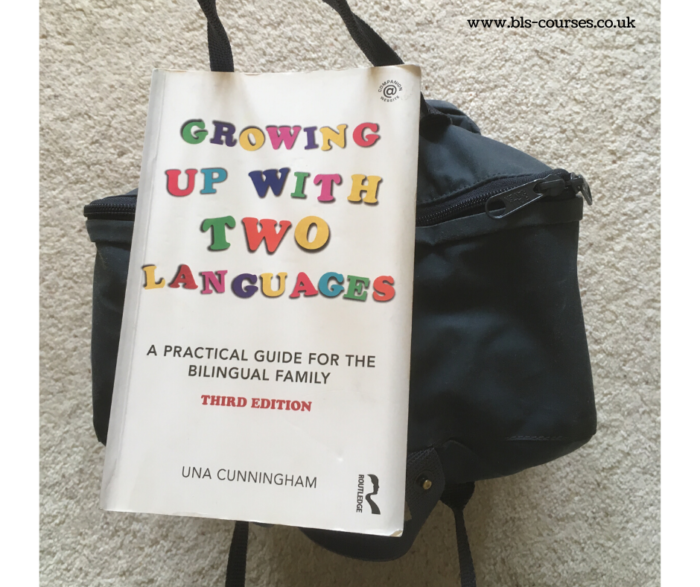
Book review: Growing Up with Two Languages. A Practical Guide for the Bilingual Family by Una Cunningham

What a fantastic compendium of practical knowledge for bilingual families! I found the publication interesting to read, as it implements stories from the author’s own experience and quotations from bilingual families, and these make the whole reading experience much more alive and real.

As we read on the back cover, the author Una Cunningham is an Associate Professor in Modern Languages at Stockholm University in Sweden, and she raised her 4 children to speak English and Swedish.

Growing Up with Two Languages is mostly a practical read, but it also has a short chapter devoted to research and further reading. We read there that most of the world’s population speak more than one language, this may well mean that we should question monolingualism in our society and see it as a (curable!) problem. (vide Li Wei, p. 165)

The book refers to many topics that new or well-established bilingual parents may find interesting to learn about, such as balancing two languages, dealing with public/family reactions to bilingual upbringing, the one parent-one language method, cultural competence, active and passive languages, practical advice from the author and from other bilingual parents (e.g. feed your child with bilingual and bicultural knowledge but do not force-feed), motivation, etc.

Another piece of advice which I found really useful to follow when reading this book is that Una Cunningham emphasises that as a reader and a bilingual parent, we know best what works in our current family setting, so we should only take the advice that will work for our children’s bilingual upbringing. “According to their circumstances, a family will develop a system regulating the use of two languages with which they live.” (p. 31) Interestingly, the language chosen by siblings to talk between themselves is usually the majority language (if it’s their dominant language). And the key ingredients to have a successful bilingual family are determination, consistency and perseverance.

Finally, of all the interviewees mentioned in the book, none of them regrets being exposed to more than one language in their childhood. Quite the opposite, those who weren’t raised bilingually (but for example only biculturally), regret that their parent/s didn’t speak to them in their native language.

What’s your recent reading on bilingualism? Please let me know in the comments below.

Kinga Macalla

August 14, 2019

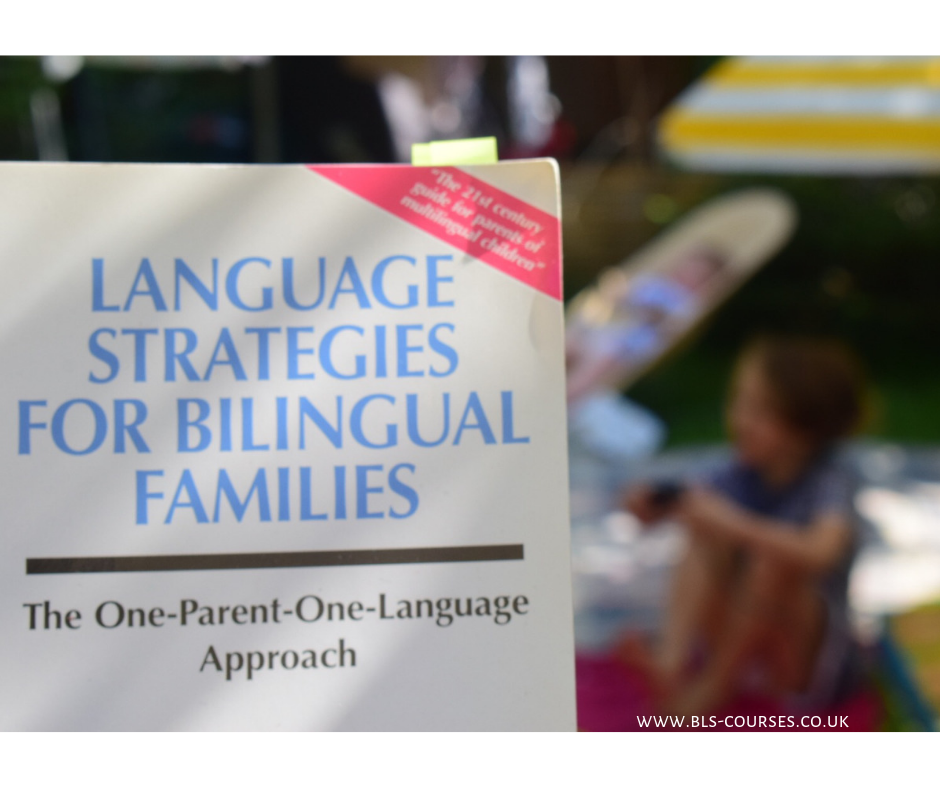
Book review: Language strategies for bilingual families. The one-parent-one-language approach by Suzanne Barron-Hauwaert

This is an interesting and useful publication for bilingual families. Mainly, because each chapter finishes with some comments from the parents on the topics discussed in the given chapter. I think it’s a very good addition to the research-based theory, the real voice of bilingual parents.

What is the one-parent-one-language approach (OPOL)? “The original term came from a French linguist, Maurice Grammont, who […] introduced the idea of une personne; une langue”. Literally translated from the French as one person; one language”. (p. 1) OPOL means that each parent speaks their language to the child. (p. 213)

Suzanne Bareon-Hauwaert, the author of Language strategies for bilingual families is an expert on bilingualism both academically, through her extensive research and practically, as a mum to her three multilingual children. In her publication, she discusses various topics linked with bilingual upbringing and OPOL, from a child’s refusal to speak one language, mixing languages, homework, grandparents’ involvement, trilingualism (multilingualism), the advantages and disadvantages of bilingualism to biculturalism. Suzanne Barron-Hauwaert also discusses the philosophy behind being successful in bilingual upbringing and I personally found it fascinating, not only in regards to bilingual upbringing, but also in other aspects of the child’s life (e.g. education or interests/hobbies). So, what guarantees successful active bilingual upbringing? Interestingly, the families who are most successful are those who are passionately committed to their kids’ bilingualism. “[They] discuss, read, and plan their children bilingualism well in advance of the child‘s arrival (…). They highly value bilingualism and its benefits to both the individual and society.” (p. 112)

Do you follow OPOL? How does this approach work in your bilingual family setting? Please let me know in the comments below.

Kinga Macalla

February 20, 2019

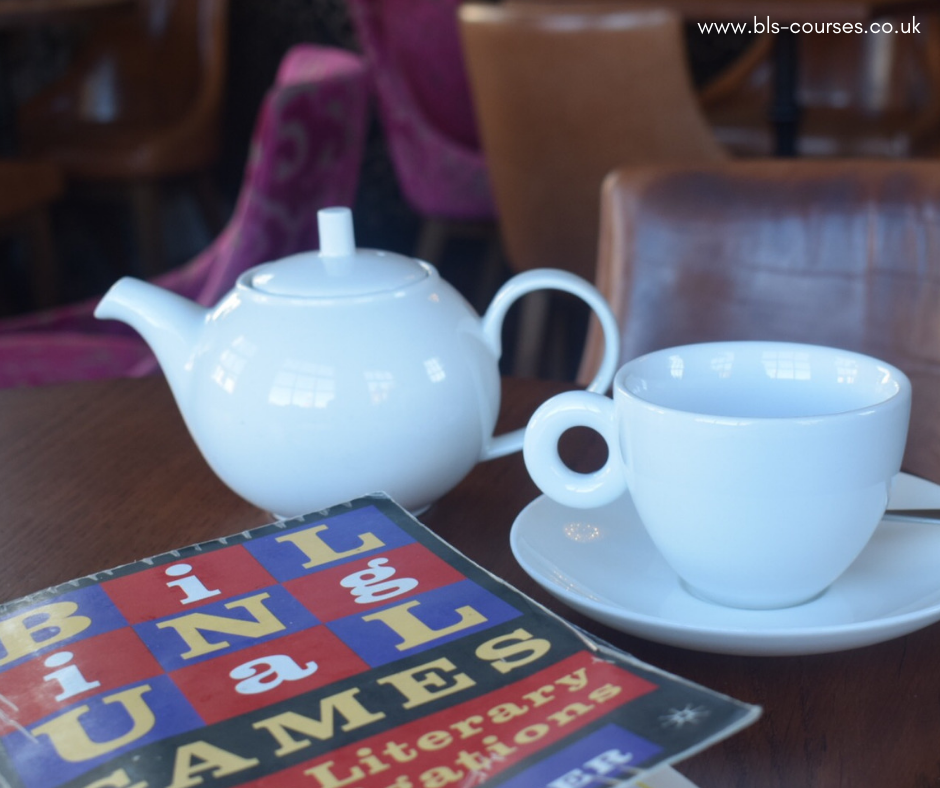
Book review: Bilingual Games. Some Literary Investigations, ed. by Doris Sommer

Speaking another language is quite simply the minimum and primary condition for being alive. Julia Kristeva

It’s a thought-provoking and fascinating read. Bilingual Games, edited by Doris Sommer, presents the idea of bilingualism from many different perspectives. The book is divided into 5 parts and each of them contains essays written by intellectuals who portray the topic of bilingualism as a concept: social, geographical, literary and cultural, educational, but most importantly as human and natural. The contributors seem to prove that multilingualism is a natural human phenomenon and we shouldn’t and cannot limit ourselves to be speaking only one language, after all monolingualism is rarer than multilingualism.

The wonderful thing about this book is that you can choose which essays you wish to read, and find your own reading order. One of the essays that I found particularly interesting was devoted to bilingualism in the educational setting: “Found in Translation. Reflections of a Bilingual American.” by Julio Marzán. Bilingualism can be defined in many different positive ways, it can be also seen as an obstruction to being a ‘true citizen’ or to being fully assimilated in a new country; it can also be understood as having a negative impact on a child’s achievement at school.  One can say that bilingualism is a personal choice on the part of parents, but if we are living in a new country and “learning that true Americans are loath to speak a foreign language” (Marzán 2003: 224), one cannot doubt it will have some impact on our and our children’s bilingualism. A simple question like, “Does your child speak another language at home?” which, as Julio Marzán writes, is also aimed at parents who are potentially seen as those who could obstruct “their child’s capacity to learn in an English-speaking classroom” (221) is not an innocent question, especially considering that Marzán answers in contradiction with the truth and says “no”.  As he later explains, he said “no” because he did not want to endanger his daughter’s “ability to achieve in the classroom”, but he also chose bilingualism, because he wanted his daughter to be able to connect with her cultural heritage. It might be surprising that bilingualism can be linked with underachievement at school, especially since the most recent research suggests that, actually, bilingualism “is now associated with a mild degree of intellectual superiority.” (Baker 2014: 54)

As you can see, it’s a fascinating read and I highly recommend it to those interested in bilingualism seen from many different intellectual perspectives. Let me know what your current read on bilingualism is in the comments below.

Quotations:

Baker, C. 2014. A Parents’ and Teachers’ Guide to Bilingualism. Bristol: Multilingual Matters

Sommer D. (ed) Bilingual Games. Some Literary Investigations. New York: Palgrave Macmillan

Kinga Macalla

January 9, 2019

Important questions about children’s bilingualism

With globalisation and the ease of travel, more often than ever people find themselves living abroad and living a multilingual and multicultural life. That is why raising my daughter bilingually was more a natural consequence of my life trajectory than a thought-through process. I read some guidebooks on bilingualism to have a general idea on how to organise our bilingual life, but that was it. It was a natural decision which I thought all parents would follow, but since having met some parents who decided not to raise their children bilingually, I started to think about why we might want to raise our children bilingually and why we decide in favour of or against our children’s bilingualism. We as parents are the main people who are responsible for our children’s bilingualism and it is true that it can be overwhelming to learn, implement and follow the principles of bilingual parenting. Moreover, as immigrants we want to fit into society; through speaking two languages we may stand out on the monolingual landscape. At the same time, a bilingual upbringing can generate many advantages for people, economically, socially and culturally. What to choose and why? Parents’ decisions on bilingualism may be based on their personal beliefs, but they might also be influenced by others, for example, medical or educational professionals.

If you’re a bilingual family or planning to become one, you may want to think and form your own definitions/answers to the below questions (I added a short commentary to each question, please treat it as some form of inspiration to your further research and study of bilingualism):

What is bilingualism?

Because of the complexity of the term, you may want to create your own definition of bilingualism. Your understanding of the notion might be influenced by the fact that bilingualism is created and functions in various environments, family settings and countries/regions and may impact individuals with different talents and skills differently.

Is Bristol a good place to raise bilingual children (if you’re from Bristol)?

I think it’s important to have a better understanding of the local perception of bilingualism. If your children go to nursery/school, ask staff members some questions about bilingualism and see their approach to bilingualism. You can also check if there are extra-curricular language or cultural classes organised by the local council, schools or private people.

What influences parents’ decision-making on family bilingualism?

Here, we can think whether society and medical, educational or governmental authorities can influence our decisions on the bilingual upbringing of our children. Parental choice for or against bilingualism will influence a child’s life in many different aspects, e.g. their identity, cultural bonding or linguistic skills, among others. If parents decide not to form a bilingual family, they may make this decision based on the disadvantages linked with bilingualism, e.g. hard work, not being a ‘normal’ family, worries about language development and potential misunderstandings. (see Barron-Hauwaert) Through choosing monolingualism and full linguistic assimilation, immigrant parents can deprive their children of certain experiences, e.g. a bond with their linguistic, family or cultural heritage.

How do stereotypes around multilingualism influence our decisions on bilingualism?

To be honest with you I didn’t know any stereotypes around multilingualism until I started reading more literature on bilingualism. One of the stereotypes around bilingualism is that bilingualism can be linked with underachievement at school (see Marzán), but the most recent research suggests the opposite, that actually bilingualism “is now associated with a mild degree of intellectual superiority.” (Baker 2014: 54)

What are the advantages of bilingualism?

Bilingualism can be associated with many different benefits, in the form of communication (being able to communicate more effectively with others) and practical and social value (facilitating cultural exchanges and promoting multi-cultural understanding). Colin Baker also mentions cognitive advantages (creativity), character advantages (increased self-esteem), curricular advantages (easier to learn a third language) and economic advantages (employment benefits). (see Baker) We can add the following benefits to the list: more freedom to be mobile, an increased tolerance towards other languages and cultures and an understanding of other foreigners’ needs. (see Barron-Hauwaert)

Can you think of any other benefits of bilingual upbringing of your children? Please let me know in the comment below.


References:

Baker, C. 2014. A Parents’ and Teachers’ Guide to Bilingualism. Bristol: Multilingual Matters

Barron-Hauwaert, S. 2014. Language Strategies for Bilingual Families. The One-Parent-One-Language Approach. Bristol: Multilingual Matters

Marzán, J. 2003. Found in Translation. Reflections of a Bilingual American. In: Sommer D. (ed) Bilingual Games. Some Literary Investigations. New York: Palgrave Macmillan

Kinga Macalla