Tag Archive: Chinese

July 24, 2019

Book review: Chineasy. The New Way to Read Chinese by Shaolan

Learning a language is a journey.
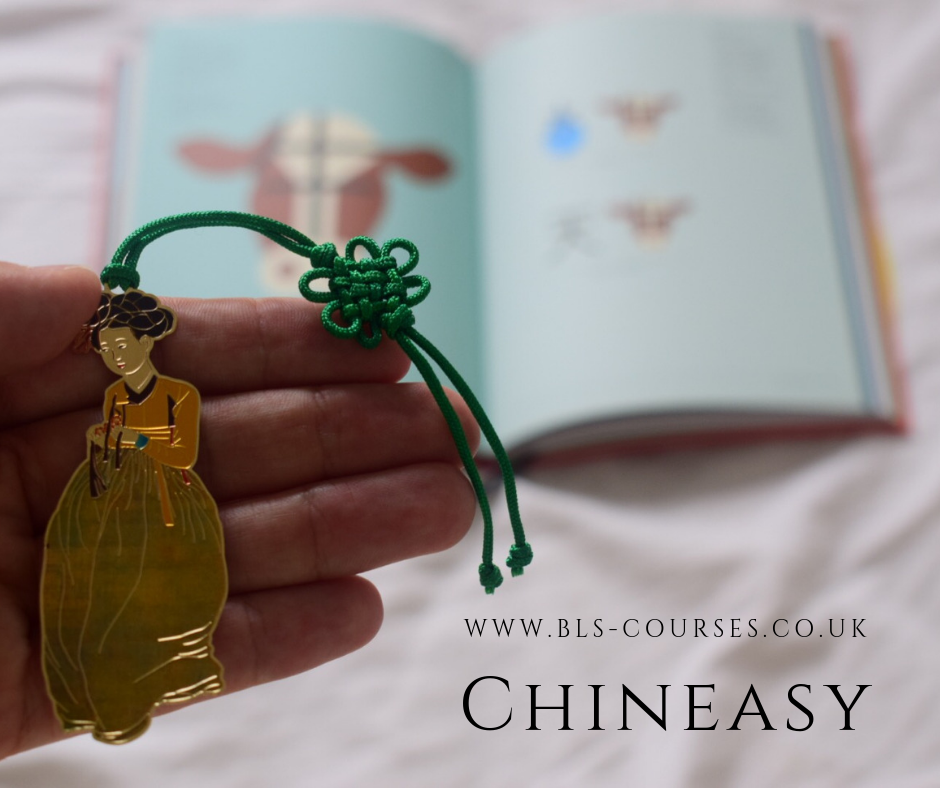
We love exploring different languages: how they work, look, and sound, and today we’re going to try Chinese. We’ll learn Chinese characters using Chineasy, a learning recourse created by Shaolan (Taiwanese now living in London). The idea behind Chineasy was born when Shaolan tried to teach Chinese to her own children. What is Chineasy? Its goal is to “allow people to learn to read Chinese easily by recognising characters through simple illustrations.” (p. 9). In other words, each Chinese character presented in the book has its own graphic design which feeds our imagination and makes the learning process easier and more enjoyable. What is more, we can also learn how to link characters, draw them or know their exact or historical/cultural meaning.

My favourite characters are: woman, boat, weapon, rain, river and numbers.

I also have a memory game which I plan to play with my friends this summer (I’ll report how we managed to memorise the Chinese characters 😉

You can learn more about Chineasy via their website: https://www.chineasy.com/

Do you use a similar recourse when learning a foreign language? Let me know in the comments below.

Kinga Macalla

July 18, 2018

Learning a Language: Learn Mandarin Chinese with BLS online & FREE!

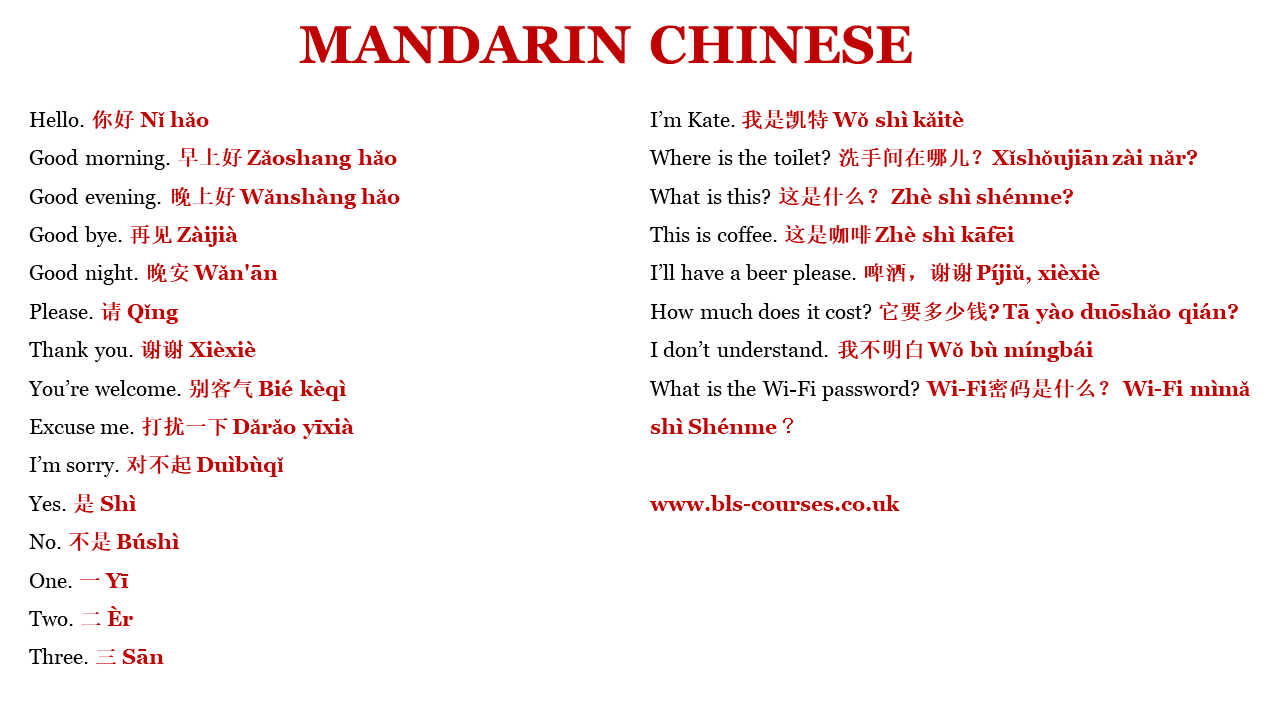
As you remember, we introduced a new series of blog posts (see Spanish, French, German, Russian, Italian & Portuguese) where we teach you some useful phrases in different languages. Sounds amazing? And it’s MANDARIN CHINESE today!

Are you planning your beach holiday on Hainan Island? Do you travel frequently to Beijing or Taipei? Do you dream of exploring rural China? If so, we would like you to taste & learn some essential Mandarin Chinese first. Below you’ll find a list of useful phrases in Mandarin Chinese (greetings, polite phrases, closed question words, numerals and simple questions & sentences). We also video recorded Zhao, our Mandarin Chinese tutor, to help you with reading, pronunciation and accent (also available on YouTube). We hope you enjoy this series and that you’ll come and learn Mandarin Chinese with us! Good luck!

Which language would like you like to learn next? Let us know in the comments below.

Kinga Macalla
May 11, 2016

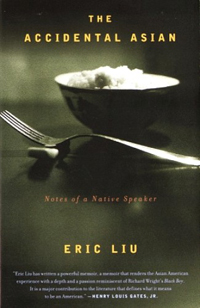
Book Review: The Accidental Asian by Eric Liu

Eric Liu is a monolingual American whose Chinese parents emigrated to the USA and lived there for the rest of their lives. In Liu’s memoir, The Accidental Asian, he presents a series of essays on ethnic identity, assimilation and “Chinese-ness ”. He chose topics that are particularly close to him, to his experience and to his unique family and life situation.

The_Accidental_Asian_cover

I found the extracts devoted to the Chinese language really fascinating. Eric Liu is not bilingual; he speaks and understands some Chinese, but not fluently. In fact, he expresses his surprise in the book at how little he could understand his Chinese grandmother, Po-Po. We also learn that he is unable to read a Chinese memorial book about his father’s life. I suppose  his complete assimilation had its price: he lost this common skill binding him to his family and ancestors.

I would definitely recommend this book to any parent who is hesitating as to whether to raise their child multilingually and also to anyone who is interested in multilingualism, multiculturalism and “Chinese-ness”.

Written by Kinga Macalla

March 9, 2016

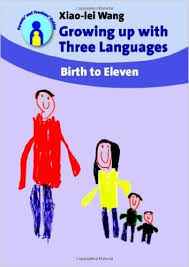
Book Review: Growing up with Three Languages by Xiao-Lei Wang

Raising children bilingually sounds challenging enough, but trilingually? Xiao-Lei Wang and her husband decided to teach their children their heritage languages: Chinese and French, while living in the USA. They were very serious about this project and gave their full attention and creativity to make it work for their boys who are now trilingual! Xiao-Lei Wang described their experience in the book Growing up with Three Languages. Birth to Eleven and says that one of the motives behind this publication was the lack of successful examples of multilingual upbringing practises. By writing this book Xiao-Lei Wang wanted to help parents discover the possibilities of raising multilingual children. This is not to say that the task in itself was somehow easy and without difficulty or frustration, rather it was overall an enjoyable and rewarding process.

Growing up with three languages

Growing up with Three Languages was recommended to me by a friend who is planning to raise her daughter trilingually and found some of the book’s guidelines very useful. I particularly enjoyed its style, case studies, real-life examples, friendly reader approach and long lists of resources. I would point out however that the addition of an all-in-one bibliography would have been useful.

The author highlights a number of key factors on the process of raising children trilingually. Firstly , if we are planning to raise our children multilingually, we must ask ourselves a number of questions: from our reasons and motives, practicalities and teaching methods to our children’s names (yes, that is important, too!) and then deciding whether they should be going to a supplementary school or not. Secondly, let’s make the whole process as interesting, enjoyable and also positively challenging as we can, so that it does not feel like a chore both for us and for our little ones. Thirdly, we should not forget that communication should always be the most important priority and that language learning is a life-long process (I certainly agree with this!).

I would definitely recommend this book to any parent who is planning to raise their children multilingually, and it is an undeniably helpful resource for those whose heritage languages are Chinese or French.

Written by Kinga Macalla