Tag Archive: foreign language learning

April 22, 2020

Book review: How languages changed my life

‘The decision to learn a foreign language is (…) an act of friendship’ John le Carré

It’s a fascinating read which should be compulsory for those studying/learning/living with foreign languages. The book “How languages changed my life” (Project MEITS) contains 26 stories written by people whose lives were transformed by languages. It made me think how languages changed my life.

Below you’ll find my favourite quotations from the book:

“I miss that working at Westminster. In fact being back here is like swimming against the internationalism of my life hitherto. I miss the opportunity, the pleasure, the luxury of being able to bump into a colleague in the corridor and just drop into another language.” (Stephen Kinnock, p. 6)

“When I speak Russian, I’m a slightly different person from when I talk in English. That’s a wonderful thing to find out about yourself, and other people recognize it in you too.” (Bridget Kendall, p.17)

“Linguistic diversity is the human cultural equivalent of biodiversity.” (John Fraser Williams, p.34)

“(…) [W]hatever you end up doing, being able to speak other languages means you’ll do it quicker and better. (Paul Hughes, p.50)

“I like to think that one day I might enjoy the luxury of sitting under a tree and studying Chinese without having to instrumentalize it. It’s such a poetic language, incredibly distilled: a whole episode in history, can be evoked in just one four-character four-syllable phrase, like an explosion in your brain.” (Carrie Gracie, p.74)

“To learn a different language is to encounter a different logic, a different cadence, a different sequence of words. It prepares you to think differently and to adapt (…).” (Martina Navratilova, p.173)

And finally, if you still think that after graduating from a university with a degree in languages your career path is either being a teacher or a translator, this book will certainly change your view as, in fact, when knowing languages the possibilities are truly endless. Enjoy reading!

Kinga Macalla

September 26, 2018

How to learn vocabulary by grouping words together

In this blog post, we look at a useful way to help us remember vocabulary – putting words into groups.  We find out how to harness our brain’s natural tendency to understand the world through association (this object is green and has leaves – it must be a plant!) to help us create groups of related words that will help us learn and remember them.  We can create groups based on different things: themes, verbs/nouns and adjectives, synonyms, prefixes – these are just a few that we explore here.
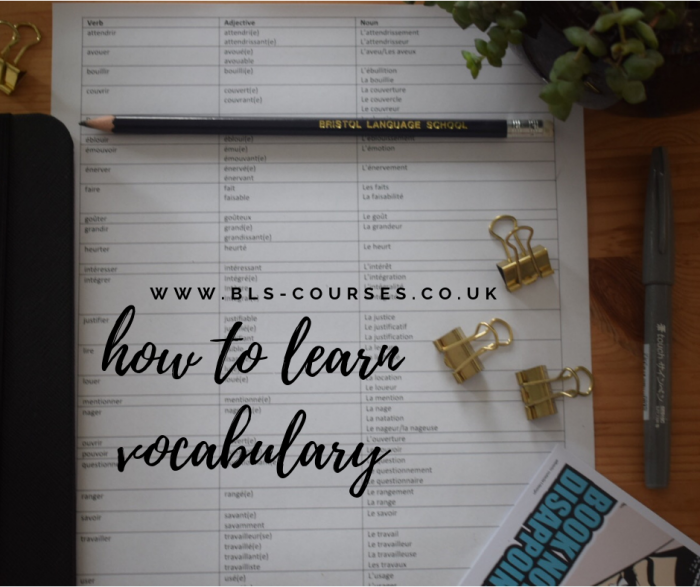
I know what you’re thinking, another post on learning vocabulary! But this technique is different from the visualisation technique or the recognising cognates technique we explored in other blog posts.  And remember, everyone is different and so everyone learns a language differently – and once you have worked out which type of language learner you are and which techniques work for you, you will have a recipe for success!

Grouping By Theme/Context

You will have heard it before, context is key to language learning.  Children learn that “hello” means “hello” because people say it to them when they see them for the first time and not when they are going away (that’s “bye bye”).  They learn that “yummy” is an adjective to describe food but not, say books.  We are no different from children in the way we learn.  When we associate words with a context, we learn and remember them more quickly.  I can assure you that you will remember that “cucchiaio” means “spoon” in Italian much more readily if you are using it to eat soup with than if you ask, “how do you say ‘spoon’?” in a car trip across the Alps and then try to remember it after a fun day’s skiing.

So, how do you group words by theme?  Try drawing and labelling a picture.  Draw a picture of the kitchen in your house and label all the things in there, draw a picture of the human body and label the parts, draw a picture of a car and label that.  If you are learning words that go together or make up a whole, you will remember them more easily.  Learn words about the weather together, learn how to say whether you are well/ill/have a headache/have a toothache together.  Learn words you will use in the classroom together.  Learn words and phrases you will need to use in a restaurant (“I’ll have a…”, “the bill, please!”).  You will remember them better than if you are learning random clusters of words.

Making Nouns and Adjectives out of Verbs

I remember when I learnt this technique to learn three words for the price of one – I was literally excited because it opened my eyes to a new, efficient way of learning!

Think of a verb in the language you are learning.  Let’s take “éclairer” (to brighten/become clear/clarify) in French.  If we look in a dictionary near “éclairer”, we will see “éclaircie” – a clear patch in a cloudy sky (which metaphorically means an improvement in a difficult situation), and “éclaircissement”, clarification.  We will also see the adjective “éclairé”, informed/enlightened.  With this exercise, we have just learnt four words instead of just one.  Try this with verbs you can think of.  You can combine this grouping technique with tools such as tables and diagrams if this will help you.

Learning Synonyms

Another way to learn several words instead of just one word at a time is to learn synonyms.  It is a good idea to use a thesaurus for this exercise.  Think of the word “hungry” in English.  How many synonyms can you think of? “Famished”? “Starving”? “Ravenous”? “Peckish”?  Try looking up  synonyms in the language you are learning and use them in conversation instead of the standard word.  This will help you remember them because you are using them and may impress your friends!

Grouping Words by Prefix

It is likely that the language you are learning will use prefixes (beginnings of words) that have a specific meaning.  Let’s look at Spanish.  If we know that “des-“ means “un-“ or “not”, we can work out that “desconocido” (des-conocido) means “unknown” and “desbloquear” means “to unblock”.  “Descubrir”, literally “to uncover”, means “to find out/discover” (it’s similar in English).  This amazing word is similar in a lot of languages – “scoprire” in Italian is “to uncover” or “discover”, “ontdekken” in Dutch is the same and “odkrywać” in Polish is similar.  These words all have prefixes (s-, ont-, od-) which also mean “un-”, “away” or “from” in the respective languages.  If we identify these little parts of words, we can understand the gist if not the meaning of new words and remember them because of their theme (such as “un-“ meanings).

Can you think of other ways to group vocabulary together?  Share them with us in the comments!

Suzannah Young
March 16, 2016

Interview with Multilingual Matters

Multilingual Matters is an international independent publishing house with lists in the areas of bilingualism, second/foreign language learning, sociolinguistics, translation and books for parents.

Most publishing companies tend to be based in London. Why did you choose Bristol?
The company was originally based in Clevedon where the company’s founders Mike and Marjukka Grover lived. When they retired and their son Tommi Grover became Managing Director we moved our office to Bristol as that’s where the majority of the staff lived.

As your publications are highly specialised, are your staff also experts in the area?
We are not all specialists in applied linguistics and tourism studies, our expertise lies in publishing not the world of academia. All our books are peer reviewed by academics working in the field to ensure that the content is accurate and appropriate.

Are all your publications written by academics or are other professionals also considered?
The majority of our books are written by academics but we do publish a small number of books aimed at parents and teachers, some of which are written by non-academics. These books are usually for a more general audience and are more accessible to the general reader. The most popular of these titles is A Parents’ and Teachers’ Guide to Bilingualism by Colin Baker which is a guide for parents bringing up their children with more than one language or teachers working with multilingual children.

Do you organise any events, such as meetings with authors or discussion forums?
We don’t tend to organise our own events but we attend a number of conferences every year where we meet with authors and often we participate in a publisher session where we advise academics, particularly younger postgraduates, on the process of academic publishing and how to get their research published.

What would you say are the most interesting aspects of working in publishing?
Working for a small independent publisher allows for a lot of variety and flexibility that isn’t always possible in bigger publishers. It’s also great to work with the same people over several years so you can build good relationships – both with colleagues in the office and authors in the academic world.

How has the publishing sector changed in the era of e-books?
People have been saying for decades that the increasing popularity of ebooks will cause the death of the print book but so far that hasn’t happened although we are selling fewer print books and more ebooks all the time. More university libraries are purchasing electronic content for students and many of our customers prefer to read books on a tablet or e-reader rather than in print these days. However, we’re pretty sure that the print book isn’t going to disappear any time soon!

Thank you!

Multilingual Matters -- photo

Interviewed by Bristol Language School  
Photo courtesy of Multilingual Matters