Tag Archive: German

September 6, 2017

Learning a Language: Learn German with BLS online & FREE!

As you remember, we introduced a new series of blog posts (see Spanish & French) where we teach you some useful phrases in different languages. Sounds amazing? And it’s GERMAN today!

Are you planning your ski holiday in Switzerland or Austria? Do you travel frequently to Berlin? Do you dream of exploring German-speaking Namibia in Africa? If so, we would like you to taste & learn some essential German first. Below you’ll find a list of useful phrases in German (greetings, polite phrases, closed question words, numerals and simple questions & sentences). We also video recorded Victoria, our German tutor, to help you with reading, pronunciation and accent (also available on YouTube). We hope you enjoy this series and that you’ll come and learn German with us! Good luck!

Which language would like you like to learn next? Let us know in the comments below.

Written by Kinga Macalla

May 3, 2017

On Languages: German

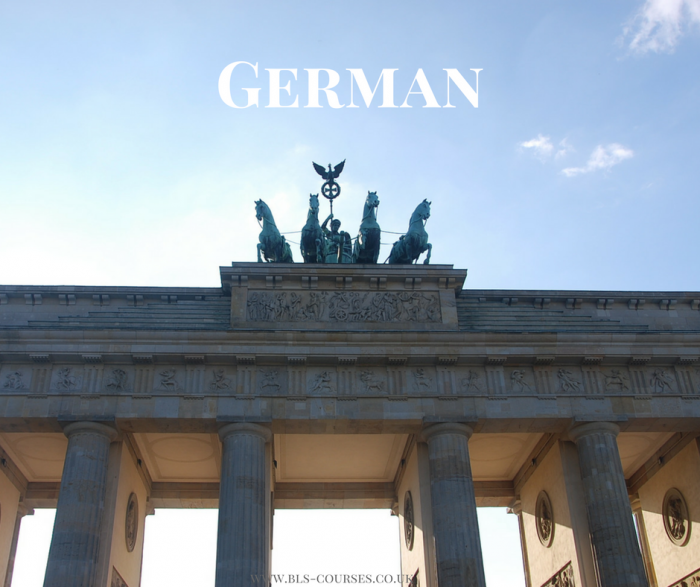
German (Deutsch in German) is a West Germanic language that is mainly spoken in Central Europe but is also found all over the world.  German has a broad range of dialects that are spoken in Europe and further afield.  It is an official language in Germany, Austria, Switzerland, South Tyrol (Italy), Belgium, Liechtenstein and Luxembourg.  It is also recognised as a minority language in the Czech Republic, Denmark, Hungary, Kazakhstan, Ukraine, Namibia, Poland, Romania, Russia, Slovakia, Slovenia, Croatia, Serbia, South Africa, the Vatican City and Venezuela. There are German-speaking communities in the USA, Canada, Brazil, Argentina, Mexico, Australia, South Africa, Chile, Paraguay, New Zealand and Peru as well.
on languages--german

German is the most widely spoken native language in the European Union.  Standard German (Hoch Deutsch) has about 95 million native speakers.  Around 30 million people speak other varieties of German as their first language too.  About 80 million people speak German as a second language, and many others study it as a foreign language.  It is the third most widely taught foreign language in the EU (after English and French), the second-most widely used scientific language and the third most widely used language on the internet (after English and Russian).

What is the German language like?

Learning these few facts about German grammar will give you a head start if you want to learn the language.

One of the particularities of German is that has three genders, masculine, feminine and neuter.  You can sometimes tell the gender of a noun from its ending: for example, words ending in –ung (-ing), -schaft (-ship), -keit or –heit (-hood, -ness) are feminine, words ending in -chen or -lein (diminutives) are neuter and nouns ending in -ismus (-ism) are masculine.  You can’t always tell just by looking at a word, though, and some endings are used for more than one gender, e.g. -er (see for example Feier (f.), celebration, party, Arbeiter (m.), labourer, and Gewitter (n.), thunderstorm).  German capitalises all its nouns.

German nouns also take four cases: nominative, accusative, genitive and dative.  Cases show the role a noun is playing in a sentence.  The nominative case shows the subject of a sentence.  The accusative shows the direct object of a sentence, i.e. the thing having the action done to it.  The dative is used for the indirect object of a sentence, i.e. the thing being affected by the action.  Finally, the genitive is used to show possession, i.e. who something belongs to.  Read more about cases here.

German is a descriptive language. Nouns are often made by combining an object and a verb, such as der Staubsauger – the vacuum cleaner, consisting of the noun Staub, ‘dust’ and the verb saugen, ‘to suck’, so a vacuum cleaner is a ‘dustsucker’.  Another example is das Fernsehen – ‘the television’, combining the words fern, ‘far’, and sehen, ‘watching’, so the television is literally the ‘far-watching’.  The longest German word is Donaudampfschiffahrtselektrizitätenhauptbetriebswerkbauunterbeamtengesellschaft (Association for subordinate officials of the head office management of the Danube steamboat electrical services) made up of 79 characters!  Most German vocabulary is of Germanic origin but it also has quite a few loanwords from other languages, mostly Latin, Greek, Italian and French.  English words have recently started finding their way into German vocabulary too.  There is even a word for them: ‘Denglish’, (the D is for Deutsch).  This makes for words such as die Airconditioning – air conditioning, babysitten – to babysit, joggen – to go jogging or running, das Handy – the mobile phone.  There are also many loanwords from German in the English language.  Here are a few examples: abseilen – to abseil; Bildungsroman; Delikatessen, Doppelgänger, Glockenspiel, Kindergarten, Leitmotiv (leitmotif in English), plündern – to plunder, Poltergeist, Schadenfreude, Wanderlust, Wunderkind and Zeitgeist.
on languages--german 2

Where can I learn German?

If you are not content with speaking Denglish, you can do a course in German at Bristol Language School! You can take Complete Beginner’s, Beginner’s Plus, Elementary, Upper-Elementary, Upper-Intermediate and Advanced German courses.  We also offer one-to-one tuition.

Several organisations promote the use and learning of the German language, such as the Goethe-Institut, Verein Deutsche Sprache and Deutsche Welle.  They can help you find German courses and have online exercises too.  There are also many websites where you can learn German, such as the BBC website, Alison and Deutsch-Lernen.  You will find more general information on the German language and courses here.

Viel Spaß!

Written by Suzannah Young
April 5, 2017

On Languages: The Languages of Belgium

With around 11 million inhabitants over an area of 30,528 square kilometres (11,787 square miles), Belgium is a small, densely-populated country in Western Europe.  It may be small but Belgium has a diverse population and three official languages, Dutch, French, and German.  Its inhabitants also speak a number of non-official, minority languages and dialects as well.  A lot of people in Belgium speak English and it is used as an unofficial language of communication in the Belgian capital, which also happens to be the European capital, Brussels.

DSCN3319

The Belgian Constitution guarantees language freedom in the private sphere. This implies that people can decide themselves which language they wish to use in their household, among friends, in the media, and for cultural, economic, commercial and religious activities. Before the federal (linguistically-defined states) structure and language legislation introduced in the 20th century, French was the only language used by the authorities. Now there is a lot of legislation around Dutch, French and German, although the constitution does not explicitly mention which languages enjoy official status.  Article 4 of the constitution does divide the country into linguistic areas: “The French-speaking area, the Dutch-speaking area, the bilingual area of Brussels Capital and the German-speaking area.”

6.25 million people live in the Flemish Region (Dutch language area), 3.5 million in the Walloon Region (French and German language area) and 1.09 million in the Brussels-Capital Region (bilingual area).  This means that 59% of Belgians belong to the Flemish (Dutch-speaking) Community (Flanders) in the north, 40% to the French-speaking Community (Wallonia in the South and part of Brussels) and 1% to the German-speaking Community (in the Ardennes area).  Alongside these official figures, there are migrants and their children living in the country who speak other languages (as well as one or more of the official languages), and speakers of other Belgian dialects. The capital, Brussels, is located in Flanders but 80% of its inhabitants speak French as their first language.  French is also used as a lingua franca in Brussels, as is English.  All public services and information in Brussels are available in both French and Dutch.  Many road signs and other notices around the rest of Belgium are written in both French and Dutch too.  Like many capital cities, Brussels is actually multilingual, especially as it is the home of many European institutions and there are a lot of foreign officials and diplomats living there.

Belgian Waffels 2

The standard form of Dutch used in Belgium is very similar to that spoken in the Netherlands but is often referred to as Flemish.  There are a lot of dialects in Flanders too.  The main ones are Brabantian, West Flemish, East Flemish, Antwerp and Limburgish.  Walloon, a dialect closer to French and mostly spoken by older people in rural areas, is used by 33% of population. Walloon has no official status in Belgium and is not used in education, though there are many evening classes in it.  The majority of the population of Wallonia can understand the language, about a quarter can speak it and a few can write it.  Luxembourgish is spoken by around 0.5% of the population, but the language has no official status, like Picard, Low Dietsch, Lorrain (also called Gaumais locally) and Champenois that are also spoken there.  About 10% of the Belgian population are non-native, and languages spoken include Italian, Spanish, Greek, Arabic and Turkish.  Antwerp, the capital of Flanders, also has one of the few Jewish communities worldwide that still speaks Yiddish as its dominant language.

Words which are unique to Belgian Dutch and Belgian French (i.e. not found in the varieties of Dutch and French spoken in other countries) are called belgicisms.

More information on the languages of Belgium can be found at http://languageknowledge.eu/countries/belgium

Written by Suzannah Young

September 7, 2016

Language learning: Which exam should I take to prove my level?

When you are learning a language, sometimes you want to have something official to show for it, to demonstrate which level you have got up to according to recognised examination bodies.  This can be useful if you are applying for a place at a university, which often require proof of level in the language in which programmes will be taught, if you are applying for a job, if you want to emigrate to a country of acquire citizenship of a country, if you want to teach the language, to add to your CV for later, or just to give yourself the reassurance that you have reached a certain level.  But which exams should you take?  Here is a list of recognised exams and qualifications for a few of the languages we teach at Bristol Language School.

IMG_7453 ready

One good place to start is looking at the list of European Language Certificates, or telc language tests, which are international standardised tests of ten languages, which offers over 70 tests, including general language and vocational examinations and tests for students. All telc language examinations correspond to the Common European Framework of Reference for Languages (CEFR) for listening, reading, speaking and writing. Your BLS teacher can also advise you on which exam to choose.

Arabic – In the UK, you can take a number of GCSEs and iGCSEs (International GCSEs) in Arabic, and the Cambridge International Examinations.  In Europe, you can take the telc in Arabic, or alternatively the European Arabic Language Test, which is based on Level A2 of the Common European Framework of Reference (lower than the telc).  Internationally, there is the Arabic Language Proficiency Test.

French – FLE is the acronym for the Français langue étrangère or “French as a foreign language” test, which is intended for learners of French for cultural or tourism purposes. There is no single test but instead a variety of possible tests used to measure language proficiency of non-francophones in non-francophone countries.  If you wish to study at a French-speaking university, you can take the DELF/DALF, which gives a certificate of your level, and the TCF (Knowledge of French Test), which is required by universities.  There is also the DELF PRO for people wishing to work in French.  People who want to teach French will need to take a different diploma.  More information is available on the French Institute website.  The exams can be taken in Belfast, Birmingham, Cambridge, Cardiff, Edinburgh, Exeter, Glasgow, Jersey, Manchester and York.  There is also the telc in French.

IMG_7454 ready

German – The Zertifikat Deutsch is a test of general German proficiency. The Zertifikat Deutsch für den Beruf (Certificate in German for Professionals) is an internationally recognised examination which tests German language ability for business and professional purposes.  The DSH (Deutsche Sprachprüfung für den Hochschulzugang) is a language proficiency test required for entry to a German university. There is also a German telc.  The Goethe Institut will have all the information you need about German proficiency exams.

Italian – The Certificate of Italian as a Foreign Language (Certificazione di Italiano come Lingua Straniera or CILS) is recognised by the Italian Ministry of Foreign Affairs and is often used to grant acceptance in any Italian university or higher education institution in Italy. There is also an Italian telc.  The Italian cultural institute in London can tell you more.

Japanese – In the UK you can do either GCSE, the International Baccalaureate qualification, a practical language test or the Japanese language proficiency test.  There is also an aptitude test in the Japanese writing system, kanji.  The Japan Foundation has more information.

Mandarin – The Hanyu Shuiping Kaoshi (HSK) is an official examination designed to assess the Chinese language proficiency of non-native speakers from beginners to advanced Level (divided in levels 1-6).  It consists of reading, writing, listening and comprehension.  The London Confucius Institute has more information.

IMG_7498ready

Polish – In the UK, you can take GCSE & A-Level Polish or the Certificate in Polish as a Foreign Language (Polish: Egzaminy Certyfikatowe z Języka Polskiego jako Obcego), are standardised tests of Polish language proficiency for non-native Polish speakers that are currently available in CEFR levels B1-C2.  There is also a Polish telc.

Portuguese – The CAPLE (Centro de Avaliação de Português Língua Estrangeira or Centre for Evaluation of Portuguese as a Foreign Language) issues certificates of proficiency in European Portuguese as a Second language developed by the University of Lisbon.  The test is offered at CEFR levels A1 – C2.  It can be taken in London.  There is also a Portuguese telc.

Russian – The Test of Russian as a Foreign Language (TORFL) is a standardised test supervised by the Russian Ministry of Education and Science.  There is also a Russian telc. The Russian Language Centre has more information.

Spanish – The Diplomas de Español como Lengua Extranjera (English: Diplomas of Spanish as a Foreign Language), or DELE, are official diplomas issued by the Spanish Instituto Cervantes to participants who have passed a standardised test indicating their European Spanish language proficiency. The exam can be taken at the Cervantes Institute in London.  There is also a Spanish telc.

Written by Suzannah Young

August 31, 2016

Language learning: Which language to choose? With helpful videos in six languages

Estimates say that there are up to 7,000 languages spoken in the world today (in around 200 states!).  Some languages have millions of speakers and some have just a few thousand speakers.  But with so many languages to choose from, how do you decide which one to learn?  This blog post gives you a few ideas on how to make the decision.

Does it match your interests?

Have you heard a song that you like in another language and you want to know what it says?  Do you enjoy books by Sándor Márai or Milan Kundera?  Do you like Italian food?  Do you like going on holiday in a particular location?  If you learn a language that is linked to something you enjoy, you are likely to get more out of it and remember it better. If the language has relevance to your life, what you learn will stay with you.

Do you know people who speak it?

Some people are inspired to learn a language because they have friends or partners who speak it.  If you have a partner whose first language is different from your own, think about whether you need to learn it to speak to their family, their parents and siblings, or their friends.  If you go and visit their family, do you want to be able to speak to the people they grew up with? Do you want to be able to go out and interact with local people?  It is also a way to get to know a person better if you understand the language they think in, the language they spent their childhood years speaking.  You can show how much you care about them by learning the language that is dear to them and learning about their culture.  Your partner is also a good person to practice your new-found skills with – they can teach you and correct you and will want to help.

Will it be useful for your work?

Has the company you work for just signed a deal with a German business?  Have you just started importing products from Japan?  Is it going to give you the opportunity to work with your new colleagues if you learn their language?  Could you get new tasks and responsibilitites or even a promotion if you learn it?  Or do you want to look for a new, exciting job? What about one that gives you the opportunity to travel?  If you are looking for a change or a challenge in your career, learning a new language could be the perfect thing for you.

Do you want to move to a new country?

In today’s world, more and more people are emigrating and making a new life in a new country – for work or to have a new experience.  If you want to integrate in the country you wish to move to it is a good idea to learn the language spoken there, and you can give yourself a head start by learning some of it before you leave.  Learning the language will also help you get to know the country, understand the way things work, its politics and its culture.  The transition to life there will be smoother if you already understand some of the language when you get there.

Will it be useful in the future?

Some countries, like India, Bolivia, Morocco or Brazil, have economies that are developing fast and countries that are likely to become politically important on the global stage in the not-too-distant future, like Turkey.  It can be beneficial to learn the languages of those countries to be able to find employment working in or with them in the future.

Do you want to have fun?

Some people just enjoy learning languages, out of intellectual interest or as a challenge.  If you are one of these people, you can pick any language you like – because you like the way it sounds, because you like the look of the alphabet, because you like how logical it is…you name it!
BLS wishes you good luck in your learning, whichever language you choose!

Written by Suzannah Young

February 23, 2015

Film Review: WINGS OF DESIRE

Wings of desire (Der Himmel über Berlin) is the only film I have seen more than once and it is definitely my favourite. It was directed by Wim Wenders in 1987 and awarded at the Cannes Film Festival. 

Wings of Desire

There are several reasons which make the film so special and lyrical. First of all, it is the romantic fantasy plot. The film tells the story of two angels, Damiel and Cassiel, who observe West Berlin’s life and listen to people’s thoughts while remaining invisible. The angels are immortal observers and can’t interact with people and their world. It changes when Damiel falls in love with Marion, a trapeze artist and decides to become human. With this decision the black and white film becomes colourful and Damiel is able to experience human sensory pleasures, such as food and the touch of his beloved woman.

One of my favourite scenes takes place in a library, where several angels sit by the readers while they immerse themselves in literature. There is an old man among them, named Homer, who dreams of an epic of peace. He expresses his disappointment that peace doesn’t inspire poets as much as war. His thoughts are illustrated with the real images of a ruined city and the victims of war.

The film not only praises peace but also music. Damiel meets Marion on the Nick Cave and the Bad Seeds concert. It is the beginning of their relationship. Music is shown as one of the greatest human pleasures with a power to bring people together.

It is also the poetic language of the inner monologues that makes the film so special. One can find inspirations of Rainer Maria Rilke’s poetry. Wings of desire begins with the poem Song of Child written by Peter Handke, who also wrote much of the dialogue and poetic narrations. One of the most significant monologues are Damiel’s plans for the first day after his metamorphosis, which expresses his passion for life: First, I’ll have a bath. Then I’ll be shaved by a Turkish barber who will massage me down to the fingertips. Then I’ll buy a newspaper and read it from headlines to horoscope. On the first day, I’ll be waited upon… For requests, ask the neighbour. If someone stumbles over my legs, he’ll have to apologize. I’ll be pushed around, and I’ll push back. In the crowded bar, the bartender will find me a table. A service car will stop, and the mayor will take me aboard. I’ll be known to everyone, and suspect to no one. I won’t say a word, and will understand every language. That will be my first day.

Wings of desire encourages the viewer to appreciate every simple moment of life. It also gives them a feeling that people and animals are not the only inhabitants of the Earth. The film was an inspiration for the City of angels with Nicolas Cage and Meg Ryan and it is also an inspiration for everyone who has watched it.
Quotations;

Written by Joanna Michta
Edited by Alicja Zajdel