Five years ago, I completed a post-graduate diploma in education at Bristol University. I mostly focused my research on bilingualism and language education. Back then I discovered Ken Robinson and his most famous publication ‘Creative schools’. When we started home-schooling our children two years ago, I was greatly inspired by “Kreda”, a Polish magazine on education and home-schooling (sadly, the print version will be discontinued from September 2023). But recently, I felt this urge to read more on education and home-schooling to get even more inspired and broaden my horizons on these subjects. Here are the books that are a great inspiration to me:

Home Education. Vol. 1. by Charlotte Mason
“The resourcefulness which will enable a family of children to invent their own games and occupations through the length of a summer’s day is worth more in the afterlife than a good deal of knowledge about cubes and hexagons.” (p. 191)
Charlotte Mason’s publication can be treated as a framework for home education. It was written more than a century ago, at the turn of the 20thcentury, so you might think it would represent some old-fashioned values and ideas, but I think her vision is as relevant today. For example, she sees education as an atmosphere, where the child’s natural surroundings, people and things form the home-schooling life together. She also points out the importance of forming habits whether in regard to education, healthy diet, savoir-vivre or having a rest. She writes fondly about the outdoors, nature, foreign languages, music and art. Charlotte Mason references many books (would love to read some of them!) and even provides some detailed instructions on how to teach children to read or write.

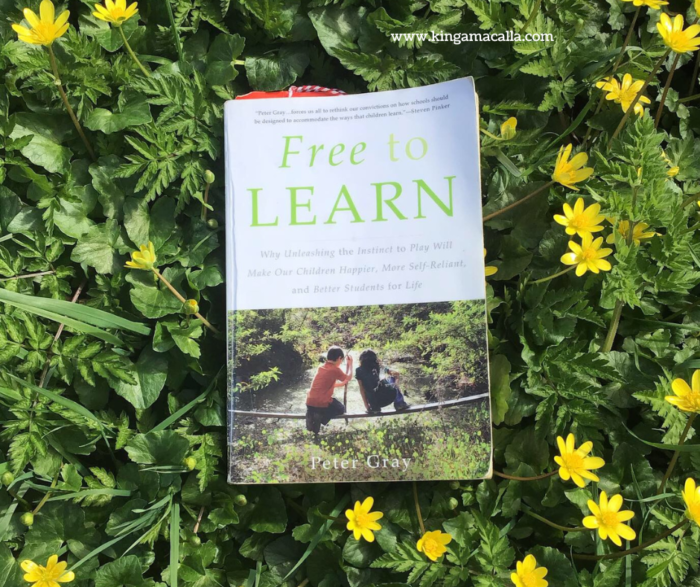
Free to Learn by Peter Gray
“When language play is carried into adulthood, we call it poetry.” (p. 123)
This is a fascinating read on the role of play in children’s education. It’s so well-written that when I read it, it felt more like a detective story than a non-fiction publication. On many different levels it made me sad. When we look at a school’s compulsory system, the obligation to sit and learn, to follow the teacher’s guide, to spend hours indoors and only short breaks outdoors, to be quiet and follow the rules, etc. Why? Because we want our children to succeed, to go to a ‘good’ university, to have a ‘good’ job and a ‘good’ life. But we don’t need to take away this tremendously important learning tool of letting our children play. Our children can still be successful and happy in their adult life. Just some food for thought. I’d make this book compulsory (!) to any parent (before their child/ren starting any form of education).
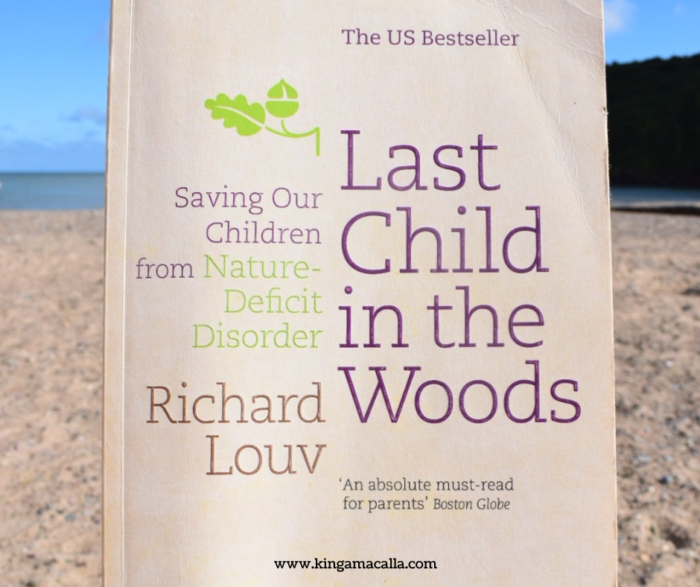
Last Child in the Woods by Richard Louv
“Not everything that can be counted counts and not everything that counts can be counted.” Quote attributed to Albert Einstein
This book is as fascinating and eye-opening as it is sad. It tells some realistic truths about our disconnection from nature, how children no longer play and explore freely the outdoors. It says that the value of knowing and understanding nature is less and less important for schools and universities, even though “[a]ny natural place contains an infinite reservoir of information, and therefore the potential for inexhaustible new discoveries.”. [p. 68] Through his extended research and interviews, Adam Louv not only tries to analyse children’s relationship with nature in the modern times, he also provides solutions on a micro and macroscale. Last Child in the Woods beautifully corresponds with the ideas presented in Free to learn, but obviously with an emphasis on nature. I couldn’t read more than a few short chapters in one go, as I needed time to digest its content. It’s written from an American perspective, but also includes some references to Europe.
What are your most inspirational books on education? Please let me know in the comments below.