Tag Archive: italy

May 22, 2019

Italy: Florence – Pisa – Torre del Lago

My travelling destination in Italy was Tuscany, and while there I visited Florence, Pisa and Torre del Lago. Today, I’d like to share with you my observations of those towns and what impressed me most.

Florence

Architectonically, it’s a true gem, breathtakingly beautiful. You can just wander around the town the whole day long and admire its architecture. I was surprised at how crowded the town centre was, there were many tourists. That also meant that the queues to various places, like the galleries or the main cathedral, were very long. Even though the ticket and entrance system is a bit chaotic, we decided to visit the main gallery, Galleria degli Uffizi, which contains paintings by Botticelli, Leonardo da Vinci and Caravaggio, among many other masterpieces. The building itself, with its painted ceilings, is worth your attention and so are the window views. We also walked around the town to see the many famous squares, but we couldn’t miss a cup of decadent hot chocolate in the Caffè Rivoire or a cup of the creamiest ice-cream in the galetaria Grom.

Pisa

I have always treasured those “first time” moments, such as when I first saw Big Ben and the Eiffel Tower, and this time was the same with the Leaning Tower of Pisa. I was moved when I had my first glimpse of this monumental tower and yes, it’s very, very slanted! Pisa was much less crowded than Florence, but every time we went to Pisa, it always rained, even if it only lasted 5 minutes. We also visited the botanical garden, which dates back to 1543 and was the first European university botanical garden. Our visit to Pisa wouldn’t have been the same without a scoop of the tastiest ice-cream (read my ice-cream post here).

Torre del Lago

This tiny seaside town is mostly famous for the Puccini Opera Festival which is held here in July-August and is the only festival fully dedicated to the composer Giacomo Puccini. Torre del Lago also has a long sandy beach which we enjoyed almost every day. Its long main street is crammed with many small shops, delis, bakeries, groceries and cafes. For me, it was so nice to see so many Italians cycling to work or to the beach (with the kids being placed everywhere on the bike!). I could definitely slow down and relax here, through walking on the beach, tasting the food, reading books or simply by dolce far niente.
What are your impressions of Tuscany and its beautiful towns? Let me know in the comments below.

Kinga Macalla
February 27, 2019

Italy: A heaven for ice-cream lovers

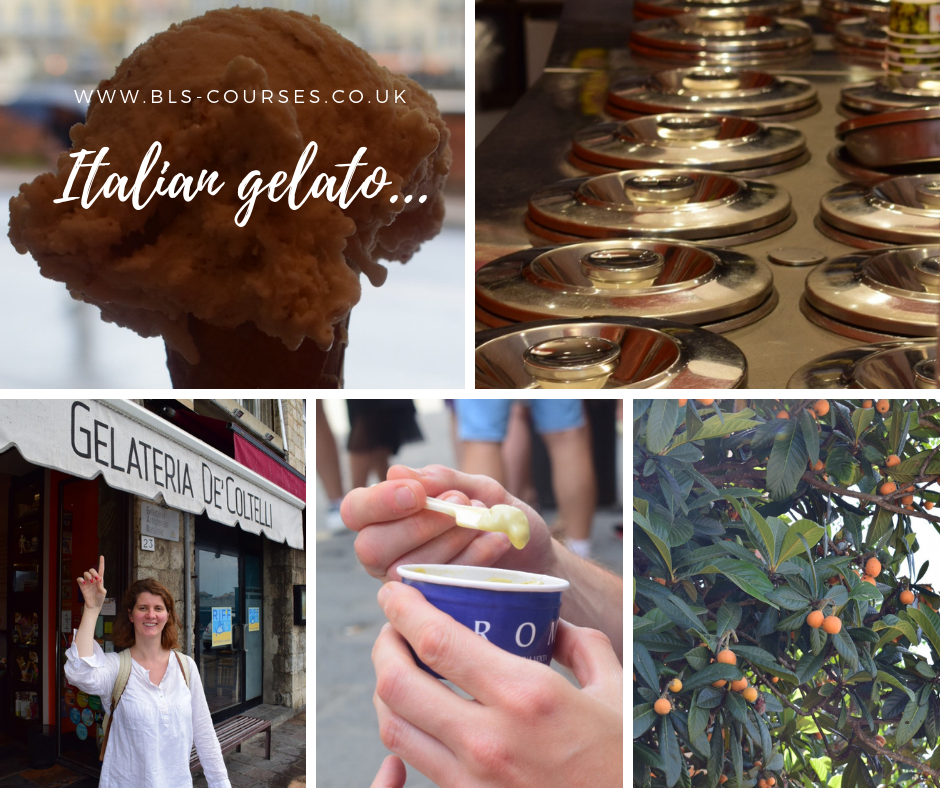
When in Italy, it’s truly difficult to avoid them… they look & taste amazing… yes, the ice-creams… As I normally don’t eat sweets (I know, shocking!!!), if I wanted to be naughty, I wanted to do it properly and experience the best of Italian ice-cream. Below are my absolute favourites.

Gelateria De’ Coltelli, Pisa

Situated very conveniently alongside the river bank. Natural & delicious. I think they change their ice-cream flavours regularly, as every time I visited them, I was tempted by new flavours (BTW all tasted amazing!).

Grom, Florence

Situated very centrally, just steps from the cathedral Duomo. The ice-cream is so creamy: our daughter had a sorbet which was really smooth & tasty. Buy your ice-cream, sit on the pavement opposite the cathedral and just enjoy the taste, that’s dreamy!

Obviously, there are many more places to taste the absolute deliciousness of Italian ice-cream, if you have some tips, please let me know in the comments below.

Kinga Macalla

August 15, 2018

Travelling corner: My bella Italia

This article is to express my admiration and fascination for Italy. I visited this wonderful country for the second time & was so happy to be there and experience all the beauties of it. As I was travelling in breathtaking Tuscany, I was thinking about what I love Italy for: I think I would say that it’s for its amazing architecture, scrumptious ice-cream, many bookshops, tiny pizzerias, delicious sweet shops & cafes, independent bakeries & groceries, smiling people, crazy bike-riders & cobbled streets.

What do I experience when I think about Italy? I smell the fragrance of summer: warmth, flowers, gentle rain in a breeze, forests & freshly baked pizza.

What are your impressions of Italy? Let me know in the comments below.

Kinga Macalla
June 1, 2016

On Languages: Italian

Do you want to get a real taste of Italian life, travel around this beautiful country with ease, appreciate its art and architecture and be able to compliment the chef when you try the local delicacies? This guide to learning the language of the Bel Paese should give you a head start.

On Languages--Italian 2

Say what you see
Unlike English, Italian spelling is phonetic. That means that the spelling of a word tells you how to say it (except in a few isolated cases, such as homonyms like ‘pesca’ (fishing) and ‘pesca’ (peach), and of course regional variations). It also means that words that have the same ending will always rhyme. For example, ‘cane’ (dog) and ‘pane’ (bread) will always rhyme (compare with English ‘chalice’, ‘police’ and ‘lice’, to give you an idea!). Italians pronounce every letter in a word, including vowels, so ‘aiuola’ (flowerbed) is a-i-u-oo-l-a and ‘cappello’ (hat) is cap-pel-lo. One thing to watch out for though is the stress pattern in words: in words with two syllables, like freddo (cold) and dito (finger), the stress falls on the first syllable, unless there is an accent on the last syllable to tell you that it is stressed (compare ‘papa’ (Pope) and ‘papà’ (dad)). In longer words, there is no predictable stress pattern, so you will need to learn them.  Uomo avvisato mezzo salvato – forewarned is forearmed!

Articulate!
Italian speakers move their mouths a lot when they are speaking.  They open their mouths wide and form the sounds with their lips – they don’t mumble!  They do this to say the vowel sounds clearly.  Have a go: try pronouncing the Italian letter ‘a’ – you just have to open your mouth wide and say ‘aahh’! Try this with new words you learn – practice pronouncing them in front of the mirror and make sure you get your mouth moving!

Get your hands moving
Anyone who has spent any amount of time in Italy or around Italians will have noticed that Italians move their hands a lot when they talk.  The insider knows that this is not just for emphasis – unlike some languages where speakers have more or less idiosyncratic hand gestures that they use to stress what they are saying, or to try to make it clearer, Italian hand gestures each have an individual meaning.  They are so vital to communication that Bruno Munari even published a (humorous) Supplement to the Italian Dictionary all about hand gestures (the text is available in Italian, English, French and German). You can also find numerous videos on the internet that explain their use. Try and learn a few to make your spoken (and silent) Italian more authentic.

Regional variations
There are many different regional accents in Italian, which means that consonants, vowels and the melody of the phrase change depending on where you are in the country. Most areas, but particularly villages and rural areas, also have a dialect that is different from standard Italian.  Dialects are mostly used at home and with friends, whereas standard Italian is used for more formal occasions and between Italians from different regions so they can understand each other. Read more about regional variations here and read about the use of different expressions here.

Take your pick
Italy has a lot to offer, be it music, art, literature, food, sport, architecture, history, travel or fashion.  Pick your favourite one of these and learn all about it – in Italian!

Written by Suzannah Young

December 19, 2015

Christmas around the world

A few examples of Christmas traditions from around the world!

ITALY
Unlike in any other country, Christmas presents are delivered by Befana, an old witch, who visits all Italian children in the night of 5th January, travelling the country on her broomstick. Being a good housekeeper, some say she will sweep the floor before she leaves. To some the sweeping meant sweeping away of the problems of the year. The child’s family usually leaves a small glass of wine and a plate of regional food for the Befana.
Another interesting tradition is Lancio dei Ciocci, which consists of throwing old crockery out the window at midnight on New Year’s Eve, symbolising the riddance of old negativity and evil. It is also common to leave doors and windows open in order to let good spirits in.

POLAND
Christmas in Poland, just like in many European countries, is celebrated on the 24th of December, known as Wigilia. It is a tradition to prepare twelve dishes, one for each of the apostles that accompanied Jesus during the Last Supper. As meat is banned on Christmas Eve, fish dishes are served instead, the most typical being karp. It is not uncommon to find one swimming in somebody’s bathtub in the days leading up to Christmas!
Before the dinner, families share Christmas wishes and opłatek (similar to a communion wafer), which is served on a small pile of hay, referring to the stables in which Jesus was born.

GERMANY
Germans are famous worldwide for their Christmas markets and advent calendars, but they also have some lesser known traditions. In some part of Germany, children write to the Christkind (‘the Christ child’), a traditional giver of gifts. In Nürnberg a young girl is chosen each year to participate in a parade as the Christkind. She wears a long white and gold dress, has blond hair and wears a gold crown and sometimes also wings, like an angel. She is responsible for the official opening of the Christmas market and visits old people’s homes and hospitals during the Advent.

FRANCE
The 6th of January is celebrated in France as Fête des Rois (Day of the Kings). A flat almond cake is eaten called Gallete des Rois in Northern France and Gâteu des Rois in the South of the country. A small charm is placed inside the cake and the person who finds it has to either buy a beverage for everyone around the table or offer to host the next king cake at theirs. This can extend the festivities through all of January!

SPAIN
Christmas celebrations in Spain start on the 22nd of December, with the launch of Sorteo de Navidad, a Christmas lottery, which takes place every year and is broadcasted on national television. There are long queues at the ticket selling points, even as early as a month before! After all, everybody is hoping to win the main price, El Gordo, literally ‘the fat one’.
On New Year’s Eve, during the countdown to midnight, twelve grapes are eaten, one for each stroke of the clock: that’s one grape per second! They represent the twelve months of the year and are meant to bring happiness in the upcoming year.

Winter 2015

On this note, we would like to wish you all a very Merry Christmas! No matter how and where you spend it, we hope that it will be a time of rest, spent with family and friends. We would also like to wish you all the best in the New Year, let it be a year filled with love and happiness.
See you in January 2016! 

Written by Alicja Zajdel