Tag Archive: Japanese

May 20, 2020

Book review: The Hidden Messages in Water by Masaru Emoto

What you know is possible in your heart is possible. Masaru Emoto

Today, I’m reviewing an amazing book about water. About water? On a language-related blog? Yes! 🙂 The author is a Japanese scientist who, through his research, discovered some fascinating truths about water. The read may inspire you to travel to Japan or to learn Japanese. Also, the presented knowledge may be transferred to our daily life and help us achieve better results in language learning.

What did the Japanese researcher discover through his research? Through analysing tap water and its crystals (e.g. from Tokyo or London) the pictures showed deformed crystals or didn’t have any crystals at all. Whereas when he analysed water from springs or lakes, there were beautifully formed crystals. But, it’s more than that. He wrote words on water, e.g. love & gratitude or thank you and then the water formed beautiful and complete crystals. After writing stupid and fool, the crystals were dark, incomplete or not formed at all. But the worst results with the crystals were when the water was ignored (interesting, huh?).

What can we take it from these amazing discoveries? That our words and thoughts have power. Whenever we say ‘I can’t do it’, ‘I’m too old’, ‘I’m a slow learner’, ‘I don’t have any language ability’, regardless of wherever that’s true or not, the said words can become our reality. A good exercise could be to watch what we say about ourselves (whether out loud or in our heads) to see what picture we draw of ourselves and what impact it can have on our language learning or, more broadly, on our lives.

The book talks deeper about the subject of water, its healing powers, its links to the beginnings of life on planet Earth, and the inner power of human beings. The book has many pictures of the water crystals which make the read more real and even more fascinating!

What interesting book have you read recently? Do let me know in the comments below.

Kinga Macalla

March 18, 2020

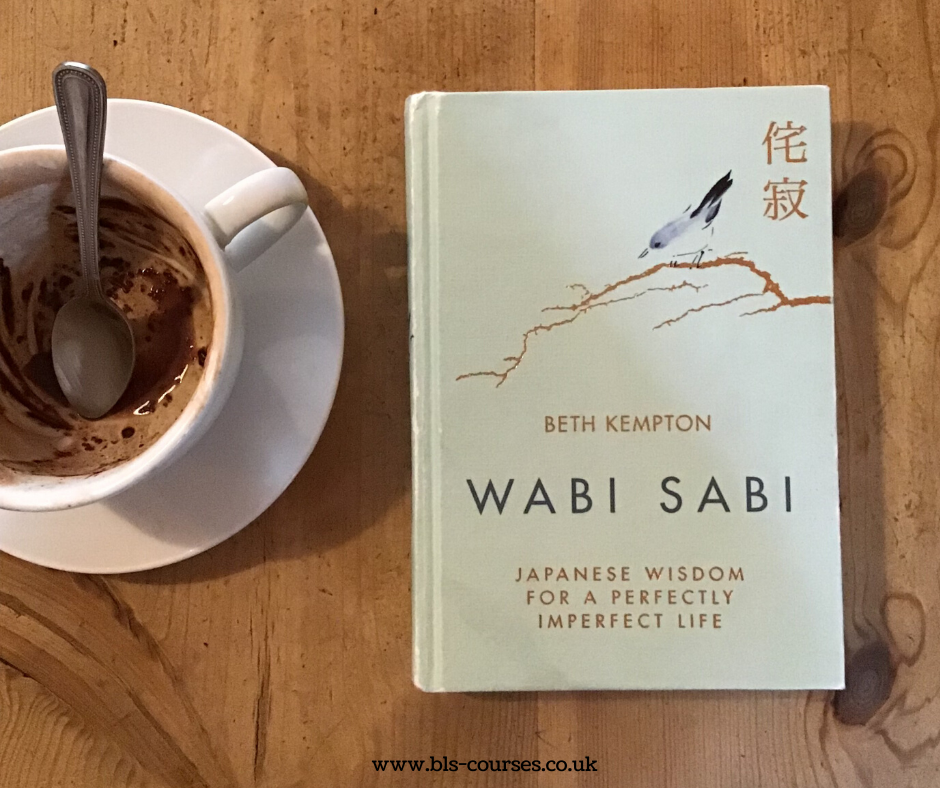
Book review: WABI SABI by Beth Kempton

“The forest does not care what your hair looks like. The mountains don’t move for any job title. The rivers keep running regardless of your social-media following, salary or your popularity. The flowers keep on blooming, whether or not you make mistakes. Nature just is, and welcomes you, just as you are.” Beth Kempton

I had a different article planned for today. But, I’ve been reading Wabi Sabi for the last week or so, every day, to keep my mind occupied and to feel calm, inspired and hopeful. I needed to find strength inside me. I enjoyed the read so much, and I’m excited to be sharing my insights here with you today.

I learnt about wabi sabi for the first time in autumn 2018 when I came across the book Wabi-Sabi Welcome by Julie Pointer Adams (you can read my review here). I was so overwhelmed by the beauty of this Japanese philosophy, that I was sad when I read the last page of it. I felt very similar this time, I wanted to continue reading about this perfectly imperfect philosophy and enjoy the little pleasure coming from reading and learning about it.

Beth Kempton, the author, is a Japologist who studied Japanese at university and spent many years living and working in Japan. As we read on the first pages of the book, she considers Japan her second home.

The book contains 8 chapters: first we learn about the origins and characteristics of wabi sabi, how to create simple yet beautiful interiors in our homes, the importance of connection with nature (shinrin-yoku aka forest bathing), the gentle reminder that everything is impermanent, imperfect and incomplete, how to overcome the fear of creative failures (!), how to maintain/create good relationships and to enjoy our career path, and finally how to enjoy the little moments in life.

My absolute favourite parts were the little reminiscences from the author’s past experiences; whether as a student, traveller, interpreter or researcher in Japan. They made the whole concept of wabi sabi more alive, funny and real. They added an emotional aspect to this wise Japanese philosophy.

Have you read a different publication on wabi sabi? Let me know in the comments below.

Kinga Macalla

February 12, 2020

Book review: Goodbye, things. On minimalist living by Fumio Sasaki

“A table, a chair, a bowl of fruit and a violin;

what else does a man need to be happy?”

 Albert Einstein

In a world so overloaded with information, things, promotions and a want-more philosophy, shall we all become minimalists? Is there happiness in having less?

Personally, I’m on a journey to declutter my belongings: I no longer have many clothes/cosmetics, I try to buy sustainable clothing/beauty products and only when I really need them (I do not wear make-up, though if an occasion requires it, I have a red lipstick ;)). And this all started before reading the book on minimalism by Fumio Sasaki. Let’s see what the next chapter will bring.

Fumio Sasaki is a Japanese minimalist who, throughout his journey to declutter his tiny apartment in Tokyo, learnt some valuable lessons on life and became a better person himself. I found the book a very interesting read, observing his from-maximalist-to-minimalist journey (Do objects make us more valuable? Certainly not!), learning about some practical minimalist tools (What do I really need to have a good life?, organising is not minimising, our homes are not museums, borrow/rent it, don’t buy it!, one in, one out) and seeing some profound benefits of having less (more time, enjoying life more, cleaning less, not comparing oneself with others, focusing better, being healthier, being present in the moment, feeling gratitude).

 “Happiness is actually all around us. We just need time to find it.” (p. 166)

“The very act of living brings me joy.” (p. 174)

“Minimalism is built around the idea that there’s nothing that you’re lacking.” (p. 160)

I truly recommend this book and suggest learning more about minimalism. It seems that via decluttering our houses, we also dust ourselves down and discover a more meaningful life.

Which item(s) would you like to have less of? Please let me know in the comments below.

Kinga Macalla

October 4, 2017

On Languages: Japanese

Japanese (日本語 [nihõŋɡo]) is the ninth most widely spoken language in the world.  It is the official language of Japan, which has a population of over 125 million people.  There are also around 2.5 million people of Japanese origin, many of whom speak Japanese as their first language, living in the Americas, particularly Brazil and the United States (Hawaii).  There is also an expatriate presence in major cities such as London, New York and Paris.  Japan is one of the world’s leading industrial powers and Japanese language services have become extremely important in social and business settings.
Much about the roots of the Japanese language is unclear.  There are debates about which other languages Japanese is related to and it only seems certain that it is a member of the Japonic language family, which includes the Japanese language spoken on the main islands of Japan and the Ryukyuan languages spoken in the Ryukyu Islands.  Little is known of the language’s prehistory, or when it first appeared in Japan. Chinese documents from the 3rd century recorded a few Japanese words, but longer texts did not appear until the 8th century.  Old Japanese vocabulary was influenced by Chinese.  Late Middle Japanese (1185–1600) saw changes brought it closer to the modern language, as well as the first appearance of European loanwords.  Portuguese, Dutch and Spanish words, such as “pan” (bread) and “igirisu” (the UK), from the Portuguese “po” and “ingles” arrived during the 16th and 17th centuries, when missionaries and merchants started to visit the country.  Following the end in 1853 of Japan’s self-imposed isolation, the flow of loanwords from European languages increased, especially English loanwords. These include “teburu” (table), “biru” (beer), “gurasu” (glass), “aisu” (ice), “takushi” (taxi) and “hoteru” (hotel).

How Japanese works

Word order in Japanese is normally subject–object–verb.  Sentence structure starts with the topic and then gives a comment about the topic.  It uses particles (small words) to mark the grammatical function of words, such as ‘wa’ (topic marker), ‘ga’ (new information).  This means they function like cases in other languages.  For example, これは本です。(‘kore wa hon desu’) = ‘This is a book’.  A longer example is 私はブリストル に 住んでいます (‘Watashi wa Bristol (Burisutoru) ni sundeimasu’).  A literal translation into English would be ‘I (topic) Bristol (in) reside’).  Thus Japanese, like many other Asian languages, is often called a topic-prominent language, which means it has a strong tendency to indicate the topic separately from the subject, and that the two do not always coincide. The sentence Zō wa hana ga nagai (象は鼻が長い) literally means, “As for elephant(s), (the) nose(s) (is/are) long”. The topic is zō “elephant”, and the subject is hana “nose”.

Particles are used at the end of sentences to add impact (‘ne’), or make questions (‘ka’) as well.  Questions can have the same structure as statements, but with intonation rising at the end.  In the formal register, the question particle -ka is added. For example, ii desu (いいです) “It is OK” becomes ii desu-ka (いいですか。) “Is it OK?”.

Nouns do not change with number or gender, and there are no articles (‘the’ or ‘a/an’).  Verbs do change with the tense, of which there are two: past and present (or non-past), which is used for the present and the future.  For verbs that represent an ongoing process, the -te iru form indicates a continuous (or progressive) aspect, similar to the suffix ing in English.  Verb conjugations are also used for voice (active or passive), but not the person the verb is are referring to.

Japanese has a grammatical system to express politeness and formality. Broadly speaking, there are three main politeness levels in spoken Japanese: the plain form (“kudaketa”), the simple polite form (“teinei”) and the advanced polite form (“keigo”).  It also has a system of honorific language, where verbs and vocabulary change to indicate the relative status of the speaker, listener and persons mentioned.  Their status is determined by a variety of factors including job and age.  The person in the lower position is expected to use a polite form of speech, whereas the other might use a more plain form.  Japanese people often use titles of the person referred to where pronouns would be used in English. For example, when speaking to one’s teacher, it is appropriate to use sensei (先生, teacher), but inappropriate to use ‘anata’ (‘you’). This is because ‘anata’ is used to refer to people of equal or lower status, and one’s teacher has higher status.  Strangers in Japan will speak to each other politely.  Most nouns in the Japanese language may be made polite by the addition of o- or go- as a prefix. o- is generally used for words of native Japanese origin, whereas go- is affixed to words of Chinese derivation. In some cases, the prefix has become a fixed part of the word, and is included even in regular speech, such as gohan ‘cooked rice; meal.’ Such a construction often indicates deference to either the item’s owner or to the object itself.  Even if you don’t have the language skills, a softening of the voice, a discreet awareness of the other person’s personal space and undemonstrative body language go a long way when it comes to courtesy and showing respect.  Read more about honorific speech here.

Writing Japanese

The Japanese writing system has three different sets of character: Kanji (several thousand Chinese characters) and Hiragana and Katakana (syllabaries with 46 characters each).  The adaptation of Chinese characters during the sixth to ninth centuries A.D. developed the language. By the 12th century, hiragana and katakana were created out of kanji, providing the Japanese new freedom in writing their native language.  Today, Japanese is written with a mixture of the three.  Hiragana are used for words without kanji representation, for words no longer written in kanji, and also following kanji to show conjugational endings.  Katakana, like hiragana, are a syllabary; katakana are primarily used to write foreign words, plant and animal names, and for emphasis. For example, “Australia” has been adapted as Ōsutoraria (オーストラリア), and “supermarket” has been adapted and shortened into sūpā (スーパー).  Japanese texts can be written in horizontal rows left to right, or in traditional Japanese style, i.e. in vertical columns from the right to the left side of the page.

Can I learn Japanese?

Japanese is considered a difficult language to learn for speakers of European languages.  Some difficulties are learning to master the Japanese writing system.  Unless you are already familiar with Chinese characters (kanji), many years of study are necessary to achieve complete literacy.  Japanese students learn about 2000 kanji until the end of junior high school and continue to learn more until the end of their school careers. The two syllabaries Hiragana and Katakana (together about 100 signs), however, can be memorized quickly time.  Another difficulty can be the existence of honorific speech: the fact that a person’s speech can vary depending on the situation and the person. A student of Japanese has to become familiar with Japanese society and customs in order to understand the detailed rules of the different levels of speech.

However, compared to many European languages, basic Japanese grammar is relatively simple. There are not the complicating factors of gender articles and plurals, and conjugation rules for verbs and adjectives are almost entirely free of exceptions.  Nouns are not declined at all, but always appear in the same form.  This makes the language relatively easy for students starting out.

You may also have a head start when learning Japanese because it has a lot of foreign loan words, especially from English.  (外来語 [gairaigo] – ‘words from outside’ are not limited to nouns, they can be adjectives too.  The word for ‘TV’ is テレビ [terebi], サンドイッチ [sandoitchi] is ‘sandwich’, ‘bread’ is パン [pan] from the Portuguese word ‘pão’ and part-time worker is アルバイト [arubaito], from the German ‘Arbeit’, work.  You have probably heard a lot of Japanese words aleady too.  A lot of Japanese words have been absorbed into English.  See how many of these words you recognise (many thanks to An Idiot Lost in Japan for these!):

Origami

Sake

Karaoke

Sumo

Tsunami

Sushi

Haiku

Sashimi

Teriyaki

Anime

Manga

Kimono

Samurai

Ninja

Bonsai

Wasabi

Shogun

Karate

Judo

Sensei

Zen

Geisha

Emoji

Koi

Sudoku

Futon

Nintendo

Where can I learn Japanese?

You can learn Japanese at Bristol Language School.  We offer group and one-to-one lessons at all levels.

There is also a lot of information about learning Japanese on the Bristol Japan Club website.  There are also teaching and learning resources on the Japan Foundation website.  This kanji dictionary with sound can help you learn to recognise and write Japanese characters.  If you want to listen to Japanese, you can try these Japanese podcast lessons from the Japan Broadcasting Corporation, NHK.  To practice reading, you can go to asahi.com, one of Japan’s leading newspapers.

You can also find out where to buy books for learning Japanese here.  You can find websites to help you with learning Japanese and other Online Resources here.  Nihongo o Narau – Learn Japanese is a free online Japanese course.  Digital Dialects’ Japanese Games are interactive games for learning the Japanese language.  There are also Mobile Apps for iPhone, iPad, Android phones and tablets.  If you want to learn for travel, use this guide to Japanese Phrases for Travellers, with a pronunciation guide.  Plus, this Glossary for Learners is a quick reference guide to the essential elements of Japanese.

In the United Kingdom, study of the Japanese language is supported by the British Association for Japanese Studies.  The Japanese government provides standardized tests to measure spoken and written comprehension of Japanese for second language learners; the most prominent is the Japanese Language Proficiency Test (JLPT), which features five levels of exams.  The JLPT is offered twice a year.

Good luck!

Written by Suzannah Young
September 7, 2016

Language learning: Which exam should I take to prove my level?

When you are learning a language, sometimes you want to have something official to show for it, to demonstrate which level you have got up to according to recognised examination bodies.  This can be useful if you are applying for a place at a university, which often require proof of level in the language in which programmes will be taught, if you are applying for a job, if you want to emigrate to a country of acquire citizenship of a country, if you want to teach the language, to add to your CV for later, or just to give yourself the reassurance that you have reached a certain level.  But which exams should you take?  Here is a list of recognised exams and qualifications for a few of the languages we teach at Bristol Language School.

IMG_7453 ready

One good place to start is looking at the list of European Language Certificates, or telc language tests, which are international standardised tests of ten languages, which offers over 70 tests, including general language and vocational examinations and tests for students. All telc language examinations correspond to the Common European Framework of Reference for Languages (CEFR) for listening, reading, speaking and writing. Your BLS teacher can also advise you on which exam to choose.

Arabic – In the UK, you can take a number of GCSEs and iGCSEs (International GCSEs) in Arabic, and the Cambridge International Examinations.  In Europe, you can take the telc in Arabic, or alternatively the European Arabic Language Test, which is based on Level A2 of the Common European Framework of Reference (lower than the telc).  Internationally, there is the Arabic Language Proficiency Test.

French – FLE is the acronym for the Français langue étrangère or “French as a foreign language” test, which is intended for learners of French for cultural or tourism purposes. There is no single test but instead a variety of possible tests used to measure language proficiency of non-francophones in non-francophone countries.  If you wish to study at a French-speaking university, you can take the DELF/DALF, which gives a certificate of your level, and the TCF (Knowledge of French Test), which is required by universities.  There is also the DELF PRO for people wishing to work in French.  People who want to teach French will need to take a different diploma.  More information is available on the French Institute website.  The exams can be taken in Belfast, Birmingham, Cambridge, Cardiff, Edinburgh, Exeter, Glasgow, Jersey, Manchester and York.  There is also the telc in French.

IMG_7454 ready

German – The Zertifikat Deutsch is a test of general German proficiency. The Zertifikat Deutsch für den Beruf (Certificate in German for Professionals) is an internationally recognised examination which tests German language ability for business and professional purposes.  The DSH (Deutsche Sprachprüfung für den Hochschulzugang) is a language proficiency test required for entry to a German university. There is also a German telc.  The Goethe Institut will have all the information you need about German proficiency exams.

Italian – The Certificate of Italian as a Foreign Language (Certificazione di Italiano come Lingua Straniera or CILS) is recognised by the Italian Ministry of Foreign Affairs and is often used to grant acceptance in any Italian university or higher education institution in Italy. There is also an Italian telc.  The Italian cultural institute in London can tell you more.

Japanese – In the UK you can do either GCSE, the International Baccalaureate qualification, a practical language test or the Japanese language proficiency test.  There is also an aptitude test in the Japanese writing system, kanji.  The Japan Foundation has more information.

Mandarin – The Hanyu Shuiping Kaoshi (HSK) is an official examination designed to assess the Chinese language proficiency of non-native speakers from beginners to advanced Level (divided in levels 1-6).  It consists of reading, writing, listening and comprehension.  The London Confucius Institute has more information.

IMG_7498ready

Polish – In the UK, you can take GCSE & A-Level Polish or the Certificate in Polish as a Foreign Language (Polish: Egzaminy Certyfikatowe z Języka Polskiego jako Obcego), are standardised tests of Polish language proficiency for non-native Polish speakers that are currently available in CEFR levels B1-C2.  There is also a Polish telc.

Portuguese – The CAPLE (Centro de Avaliação de Português Língua Estrangeira or Centre for Evaluation of Portuguese as a Foreign Language) issues certificates of proficiency in European Portuguese as a Second language developed by the University of Lisbon.  The test is offered at CEFR levels A1 – C2.  It can be taken in London.  There is also a Portuguese telc.

Russian – The Test of Russian as a Foreign Language (TORFL) is a standardised test supervised by the Russian Ministry of Education and Science.  There is also a Russian telc. The Russian Language Centre has more information.

Spanish – The Diplomas de Español como Lengua Extranjera (English: Diplomas of Spanish as a Foreign Language), or DELE, are official diplomas issued by the Spanish Instituto Cervantes to participants who have passed a standardised test indicating their European Spanish language proficiency. The exam can be taken at the Cervantes Institute in London.  There is also a Spanish telc.

Written by Suzannah Young