Tag Archive: Language Learning

January 16, 2019

New Year, New Language-Learning Trends for You to Try Out

Welcome to my first blog post of 2019!  Before I start, I would like to wish you all Buon Anno / Bonne Année / Prospero Año Nuevo / ةديعس ةديدج ةنس / Fröhes Neues Jahr / Gelukkig Nieuwjaar / Szczęśliwego Nowego Roku / Feliz Ano Novo / Поздравляю с Новым годом / Happy New Year!

We hope you are ready for and looking forward to your lessons with BLS this year.  In this blog post, we look at which will be the language learning trends you can follow in 2019 to help boost your language skills.

Artificial Intelligence (AI)

Artificial intelligence in language learning is mainly found in online language-learning tools.  It means learners are accompanied and supported in their learning by intelligent programmes that can track their learning or even make their learning interactive.  When language learning is interactive, it is more effective.  Compare how much you learn and how motivated you are when speaking to people in your new language with your experience of learning from a book.  This shows you how interaction makes language learning more fun and therefore means that you are more likely to remember what you have learnt.  AI can foster interaction through “chatbots” that ask you questions or prompt you to give an answer, and congratulate you when you answer correctly.  Even though they are not real people, they make learners aware of how much progress they are making and therefore keep them motivated.  One article even goes as far as to say that people take less time to learn a language with the help of AI than they do using traditional language learning methods.

Adaptive Learning

Adaptive learning uses technology to deliver personalized, customised learning. Adaptive learning adjusts the trajectory and pace of learning, giving appropriately-pitched and relevant material to meet learners’ needs.  If learners need to learn something specific, such as business language in order to meet international colleagues or phrases to use on holiday, adaptive learning provides them with focused training modules.  Adaptive learning programmes use algorithms to gauge learners’ needs.  For example, when the learner takes a test, the algorithms measure the learner’s understanding and identifies gaps in the learner’s knowledge. The programme then and adapts the modules to be taken to the learner’s ongoing learning needs.  This approach helps the learner to focus on progress and what they need to learn rather than what they already know (although repetition is always useful!). This creates better learner engagement because they don’t get bored.  This will improve their performance.

Gamification

“Gamification” or “game-based learning” means using the principles of gameplay in non-game contexts. Gamification is used to encourage user engagement, productivity, employee recruitment, physical exercise, voter apathy, and more by making engagement fun and by rewarding “players” for doing certain things.  It is meant to empower and engage learners.  Examples of how this can be applied in language learning is a computerised programme that allows learners to collect points for each correct answer and reach the next level of difficulty, or creating a language-learning board game.  Research shows that gamification mostly has positive effects on individuals, improves retention rates and helps learners apply their learning better.  Studies have also shown that games release happy hormones like dopamine and serotonin that will make learners want to return to their learning.

Video-Based Learning

Videos are a very popular training tool at the moment.  There is a wealth of language-learning videos on the internet.  They are popular because learners can choose which videos they want to watch and how many times they watch them, and because they break learning into manageable chunks.  The availability of this type of material means that users can pick and choose from a whole host of different teaching styles and content.  Individuals can create their own videos; it is not just language schools that create them.  This gives the content a personal touch that means that learners like them.  Users can also comment on videos and ask questions that means they engage with the content.

Social Learning

Thankfully, we still want to interact with our fellow humans and it has been proven (unsurprisingly) that learning with our peers is more effective than learning on our own.  “Social learning” harnesses that concept.  It can mean groups working on a specific project, conversation tables, sharing sessions (where one learner shares what they have learnt with the others and their interest in their chosen subject rubs off on the other learners), and learning circles, where learners share wisdom and work out a problem together, as well as practising listening and speaking skills.

We hope these different techniques inspire you to continue your journey into learning a language.  Happy language learning in 2019!

Suzannah Young

September 26, 2018

How to learn vocabulary by grouping words together

In this blog post, we look at a useful way to help us remember vocabulary – putting words into groups.  We find out how to harness our brain’s natural tendency to understand the world through association (this object is green and has leaves – it must be a plant!) to help us create groups of related words that will help us learn and remember them.  We can create groups based on different things: themes, verbs/nouns and adjectives, synonyms, prefixes – these are just a few that we explore here.

I know what you’re thinking, another post on learning vocabulary! But this technique is different from the visualisation technique or the recognising cognates technique we explored in other blog posts.  And remember, everyone is different and so everyone learns a language differently – and once you have worked out which type of language learner you are and which techniques work for you, you will have a recipe for success!

Grouping By Theme/Context

You will have heard it before, context is key to language learning.  Children learn that “hello” means “hello” because people say it to them when they see them for the first time and not when they are going away (that’s “bye bye”).  They learn that “yummy” is an adjective to describe food but not, say books.  We are no different from children in the way we learn.  When we associate words with a context, we learn and remember them more quickly.  I can assure you that you will remember that “cucchiaio” means “spoon” in Italian much more readily if you are using it to eat soup with than if you ask, “how do you say ‘spoon’?” in a car trip across the Alps and then try to remember it after a fun day’s skiing.

So, how do you group words by theme?  Try drawing and labelling a picture.  Draw a picture of the kitchen in your house and label all the things in there, draw a picture of the human body and label the parts, draw a picture of a car and label that.  If you are learning words that go together or make up a whole, you will remember them more easily.  Learn words about the weather together, learn how to say whether you are well/ill/have a headache/have a toothache together.  Learn words you will use in the classroom together.  Learn words and phrases you will need to use in a restaurant (“I’ll have a…”, “the bill, please!”).  You will remember them better than if you are learning random clusters of words.

Making Nouns and Adjectives out of Verbs

I remember when I learnt this technique to learn three words for the price of one – I was literally excited because it opened my eyes to a new, efficient way of learning!

Think of a verb in the language you are learning.  Let’s take “éclairer” (to brighten/become clear/clarify) in French.  If we look in a dictionary near “éclairer”, we will see “éclaircie” – a clear patch in a cloudy sky (which metaphorically means an improvement in a difficult situation), and “éclaircissement”, clarification.  We will also see the adjective “éclairé”, informed/enlightened.  With this exercise, we have just learnt four words instead of just one.  Try this with verbs you can think of.  You can combine this grouping technique with tools such as tables and diagrams if this will help you.

Learning Synonyms

Another way to learn several words instead of just one word at a time is to learn synonyms.  It is a good idea to use a thesaurus for this exercise.  Think of the word “hungry” in English.  How many synonyms can you think of? “Famished”? “Starving”? “Ravenous”? “Peckish”?  Try looking up  synonyms in the language you are learning and use them in conversation instead of the standard word.  This will help you remember them because you are using them and may impress your friends!

Grouping Words by Prefix

It is likely that the language you are learning will use prefixes (beginnings of words) that have a specific meaning.  Let’s look at Spanish.  If we know that “des-“ means “un-“ or “not”, we can work out that “desconocido” (des-conocido) means “unknown” and “desbloquear” means “to unblock”.  “Descubrir”, literally “to uncover”, means “to find out/discover” (it’s similar in English).  This amazing word is similar in a lot of languages – “scoprire” in Italian is “to uncover” or “discover”, “ontdekken” in Dutch is the same and “odkrywać” in Polish is similar.  These words all have prefixes (s-, ont-, od-) which also mean “un-”, “away” or “from” in the respective languages.  If we identify these little parts of words, we can understand the gist if not the meaning of new words and remember them because of their theme (such as “un-“ meanings).

Can you think of other ways to group vocabulary together?  Share them with us in the comments!

Suzannah Young

August 29, 2018

Funny language mistakes

We’ve all been there.  We are trying to speak a new language and sometimes we forget a word and try to make it up, or we misunderstand, or we just get a bit mixed up and say the wrong thing.  Language mistakes can be embarrassing, but they can be funny, too!  Usually the people you are speaking to don’t mind and they probably find it endearing!

What kinds of mistakes can you make?  Sometimes it’s because a word is difficult to pronounce and you end up saying another word that is funny or even rude.  I remember being told by a Brazilian friend to be careful when asking for coconut – “coco” – because if I pronounced it wrong I would end up saying “cocô” – what children say when they are learning to become potty trained!

Some words in other languages look like words in English but they do not always have the same meaning.  It is easy to say the wrong thing by accident and it can sometimes be embarrassing.  That word is a case in point, because if you tell someone you are “embarazada” in Spanish, hoping to tell them that you are embarrassed, what you have actually told them is that you are pregnant.  If you ask people to come and assist you with organising an event in France, by saying “venez assister à mon evenement”, you will actually find that they don’t turn up until you have done it all and just watch – “assister à” in French means “to watch” or “to observe” (or even “to witness” – if you’re telling someone “j’ai assisté à un crime”, luckily it means you witnessed it rather than you committed it!).  Still on the subject of crime, if you say something is a “delikt” in Polish, it doesn’t mean it is a delight, it means it is a tort or wrongdoing.

It’s not always about false friends, though.  You might be tripped up by words that look or sound similar or are near homophones (words that sound the same but have different meanings, like “knew” and “new”).  Here is one to watch out for in French: imagine you wanted to meet someone at the hotel, “Je vais vous rencontrer à l’hôtel”, but you struggle with the closed “o” of “hôtel” and you actually say “Je vais vous rencontrer à l’autel” – “I’ll meet you at the altar” – instead! You might get a funny look, at least – or perhaps a very enthusiastic response! (From: https://www.qlanguage.com.hk/foreign-language-faux-pas/) Something similar happened to a friend of mine.  My friend had rented a gîte in France and was having trouble getting the gas hob to work so she went to ask her neighbour for help.  It turned out that the gas had been switched off so her neighbour rang the supplier to get it switched back on.  My friend wanted to thank her neighbour by saying “merci, Monsieur, vous êtes très gentil” – “thank you, sir, you are very kind” – but she couldn’t quite remember the word and ended up saying “vous êtes très joli” – “you are very pretty” – instead.  He just smiled.

You can also hear things wrong.  I was once asked in Italian if I was “scoraggiata”, “discouraged” or “disheartened” but I thought I had been asked if I had done something else, “scorreggiato” (look it up!) – which I hotly denied, of course!

If you are lucky enough to speak a few languages you might get them mixed up, or try to guess what a word is based on your knowledge of another, similar language.  A friend of mine was on holiday in Italy and wanted to compliment the chef on a cake she had eaten.  She knew that “gâteau” meant “cake” in French and so tried to think of a similar word in Italian that she thought meant the same thing.  She told him “il gatto è buonissimo”, which actually means “the cat is very tasty” (the correct word for “cake” in Italian is “torta”, which is actually like another French word, “tarte” (“tart” or “torte” in English).  If only she’d chosen that one!

Here are the best funny language mistakes I’ve heard from what people have shared on the internet: French faux pas https://www.frenchentree.com/living-in-france/learn-french/faux-pas-in-french/, a mixed bag http://www.rosettastone.co.uk/blog/6-most-funny-and-embarrassing-language-mistakes/ and some that users themselves have shared https://forum.duolingo.com/comment/10989895/Your-funniest-mistakes-in-language-learning

Have you made any funny language mistakes? Share them in the comments!

Suzannah Young

August 22, 2018

Talking the Talk: Slang and Idioms Help You Sound Authentic and Understand Nuance

When I moved to France, I thought I could speak French quite well – but, I soon realised that although I could hold a high-brow conversation about politics or recycling, I couldn’t have an informal conversation that would help me make friends!  One of the problems was that I hadn’t learnt any slang and the idiomatic expressions I had learnt were very out of date.  I didn’t have the right vocabulary for informal situations and the register I could use was much too high for conversations with people of my age.  My French was correct but it didn’t sound natural.  I didn’t have the same casual, effortless way of speaking that the people around me did.  We have all heard the expression “to talk like a book” – speaking much too formally for the situation – and we can relate to it.  This is how I felt because I hadn’t learnt slang or idiomatic expressions.

This experience showed me that to be able to understand and produce authentic spoken language and sound like a human, for use in interaction with humans, we should learn and use all registers of language, where they are appropriate, and slang and idiomatic expressions are as important as formal language.  If we don’t learn slang and idiomatic expressions when we are learning a new language, we shut ourselves off from a rich array of meaning and tools we need to really connect with other people.

Not everyone agrees with me, though.  Some commentators think that slang and idiomatic expressions are not that important in language learning, and insist that communication is the most important thing.  I will explore both viewpoints in this article.

What is slang?

Slang is an informal vocabulary that exists alongside formal language.  Slang words take the place of standard words in informal conversation.  Existing words can be used to mean something different, such as “cool” to mean “good” in English, or they can be new words altogether that have the same meaning as a standard term, such as “nosh” for “food” or “bloke” for “man”.  Slang words can be used to express emotion but can also be used as a neutral descriptor in an informal situation.  It is not usually possible to guess what the words mean without learning them.  Slang can start as a kind of secret language within certain group, such as Cockney Rhyming Slang.  Slang can be regional or generational.  It can be short lived – very popular for a short time and then replaced by something else.  Sometimes, though, the slang used by a certain group finds its way into the national language and is understood and used by the majority of the population in informal conversation.

What are idiomatic expressions?

Idiomatic expressions, or idioms, are phrases or expressions that have a figurative meaning. They are usually formulaic, meaning that their form does not change and only that particular phrase has the meaning intended by the idiomatic expression.  They should not be taken literally as their figurative meaning is totally different from their literal meaning.  Some figurative expressions have their origins in a literal practice that has become obsolete.  Examples in English are “to pull the wool over someone’s eyes” (meaning to trick someone or hide the truth from them), “to hear it straight from the horse’s mouth”, (meaning to hear something about someone from that very person) and “to beat about (or around) the bush” (meaning not to address a subject directly).

Why is it useful to learn slang and idiomatic expressions?

Slang is usually seen as being grammatically incorrect.  It breaks the rules that we learn in textbooks.  So why would you want to learn the “wrong way” to use language?

Language researcher Jane Reed, says that slang is used to create a sense of belonging and help create a community.  If you want to be included in conversations between native speakers as an equal, it is very useful to be able to understand and use slang and idiomatic expressions.  Learning slang helps you use language how it is really used by people who speak it.  Informal language develops stronger connections between people.

Slang and idiomatic expressions are also playful, creative and fun to use.  Some expressions are very suggestive, such as “he’s not the sharpest knife in the drawer”, (meaning he is not very clever), or “the elephant in the room” (meaning something that everyone knows about but does not talk about).  That is why slang is used a lot in advertising and literature.  Informal language can help us express emotions that we are feeling in a more “real” way.  A complete understanding of cultural artefacts that express emotion, such as film and music, also calls for an understanding of slang and idiomatic expressions from the period in which they were made.  Expressions used in advertising or literature can even find their way into common parlance.  Anyone who has spent some time in the UK will probably have heard the idiomatic expression “it does exactly what it says on the tin”, meaning that something is obvious.  This comes from an advert that was popular in the 1990s.  Not to mention the array of expressions in English that come from Shakespeare’s works.

Why is it not worth the effort to learn slang and idiomatic expressions?

It is of course possible to have a conversation with someone and be understood without using slang or idiomatic expressions.  Both participants in the conversation can communicate using terms that they share from their knowledge of standard language.  In this way, slang can be seen like a dialect that is shared by a certain group but is not used when members of that group have to communicate using the standard national language.

It is always necessary to have a good basis in the standard version of the language you are learning as you will always be able to communicate.  This is perhaps even more the case if you are learning a world language like Arabic, French or Spanish – there are many regional and national slang or informal words that will not even be known by people from different countries that share the same standard language.

It also depends who you are speaking to as to whether slang and idiomatic expressions are necessary.  If you are at work or at an academic conference, it is probably less likely that you will encounter these types of language forms than if you are having an informal conversation.

If you want to use slang, you must also be careful to use it appropriately and in the right context, to avoid causing offence.  This can be a bit of a minefield.   There can be very subtle differences between when it is appropriate to use informal language and when it isn’t – but native speakers can make mistakes with this too.

Informal language also evolves all the time and certain terms can become outdated, and someone who uses them may sound strange, or even stand out more as a learner of the language.  “It’s raining cats and dogs” is a classic example that is taught to learners of English, but it is rarely used by native English speakers.  It might be less useful to learn little-used informal phrases than it is to use commonly-used, standard terms.

So, what’s the answer?

At the end of the day, whether or not you wish to learn slang and idiomatic expressions depends on what you want to get out of your language learning adventure.  If you want to get by, learning slang and idiomatic expressions won’t really help you, but if you want to interact on a deeper level with people and you want to understand native speakers, a smattering of slang and an inkling of idioms will go a long way.

If you want to use the language you are studying for work or to attend university abroad, then you will need to learn more formal language than informal language.  If you want to settle somewhere and make a life for yourself outside of work or study, it is likely that you will need to learn and use informal language.

This excellent article on slang in language-learning (about English-language learning but relevant to other languages too) is a good summary of this topic.

Where can I learn slang and idiomatic expressions?

It is unlikely that you will learn modern and appropriate slang in textbooks classroom settings.  You can increase your knowledge of slang and idiomatic expressions by using language actively: reading fiction, listening to songs, watching films and talking to native speakers.  If at first you do not understand a term that someone is using, you can of course ask them what it means, but it is also a good idea to pay attention to their body language and to the context of the conversation.  Hot English Publishing gives the English example of when you ask your friend what they thought of a film and they say, “It was wicked!”  Even though you know that the standard meaning of “wicked” is “evil” or “bad”, you can see that your friend looks enthusiastic, which will help you realise that “wicked” means “good” in this context!

There are also a number of online dictionaries where you can brush up your knowledge of slang and idiomatic expressions.  Here is a list by language:

French

http://www.languagerealm.com/french/frenchslang.php

https://www.fluentu.com/blog/french/french-slang-argot/

https://theculturetrip.com/europe/france/paris/articles/15-french-slang-words-to-make-you-sound-like-a-local/

https://www.thelocal.fr/20171116/french-slang-everyday-words-you-need-to-know (PG rating)

http://www.coolslang.com/in/french/index.php (user-generated content)

German

https://www.fluentu.com/blog/german/casual-informal-german-slang/

http://www.coolslang.com/index.php?OL=deu&TL=eng (user-generated content)

https://takelessons.com/blog/german-slang-z12

https://www.fluentin3months.com/german-slang/

Italian

https://www.fluentu.com/blog/italian/italian-slang/

https://www.smartling.com/blog/40-italian-slang-words-phrases-you-need-to-know/

https://www.thoughtco.com/italian-slang-dictionary-2011657

Polish

http://polish.study-time.org/polish-slang-insults.htm

https://culture.pl/en/article/a-short-glossary-of-polish-urban-slang

https://matadornetwork.com/abroad/10-ultra-meaningful-polish-expressions/

http://www.coolslang.com/index.php?OL=pol&TL=eng – user-generated content

https://polishforums.com/language/slang-phrases-popular-7406/ – user-generated content

https://en.wiktionary.org/wiki/Category:Polish_slang

https://www.polishpod101.com/lesson-library/must-know-polish-slang-words-phrases/ – with audio

Spanish

Be aware that Spanish is a world language and there will be different slang used in different Spanish-speaking countries:

https://www.smartling.com/blog/65-spanish-slang-words-phrases-you-need-to-know/

http://www.languagerealm.com/spanish/spanishslang.php

https://www.fluentu.com/blog/spanish/spanish-slang-dictionary/

http://www.gueyspanish.com/browse

https://www.proz.com/glossary-translations/english-to-spanish-translations/149

If you have come across and slang and idiomatic expressions in the language you are learning, please write them in the comments!

Suzannah Young
August 1, 2018

I moved to Russia with my family for 6 months. Interview with BLS Russian Tutor, Natalia

Natalia is one of BLS’s Russian language tutors, who moved to Russia last year to live there with her family for 6 months. I interviewed her to find out more about her experience of living abroad. The interview is available on YouTube. We had great fun recording it (or actually re-recording it as, by accident, we lost our first video and needed to re-record it! We didn’t complain, though, because we had so much fun doing it again!). What did we talk about? We talked about where they lived in Russia, how they packed for their 6-month relocation, how they organised their lives in Russia, what surprised them most, and whether or not Natalia is missing her Russian life now. Curious to find out more? Click the link here to watch the whole interview. Enjoy!!!

Do you have a similar experience, please let us know about your temporary move to a new country in the comments below.

Kinga Macalla

July 25, 2018

Learning a Language: Learn Arabic with BLS online & FREE!

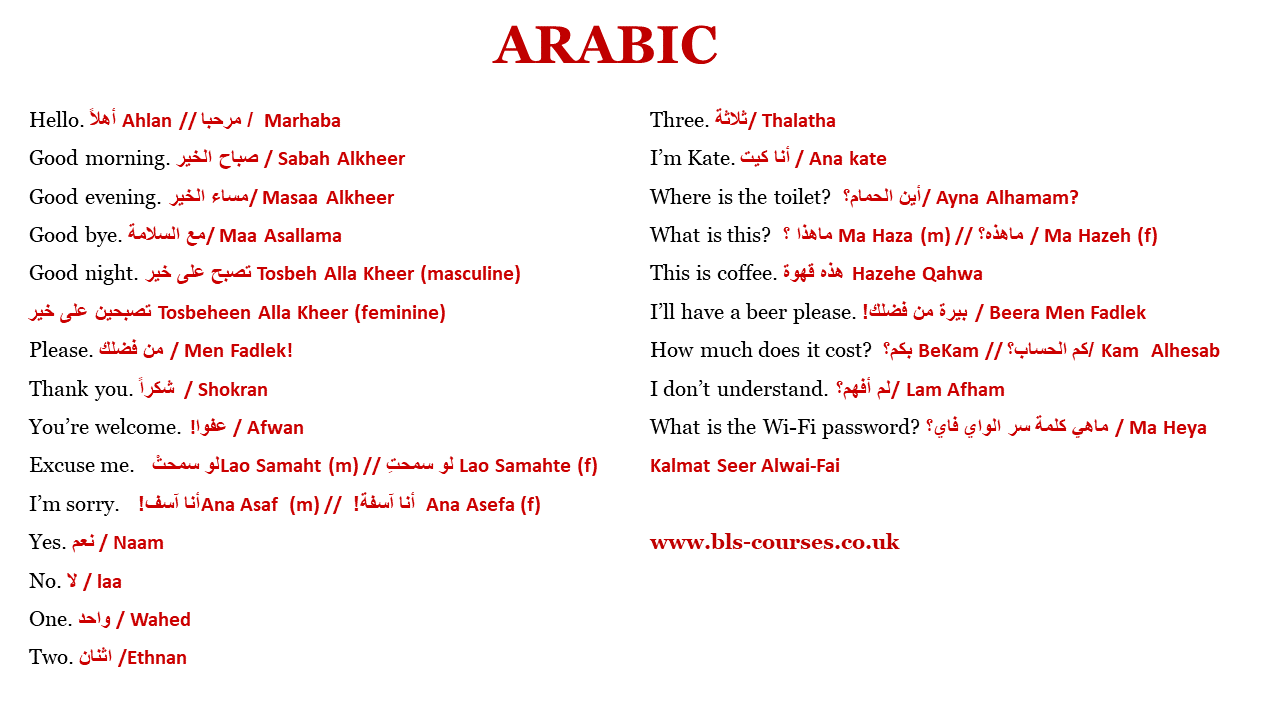
As you remember, we introduced a new series of blog posts (see Spanish, French, German, Russian, Italian, Portuguese & Mandarin Chinese) where we teach you some useful phrases in different languages. Sounds amazing? And it’s ARABIC today!

Are you planning your beach holiday in Monastir, Tunisia? Do you travel frequently to the United Arab Emirates or Saudi Arabia? Do you dream of exploring Morocco or Egypt? If so, we would like you to taste & learn some essential Arabic first. Below you’ll find a list of useful phrases in Arabic (greetings, polite phrases, closed question words, numerals and simple questions & sentences). We also video recorded Enas, our Arabic tutor, to help you with reading, pronunciation and accent (also available on YouTube). We hope you enjoy this series and that you’ll come and learn Arabic with us! Good luck!

Which language would like you like to learn next? Let us know in the comments below.

Kinga Macalla

July 11, 2018

Learning a Language: Learn Portuguese with BLS online & FREE!

As you remember, we introduced a new series of blog posts (see Spanish, French, German, Russian & Italian) where we teach you some useful phrases in different languages. Sounds amazing? And it’s PORTUGUESE today!

Are you planning your beach holiday in Ilha de Tavira? Do you travel frequently to Lisbon or Porto? Do you dream of exploring Azores or Madeira? If so, we would like you to taste & learn some essential Portuguese first. Below you’ll find a list of useful phrases in Portuguese (greetings, polite phrases, closed question words, numerals and simple questions & sentences). We also video recorded Patricia, our Portuguese tutor, to help you with reading, pronunciation and accent (also available on YouTube). We hope you enjoy this series and that you’ll come and learn Portuguese with us! Good luck!

Which language would like you like to learn next? Let us know in the comments below.

Kinga Macalla

July 4, 2018

Learning a Language: Learn Italian with BLS online & FREE!

As you remember, we introduced a new series of blog posts (see Spanish, French, German & Russian) where we teach you some useful phrases in different languages. Sounds amazing? And it’s ITALIAN today!

Are you planning your beach holiday in Positano? Do you travel frequently to Rome? Do you dream of exploring Sardinia or Sicily? If so, we would like you to taste & learn some essential Italian first. Below you’ll find a list of useful phrases in Italian (greetings, polite phrases, closed question words, numerals and simple questions & sentences). We also video recorded Marika, our Italian tutor, to help you with reading, pronunciation and accent (also available on YouTube). We hope you enjoy this series and that you’ll come and learn Italian with us! Good luck!

Which language would like you like to learn next? Let us know in the comments below.

Kinga Macalla

June 6, 2018

Learning a language: Where to find foreign-language film and TV

In several of our blog posts, we have promoted the benefits of watching films or TV programmes in the language you are learning as a way to help you practise listening and pick up new words and expressions.  It’s not always obvious where you can find film and TV in other languages, though, as in the UK there is not always the same access to foreign-language TV channels as there is in other countries – and if you want these channels you may have to pay a lot more.  This blog post gives you ideas of where you can find film and TV in other languages to help you practise without breaking the bank.

Online

Here is just a selection of what you can find online.  An internet search will reveal more options.

Netflix is a subscription service (around £10 per month, with the first month free) that provides streaming media and video-on-demand online.  It is an international service and lots of its original creations are in other languages.  It is also a great repository of foreign-language film and television programmes.  There are 42 titles in “French-Language Movies”, 15 Italian, 42 Spanish, 4 Polish, 42 German, 13 Russian, 42 Chinese, 15 Arabic and several Portuguese titles.  You can also change the audio of English programmes and add subtitles to help you follow the dialogue.

All 4, the on-demand channel from Channel 4 has a category called “World Drama”, which currently has 1 Czech title, 3 Danish titles, 9 Dutch-language, 12 French, 8 German, 2 Hebrew, 1 Icelandic, 1 Italian, 4 Norwegian, 2 Portuguese-language, 5 Spanish-language and 4 Swedish titles.  You need an account to access these programmes.

BBC iPlayer is an internet streaming, catch-up, television and radio service from the BBC. At the moment, there are Danish/Swedish, Dutch/French and Spanish programmes.  Most of these are available on BBC Four.  You must have an account and a TV Licence to access these programmes.

Arte is a public Franco-German TV network that promotes programming in the areas of culture and the arts and is free to view online.

On YouTube, you can find several full-length films with subtitles as their copyright period has ended.  Ask your tutor for recommendations.

MUBI is a film website that integrates a subscription video-on-demand service, a database, and an online magazine. It has been described as an “online cinematheque”.  You can search by language in its database and find classic films in a variety of languages.

On TV

Freeview lets you watch 70 TV channels and 15 HD channels with no monthly cost or contract, including Arte in some areas.  Which channels you can get depends on where you live.  You can search for the channels available in your area online.

BBC4 is where you will find most foreign-language films on BBC television.  You need a TV Licence to be able to watch it.

Film4 often shows foreign-language films and is free to watch but you must have a TV Licence to watch it.

In Bristol

Odeon Cinema Bristol often shows Polish films and sometimes other language films too, including Russian. They also do deals if you go with a group of friends.

Watershed is an independent cinema and digital creativity centre on Bristol’s historic harbourside. It shows foreign-language films almost every week and often does seasons of particular directors or themes, including films in other languages.

The Cube Microplex Cinema is a social art experiment existing in the shape of an autonomous, non-profit, collective, cinema and event venue.  It has affordable tickets to foreign-language films (£5 full price or £4 concessions).

The Orpheus Cinema occasionally has foreign-language films – have a look at the list of showings to see if there is anything coming up.

If you are not a fan of cinema-going or you are looking for something more affordable, your local library should have DVDs of foreign-language films that you can borrow for several weeks (and watch several times if you wish!).

Please let us know in the comments if you are aware of any other places in Bristol where you can watch foreign films!

Suzannah Young

April 4, 2018

It’s the way you say it… How to improve your pronunciation in a foreign language

Getting pronunciation right in the language you are learning helps you feel at home in that language.  It also helps you be understood by speakers of the language.  Below are a few tips on how to improve your pronunciation in a foreign language.

First things first

Learning a bit about phonetics will help you pronounce your new language better.  It is a good idea to learn (or keep a handy copy of) the international phonetic alphabet (IPA).  The IPA can be used to represent all the phonemes (the smallest possible units of sound) of human speech, so is a reliable guide to pronunciation.  Wikipedia has IPA charts for most languages.  Language textbooks also often have a pronunciation key at the beginning if the book and these are represented with the IPA (or sometimes with approximations in the reference language, e.g. the ‘j’ in Spanish is said to be like the ‘ch’ in the Scottish word ‘loch’. These are just approximations though and it is best to bear this in mind as they can be misleading.)

The spelling of many languages (not English!) represents the way they are spoken, so, if you are learning those languages, you know that when you read a letter or combination of letters, it will always be pronounced in the same way, e.g. ‘ui’ in Dutch (‘huis’ (‘house’), ‘tuin’ (‘garden’), ‘ui’/’ajuin’ (‘onion’)) will always sound the same, a bit like ‘oh’ in English (but not quite).

Communication is key

As we have been saying in many of these blog posts, you don’t have to do everything perfectly right from the beginning; what is important is making yourself understood.  This goes for pronunciation too.  Correct pronunciation does not necessarily mean having a flawless accent and sounding like a native speaker.  As long as you are following the right pronunciation rules and reproducing the sounds, you will be able to communicate.

Break it down

Break words down into vowel and consonant sounds, especially if there are ones that don’t exist in your own language, and say them separately, then together.  If you speak slowly at first, this will help you distinguish the sounds and pronounce similar-but-slightly-different words correctly (see minimal pairs) without getting them mixed up, such as ‘capello’ (‘hair’ (singular)) and ‘cappello’ (‘hat’) in Italian.

Get the mechanics right

Feel which part of your mouth (and sometimes nose) you are using when you try to pronounce each sound and, if you’re struggling, read pronunciation guides that tell you which part of your mouth you should be using (e.g. lips, teeth, throat) (or that tell you whether or not you should be using your nose, e.g. for the nasal sounds ‘en’, ‘an’, ‘un’, ‘in’ and ‘on’ in French).  Also read or observe where you should be putting your lips.  I will never forget my wonderment when I discovered that I could make a French ‘u’ sound by trying to say an English ‘e’ with my lips pursed!

Read aloud

Read everything you can get your hands on in your chosen language, and read it aloud.  This will help you get your teeth and tongue around the difficult words, as you can read the same passage again and again, fast or slow, broken down into chunks or single words, loud or soft, until it feels natural and flows.  You could read a play in this way to help you practise pronunciation with written sentences that mimic speech.  You can also try reciting poems and stories or singing songs.

Listen out for intonation

Languages have their own rhythms and stress patterns, a little like music.  Following these patterns will make you sound more like a native speaker.  Listen to the radio and watch films and television in your chosen language and pay attention to the intonation people use when speaking.  Repeat what you hear and try to match the stress patterns.  Ask a native speaker you know to help you; get them to pronounce words slowly for you to mimic and ask them to speed up the words and phrases as you get better at pronouncing them.  If you like, you can record yourself and compare the recording to native speech.  If you don’t know any native speakers, you can find a language partner online or through a local educational institution.

Immerse Yourself

Listen to your chosen language as often as you can.  Listen to it actively or passively but do it regularly.  Without you even realizing it, your accent will improve as you get more used to the sounds in the language.  This is similar to when children learn to speak: they are surrounded by the language and spend a long time listening before reproducing the sounds themselves.

Resources

There are some great online and mobile resources to help you practise pronunciation.  Two websites, Forvo and How to Pronounce are online pronunciation dictionaries.  You can search for any word and hear it pronounced by a native speaker.

Apps can also help you train your pronunciation. Duolingo judges your pronunciation on how close it is to the original, and allows you to play around until you get an authentic sound.  Listen & Speak also has this feature.  These two apps give you full sentences to pronounce, whereas the How to Pronounce app gives you single words or phrases.  It can slow down words to help you hear each part of the word you should be pronouncing.  Languages pronunciation is similar to this.

Have fun practising!

Suzannah Young