Tag Archive: Languages

July 4, 2018

Learning a Language: Learn Italian with BLS online & FREE!

As you remember, we introduced a new series of blog posts (see Spanish, French, German & Russian) where we teach you some useful phrases in different languages. Sounds amazing? And it’s ITALIAN today!

Are you planning your beach holiday in Positano? Do you travel frequently to Rome? Do you dream of exploring Sardinia or Sicily? If so, we would like you to taste & learn some essential Italian first. Below you’ll find a list of useful phrases in Italian (greetings, polite phrases, closed question words, numerals and simple questions & sentences). We also video recorded Marika, our Italian tutor, to help you with reading, pronunciation and accent (also available on YouTube). We hope you enjoy this series and that you’ll come and learn Italian with us! Good luck!

Which language would like you like to learn next? Let us know in the comments below.

Kinga Macalla

June 6, 2018

Learning a language: Where to find foreign-language film and TV

In several of our blog posts, we have promoted the benefits of watching films or TV programmes in the language you are learning as a way to help you practise listening and pick up new words and expressions.  It’s not always obvious where you can find film and TV in other languages, though, as in the UK there is not always the same access to foreign-language TV channels as there is in other countries – and if you want these channels you may have to pay a lot more.  This blog post gives you ideas of where you can find film and TV in other languages to help you practise without breaking the bank.

Online

Here is just a selection of what you can find online.  An internet search will reveal more options.

Netflix is a subscription service (around £10 per month, with the first month free) that provides streaming media and video-on-demand online.  It is an international service and lots of its original creations are in other languages.  It is also a great repository of foreign-language film and television programmes.  There are 42 titles in “French-Language Movies”, 15 Italian, 42 Spanish, 4 Polish, 42 German, 13 Russian, 42 Chinese, 15 Arabic and several Portuguese titles.  You can also change the audio of English programmes and add subtitles to help you follow the dialogue.

All 4, the on-demand channel from Channel 4 has a category called “World Drama”, which currently has 1 Czech title, 3 Danish titles, 9 Dutch-language, 12 French, 8 German, 2 Hebrew, 1 Icelandic, 1 Italian, 4 Norwegian, 2 Portuguese-language, 5 Spanish-language and 4 Swedish titles.  You need an account to access these programmes.

BBC iPlayer is an internet streaming, catch-up, television and radio service from the BBC. At the moment, there are Danish/Swedish, Dutch/French and Spanish programmes.  Most of these are available on BBC Four.  You must have an account and a TV Licence to access these programmes.

Arte is a public Franco-German TV network that promotes programming in the areas of culture and the arts and is free to view online.

On YouTube, you can find several full-length films with subtitles as their copyright period has ended.  Ask your tutor for recommendations.

MUBI is a film website that integrates a subscription video-on-demand service, a database, and an online magazine. It has been described as an “online cinematheque”.  You can search by language in its database and find classic films in a variety of languages.

On TV

Freeview lets you watch 70 TV channels and 15 HD channels with no monthly cost or contract, including Arte in some areas.  Which channels you can get depends on where you live.  You can search for the channels available in your area online.

BBC4 is where you will find most foreign-language films on BBC television.  You need a TV Licence to be able to watch it.

Film4 often shows foreign-language films and is free to watch but you must have a TV Licence to watch it.

In Bristol

Odeon Cinema Bristol often shows Polish films and sometimes other language films too, including Russian. They also do deals if you go with a group of friends.

Watershed is an independent cinema and digital creativity centre on Bristol’s historic harbourside. It shows foreign-language films almost every week and often does seasons of particular directors or themes, including films in other languages.

The Cube Microplex Cinema is a social art experiment existing in the shape of an autonomous, non-profit, collective, cinema and event venue.  It has affordable tickets to foreign-language films (£5 full price or £4 concessions).

The Orpheus Cinema occasionally has foreign-language films – have a look at the list of showings to see if there is anything coming up.

If you are not a fan of cinema-going or you are looking for something more affordable, your local library should have DVDs of foreign-language films that you can borrow for several weeks (and watch several times if you wish!).

Please let us know in the comments if you are aware of any other places in Bristol where you can watch foreign films!

Suzannah Young

May 30, 2018

A Summer Getaway With a Difference

The holidays are calling – it’s time to get away, or at least get booking, and dream of adventure.  For language learners, holidays can be a great time to practise what they have learned in term-time.  But have you ever thought of going on a holiday where language learning is the main event?  A language holiday, where you live and breathe your chosen language whilst having an amazing holiday.  These types of courses – language learning combined with another activity such as sports or cookery – are the fastest-growing trend in language learning.  You can learn a language from scratch or improve on your existing language whilst enjoying the local culture and landscapes.  In this blog post, we look at what you can expect from language holidays and give you a couple of ideas for holidays to try.  What better way to spend the summer months?

So, what’s it all about?

Language holidays are not just about being in a classroom, they give learners to experience the country and culture first hand.  On a language holiday, you have the opportunity to combine language learning in a formal setting with cultural or sporting activities and practise what you have learnt in the lessons in an authentic environment.  The idea is that you have lessons in the country of your choice and then use your newly-acquired skills with locals or your classmates after the class, not least because you will be surrounded by the language you are learning.  The lessons can be combined with activities so you can use your language skills and soak up a bit of culture, such as cookery lessons in Italian or a football masterclass in Brazilian Portuguese.  This way you also learn about the way of life and traditions in the place where you are staying.  You can even go for on full immersion holiday and stay with a family who will help you practise their language.

Why is it different?

Language holidays are not just about being in the classroom and they are not just about being on holiday – they are a unique opportunity to learn whilst having fun.  Doing fun activities, spending time with fellow language learners and visiting new places whilst learning at the same time makes language holidays a unique experience.  The holiday can have a theme, such as wine growing, working on a farm, cooking lessons, dance lessons, photography, yoga, football, opera singing, horse riding, DJ-ing, surfing – the list is endless.  This means that most people’s interests are covered and they can combine their interests with their desire to learn a language.

What’s good about language holidays?

Because you are surrounded by the language, putting it into practice and engaging with activities, you will find that you learn faster than you do going to lessons once a week.  Learning the language in the classroom combined with another activity outside the classroom help embed the knowledge you have gained.  Familiarising yourself with a country’s culture will also help your language learning as you are learning it in context.

Language holidays can be tailored to suit your learning style, your budget or your schedule.  You can choose the level you want, the location you want and the length of course you want; there are even one-week courses if you haven’t got much time off.  The school you book through can sometimes also offer accommodation – homestay with a family or in a student residence or shared flat, for example.  They may also be able to give advice on short-term lets if you prefer to look for your own accommodation.

Language holidays can – if you want them to – be like package holidays, where the school you attend arranges activities such as tours and sports contests.  You can also be independent and find a school and accommodation yourself – you are not obliged to take part in organised activities.  You will probably find that your fellow students also want to spend time doing their own activities that the school hasn’t arranged, like going to the pub or to the park or the museum, for example.

One advantage of learning abroad is that your fellow students may be from all over the world and speak all different languages, so this means you will have to use the language you are all learning to communicate – instant practice!  When all your fellow students speak the same language as you, the temptation to speak it is often too great to resist, whereas you will want to use the language you are learning on a language holiday so you can socialise and make friends.

Where can I find out more?

If you think all that sounds great and would like to have a look at what’s on offer, try these sites to start off with.  You can of course search for other holiday providers too or search for language schools and book independently.

Go Learn To has a wide selection of languages, destinations and activities, and they don’t just do language holidays.  Responsible Travel also offers tailored language holiday packages. Flavours offers Italian language holidays in Italy and Spanish Study Holidays offer Spanish language holidays in Europe and Latin America.

If you needs some more inspiration, The Guardian newspaper recommends a selection of providers for several different languages, including Arabic, Portuguese and Welsh ; The Independent looks at other possibilities.

What if I want more study time?

If you are looking for a more intensive course with set lesson times and access to study material, as well as the opportunity to take an exam and gain a qualification, you might prefer to sign up for a language course at a university abroad.  Their courses can be longer and you can choose what time of year to go and what level to study.  Sometimes sector-specific lessons are available, such as Italian for Medicine at Milan University.  There can also be lessons on culture.  If you would like to, you can study the language before the academic year starts and then study for a degree in that language at the same university.  Here is a selection of what is available: you can learn Spanish in Barcelona, Oviedo, Salamanca or elsewhere; you can learn Italian in Milan, Pavia, Siena, Turin; French in Bordeaux, Nancy; German in Berlin, Bonn, Graz, Vienna; Polish in Gdansk, Warsaw – the list is endless!

What if I want to stay at home?

If you have commitments that mean you need to stay in Bristol, or you are looking for something more affordable, look no further than Bristol Language School: we offer summer courses in many different languages in August and in September (twice a week).

Bon voyage!      Prettige reis!     Buon viaggio!    Buen viaje!        Gute Reise!       Miłej podróży!            Boa viagem!                ! رحلة سعيدة      一路順風 !       Šťastnou cestu!          Счастливого пути !

Suzannah Young

May 23, 2018

On teaching: How to improve the language learning experience using the flipped learning model

Don’t bother just to be better than your contemporaries or predecessors. Try to be better than yourself. William Faulkner

In the post-method era, the role of language teachers changed, as did the learners’, who do not receive their knowledge passively, but are instead expected to actively participate in learning. There are many pedagogical innovations that support this notion of student-centred teaching, one of which is flipped learning. The flipped learning method can improve the foreign language learning experience of adult language learners and, in turn, equip students with the right skills to become life-long learners.

Flipped learning means that students are first exposed to material outside of class in the form of homework and then use class time to utilise this in a meaningful way using different forms such as group activities and project-based language learning. In flipped learning approach, students are expected to be active and responsible learners who take care over their home study before becoming actively involved in the lesson by asking questions, critiquing ideas, analysing concepts, giving presentations and taking part in debates. For teachers, the idea of flipped classes is based on designing active, hands-on, creative activities for in-class learning and for students to prepare for such activities at home by reading articles, watching videos or analysing info-graph instructions.

When implementing the flipped learning model and consequently the culture of life-long learning, we may also increase the mastery of our students in the intended subject matter. In his TED talk Let’s teach for mastery – not test scores, Salman Khan, accidental founder of the Khan Academy; an educational site regularly visited by seven million people, presents teaching from a different perspective, in which we as teachers help students to achieve mastery and guide them to develop the right mindset muscle and perseverance. We can achieve this through various factors which are part of flipped learning, for example, individual feedback and support from the teachers, specifically designed activities and the adaptable pace of the lessons. Here, the aim is not to get a good mark, but to truly and authentically learn the subject matter and deeply and meaningfully engage with the topic.

You can learn more about flipped learning, e.g. here.

Have you ever heard about flipped learning? What do you think about this approach? Please let me know in the comments below.

Kinga Macalla

May 2, 2018

Translation tips: How to improve your own translation

As well as language lessons, BLS offers a translation service.  We also encourage our students who are interested in translation as a career to have a go at it.  In this blog post, Suzannah, one of our translators, shares tips from her experience on how to translate texts effectively.  Suzannah translates into English from French, Italian, Dutch and Spanish and has been working as a freelance translator since 2015.  She has a DipTrans IoLET and is currently studying public service interpreting too.  We hope her tips will help our readers who want to try their hand at translation to find their feet and improve as translators.  Please let us know what you think and if you have any other tips you would like to share!

Know Your Text Type

When you study translation, you are advised to read any text you have received all the way through before translating it.  This can be useful when you are starting out because it gives you a feel for the types of texts you will be translating but becomes impractical when you are working as a translator and have deadlines to meet – imagine reading a whole report or even a whole book, cover to cover, before you start to translate it.  You just wouldn’t have time.  You would also be itching to translate what you are reading and most likely won’t be able to resist the urge to do so before reaching the end.  Some jobs also require a sight translation to be done so you would definitely not have the opportunity to read all the way to the end without starting the translation in those cases.

Don’t worry though, because there are ways to prepare yourself for translating a text even without knowing its full content before you begin.  For example, clients asking you to do a translation for them may tell you the field the text covers in the translation brief they send you – or, failing that, you can usually tell what field you are dealing with by casting your eye over the first few lines of the text.  You will also likely know the type of publication that the text was published in and which the translation is going to be published.  These hints will alert you to the type of vocabulary, register, style and format that you will need to use in your translation.

Keep Glossaries

If you translate similar texts regularly (or even if you don’t), it is likely that you will come across the same words or turns of phrase with some frequency.  It is helpful to keep a record of how you have translated a particular word or expression previously so that you can remind yourself if you come across that word or phrase again (especially helpful when you find the perfect translation for a term or phrase you were stuck on before).  You will find that your lists will improve over time as you will have more time to think about a particular translation and come up with alternatives.  You can also keep glossaries of terms used in certain fields that you can prepare in your spare time between translations and go to them when you need that vocabulary.

Use the Internet

An internet search engine is an extremely useful tool for the translator.  If you are unsure of the translation of a term, you can look it up in online dictionaries that may also have example translations from existing texts where the term features.  You can also search your chosen translation to check if the way you have written it is correct (good for idiomatic expressions and cultural references).  You can even find whole texts written in the field you are translating in so you can check the types of vocabulary used – and, if you are lucky, you may find an existing bilingual glossary for that field.

Come Back to It

If you cannot decide which of a variety of possible translations you want to use, put them all down and then make the decision when you are rereading your translation – go with the one that works best in the target language.  If you are unsure of a translation, but don’t want to interrupt your flow, mark the unknown word and come back to it later.  When you have finished, go back to the beginning – you should always read through your translation to make sure it flows and reads well as a coherent text in the target language.

Get Plenty of Practice

As with all things, practice makes perfect – so the more texts of different types you translate, the better you will become.  You don’t have to wait to be asked to do a translation – you can practise for fun as well.  Experiment with different fields.  If you can, also read other people’s translations to get an idea of how they translate certain things.

Read Widely

Read all kinds of texts – whatever you can get your hands on – in your source language(s) (the language(s) you are translating from) and your target language(s) (the language(s) you are translating into).  You need to have a good understanding of source texts in all different genres but you also need to have a very good grasp of the target language and write well and accurately in it.

Enjoy What You Do

The best way to get better at something is to enjoy doing it – so, if you love translation, keep doing it because you clearly have a flair for it and will be interested enough to keep improving.  Have fun!

Suzannah Young

April 4, 2018

It’s the way you say it… How to improve your pronunciation in a foreign language

Getting pronunciation right in the language you are learning helps you feel at home in that language.  It also helps you be understood by speakers of the language.  Below are a few tips on how to improve your pronunciation in a foreign language.

First things first

Learning a bit about phonetics will help you pronounce your new language better.  It is a good idea to learn (or keep a handy copy of) the international phonetic alphabet (IPA).  The IPA can be used to represent all the phonemes (the smallest possible units of sound) of human speech, so is a reliable guide to pronunciation.  Wikipedia has IPA charts for most languages.  Language textbooks also often have a pronunciation key at the beginning if the book and these are represented with the IPA (or sometimes with approximations in the reference language, e.g. the ‘j’ in Spanish is said to be like the ‘ch’ in the Scottish word ‘loch’. These are just approximations though and it is best to bear this in mind as they can be misleading.)

The spelling of many languages (not English!) represents the way they are spoken, so, if you are learning those languages, you know that when you read a letter or combination of letters, it will always be pronounced in the same way, e.g. ‘ui’ in Dutch (‘huis’ (‘house’), ‘tuin’ (‘garden’), ‘ui’/’ajuin’ (‘onion’)) will always sound the same, a bit like ‘oh’ in English (but not quite).

Communication is key

As we have been saying in many of these blog posts, you don’t have to do everything perfectly right from the beginning; what is important is making yourself understood.  This goes for pronunciation too.  Correct pronunciation does not necessarily mean having a flawless accent and sounding like a native speaker.  As long as you are following the right pronunciation rules and reproducing the sounds, you will be able to communicate.

Break it down

Break words down into vowel and consonant sounds, especially if there are ones that don’t exist in your own language, and say them separately, then together.  If you speak slowly at first, this will help you distinguish the sounds and pronounce similar-but-slightly-different words correctly (see minimal pairs) without getting them mixed up, such as ‘capello’ (‘hair’ (singular)) and ‘cappello’ (‘hat’) in Italian.

Get the mechanics right

Feel which part of your mouth (and sometimes nose) you are using when you try to pronounce each sound and, if you’re struggling, read pronunciation guides that tell you which part of your mouth you should be using (e.g. lips, teeth, throat) (or that tell you whether or not you should be using your nose, e.g. for the nasal sounds ‘en’, ‘an’, ‘un’, ‘in’ and ‘on’ in French).  Also read or observe where you should be putting your lips.  I will never forget my wonderment when I discovered that I could make a French ‘u’ sound by trying to say an English ‘e’ with my lips pursed!

Read aloud

Read everything you can get your hands on in your chosen language, and read it aloud.  This will help you get your teeth and tongue around the difficult words, as you can read the same passage again and again, fast or slow, broken down into chunks or single words, loud or soft, until it feels natural and flows.  You could read a play in this way to help you practise pronunciation with written sentences that mimic speech.  You can also try reciting poems and stories or singing songs.

Listen out for intonation

Languages have their own rhythms and stress patterns, a little like music.  Following these patterns will make you sound more like a native speaker.  Listen to the radio and watch films and television in your chosen language and pay attention to the intonation people use when speaking.  Repeat what you hear and try to match the stress patterns.  Ask a native speaker you know to help you; get them to pronounce words slowly for you to mimic and ask them to speed up the words and phrases as you get better at pronouncing them.  If you like, you can record yourself and compare the recording to native speech.  If you don’t know any native speakers, you can find a language partner online or through a local educational institution.

Immerse Yourself

Listen to your chosen language as often as you can.  Listen to it actively or passively but do it regularly.  Without you even realizing it, your accent will improve as you get more used to the sounds in the language.  This is similar to when children learn to speak: they are surrounded by the language and spend a long time listening before reproducing the sounds themselves.

Resources

There are some great online and mobile resources to help you practise pronunciation.  Two websites, Forvo and How to Pronounce are online pronunciation dictionaries.  You can search for any word and hear it pronounced by a native speaker.

Apps can also help you train your pronunciation. Duolingo judges your pronunciation on how close it is to the original, and allows you to play around until you get an authentic sound.  Listen & Speak also has this feature.  These two apps give you full sentences to pronounce, whereas the How to Pronounce app gives you single words or phrases.  It can slow down words to help you hear each part of the word you should be pronouncing.  Languages pronunciation is similar to this.

Have fun practising!

Suzannah Young

March 7, 2018

Learning a Language: Learn Russian with BLS online & FREE!

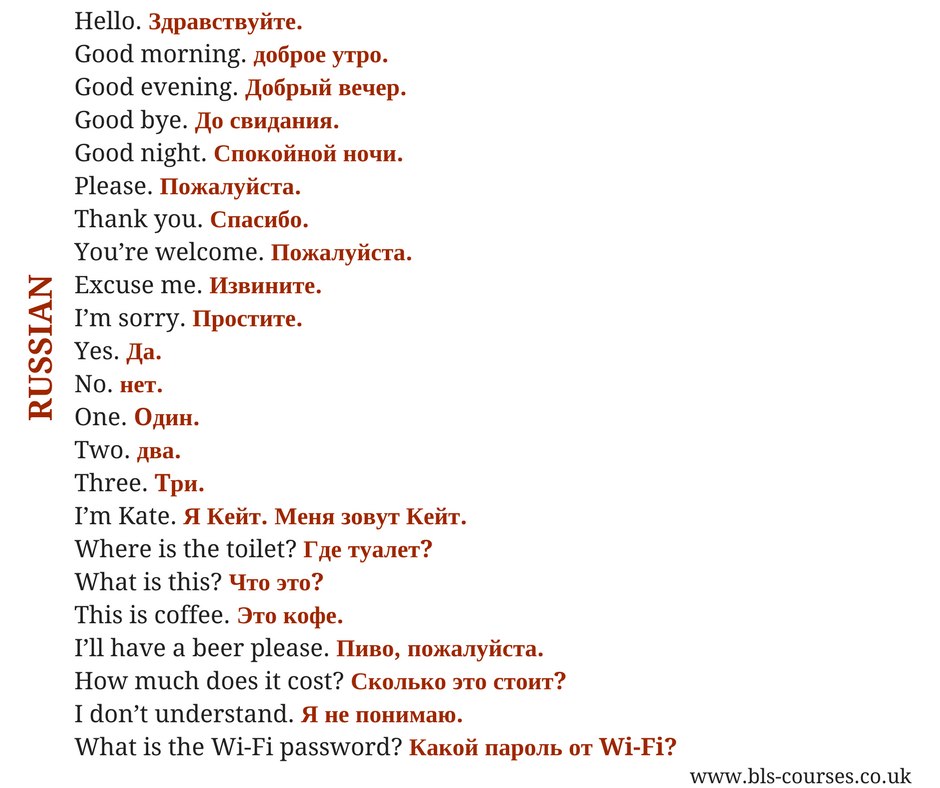
As you remember, we introduced a new series of blog posts (see Spanish, French & German) where we teach you some useful phrases in different languages. Sounds amazing? And it’s RUSSIAN today!

Are you planning your ski holiday in Sochi? Do you travel frequently to St Petersburg? Do you dream of exploring Russian-speaking Ukraine or Georgia? If so, we would like you to taste & learn some essential Russian first. Below you’ll find a list of useful phrases in Russian (greetings, polite phrases, closed question words, numerals and simple questions & sentences). We also video recorded Anna, our Russian tutor, to help you with reading, pronunciation and accent (also available on YouTube). We hope you enjoy this series and that you’ll come and learn Russian with us! Good luck!

Which language would like you like to learn next? Let us know in the comments below.

Kinga Macalla

December 6, 2017

Beauty and Style: Facts about the Arabic Language and How to Learn It

Arabic is one of the five most spoken languages in the world.  It is spoken by around 422 million people and is the native language of over 200 million people in the geographical region stretching from Southwest Asia to Northwest Africa, also known as the Arab World.  Arabic is the official language of the 22 countries of the Arab League and it is the language of prayer of 1.7 billion Muslims, as it is the language in which the Qur’an القرآن, the Holy Book of Islam, was revealed.  It is also one of the six official languages of the United Nations.  In the UK, one per cent of the adult population can hold a basic conversation in Arabic.

Arabic has influenced many languages throughout its history.  During the Middle Ages, Literary Arabic was a major vehicle of culture in Europe, especially in science, mathematics and philosophy.  As a result, many European languages have also borrowed words from it, mainly Portuguese and Spanish (approximately 4000 words).  English too has words borrowed from Arabic, typically words starting with “al” (“the”) such as “alchemy”, “algorithm”, “algebra”, “alcohol”, “algebra”, “alkaline”.  The Arabic numerals (0,1,2,3, etc.) are also used all over the world now.  Arabic has also borrowed words from other languages including Greek and Persian in medieval times, and contemporary European languages such as English and French in modern times.

Basic features of Arabic

Arabic has different forms depending on the context in which it’s used.  The “formal” Arabic language, known as الفصحى, Fus-ha (elegant or clear language), Classical Arabic and sometimes Literary Arabic or Qur’anic Arabic is the language in which the Qur’an is written and is the base of Arabic grammar rules. It is the recognized language of literacy across the Arabic speaking world.

Modern Standard Arabic, or MSA, is derived from the language of the Qur’an but is easier than Classical Arabic. It’s understood across the Arab world and used by the media, government, in works of modern Arabic literature and in the workplace.  It is taught in schools and universities and is used to teach Arabic as a foreign language. Modern Standard Arabic largely follows the grammatical standards of Qur’anic Arabic and uses a lot of the same vocabulary.  However, some grammatical constructions and vocabulary that no longer exist the spoken varieties are no longer used.

Arabic developed through an oral and poetic tradition that flourished in the Arabian Peninsula before the emergence of Islam and a codified Arabic script.  “Spoken” Arabic, ‘Aamiya, has many forms and varies from country to country, even town to town. While roughly four major regional dialects of Arabic are spoken in the Arab world, many different variants can even be found within one country. The four regional dialects are: Maghreb Arabic (North Africa), Egyptian Arabic (Egypt and the Sudan), Levantine Arabic (Lebanon, Syria, Jordan and Palestine/Palestinians in Israel), and Iraqi/Gulf Arabic.  These dialects are so different from one another that speakers of different varieties may not be able to understand each other.  They will be able to communicate in Modern Standard Arabic instead.

How the language works

The Arabic Alphabet

Arabic is written from right to left, in cursive (joined-up) script.  Sometimes, especially with the advent of computers and mobile telephony, its spoken varieties are written using the Latin alphabet and from left-to-right, using non-standard spelling.  There are 18 distinct letter shapes in the Arabic alphabet.  The shapes vary slightly depending on whether they are connected to another letter before or after them.  There are no capital letters.  The full alphabet of 28 letters is created by placing various combinations of dots above or below some of these shapes.  A single dot, added by mistake, can make a certain word mean something completely different – so be careful!  The Arabic language uses the same punctuation marks and rules as English, but some of the symbols are inverted, such as the comma (،), or reversed, like the question mark (؟).

Calligraphy

After Khalil ibn Ahmad al Farahidi set down the Arabic script around 786, many styles were developed, both for writing down the Qur’an and other books, and for inscriptions on monuments as decoration.  There are several styles of script, such as naskh, which is used in print and by computers, and ruq’ah, which is commonly used in handwriting.  Arabic calligraphy is still considered a major art form. Its composition is often abstract, but sometimes the writing is made into a shape such as an animal.

Numerals

In most of North Africa, the Western Arabic numerals (0, 1, 2, 3, 4, 5, 6, 7, 8, 9) are used.  However, in Egypt and countries to the east of it, the Eastern Arabic numerals (٠‎ – ١‎ – ٢‎ – ٣‎ – ٤‎ – ٥‎ – ٦‎ – ٧‎ – ٨‎ – ٩‎) are used.  When writing a number in Arabic, you would place the lowest-value numeral on the right, so the order of positions is the same as in left-to-right scripts. Sequences such as phone numbers are read from left to right, but numbers are said with units first and then tens, for example, “24” is said “four and twenty”.

Pronunciation

Arabic has 28 consonants (including two semi-vowels) and three vowels – a,  i, u – which can be short or long.  Some sounds don’t exist in English like the glottal stop, usually transliterated by (‘) like in the word ‘elm (science), “ح” , which is a “h” sound as in “hubb” (“love”), the consonants (“q”) and “gh”) produced far back in the mouth in English like in “qalam” (“pen”), and “loghah” (language). (“kh”) which sounds like the Scottish “ch” (as in “Loch Ness”).

Grammar

Arabic constructs words from a basic root of (usually) three letters, based on a semantic field. For example, words with the “k-t-b” root will always be the base of words that have the semantic field of “writing”, such as “kitāb”, “a book”, “maktab”, “a desk or office”, “katabtu”, “I wrote”.[1]  Words in Arabic dictionaries are normally listed under their three-letter roots. So, you would look for “istiqbāl” (“reception”) under “q” because the root letters are q-b-l. Getting used to this takes a little practice but it is not particularly difficult because additions to the roots follow set patterns. It becomes easier to memorise vocabulary once you understand the concept behind a particular root. Knowing a root unlocks the door to knowing the various words derived from it.

In Arabic word order, the verb comes first.  To say, “the boy eats the apple” you should say “eat the boy the apple”: اكل الولد التفاحة [akala al walado attofaha].

Nouns in Literary Arabic have three grammatical cases (nominative, accusative, and genitive); three numbers (singular, dual and plural); two genders (masculine and feminine); and three “states” (indefinite, definite, and construct).  Adjectives come after the noun, rather than before as in English: السيارة الحمراء [assayara alhamra”a], “the red car”, literally “the car red”.

Can I learn Arabic?

Arabic is like any other language, easy in some aspects and hard in some others. A person whose mother tongue is a language like, say, Hebrew will find it easier than a person whose mother tongue is English, because of the similarities between the two languages.

If you speak English, you will find that you already know some Arabic words.  Arabic has contributed numerous words to the English language like قطن [koton], “cotton”, سكر [succar], “sugar”, غزال [ghazal], “gazelle”, قيثارة [qithara], “guitar”, الكحول [alcoo’hool], alcohol, صحراء [sahra’a], “sahara”, قيراط [qeerat], “carat”, and ليمون [laymoon], “lemon”, قهوة [qahua], “coffee”, ترسانة [tirsana] “arsenal”, غول [ghawl] “ghoul”, خطر [khatar] “hazard”, لاعب اللو [laeib allaw] “loofah”, مخزن [makhzin] “magazine”, شربات [sharabat] “sherbet”, تعريفة [taerifa] “tariff”, صفر [sifr] “zero”.

These four lessons give an idea of what is involved in learning to read and write Arabic: Lesson One ; Lesson Two ; Lesson Three ; Lesson Four .

Where can I learn Arabic?

You can learn Arabic at Bristol Language School.  We offer one-to-one and group lessons at all levels.

You can also get more information on learning Arabic and links to resources/a bibliography on the Al Bab (The Door) website.  For more about reading and writing Arabic, see: Learning the alphabet.  This animated version of the alphabet also shows how to move the pen when writing the letters.

There is also quite a bit of information on the BBC website, including key phrases and the Arabic alphabet, as well as some videos to help you learn.  The BBC World Service is also available in Arabic so you can use it to practise.  If it’s the basics you’re looking for, check out this key word resource and this free online Arabic dictionary.

Written by Suzannah Young

[1] More examples: kattabtu “I had (something) written”; kātabtu “I corresponded (with someone)””; aktabtu “I dictated”; iktatabtu “I subscribed”; takātabnā “we corresponded with each other”; aktubu “I write”; ukattibu “I have (something) written”; ukātibu “I correspond (with someone)”; uktibu “I dictate”; aktatibu “I subscribe”; natakātabu “we correspond each other”; kutiba “it was written”; uktiba “it was dictated””; maktūb “written”; muktab “dictated”; kutub “books”; kātib “writer”; kuttāb “writers”; maktabah “library, bookshop”.
November 8, 2017

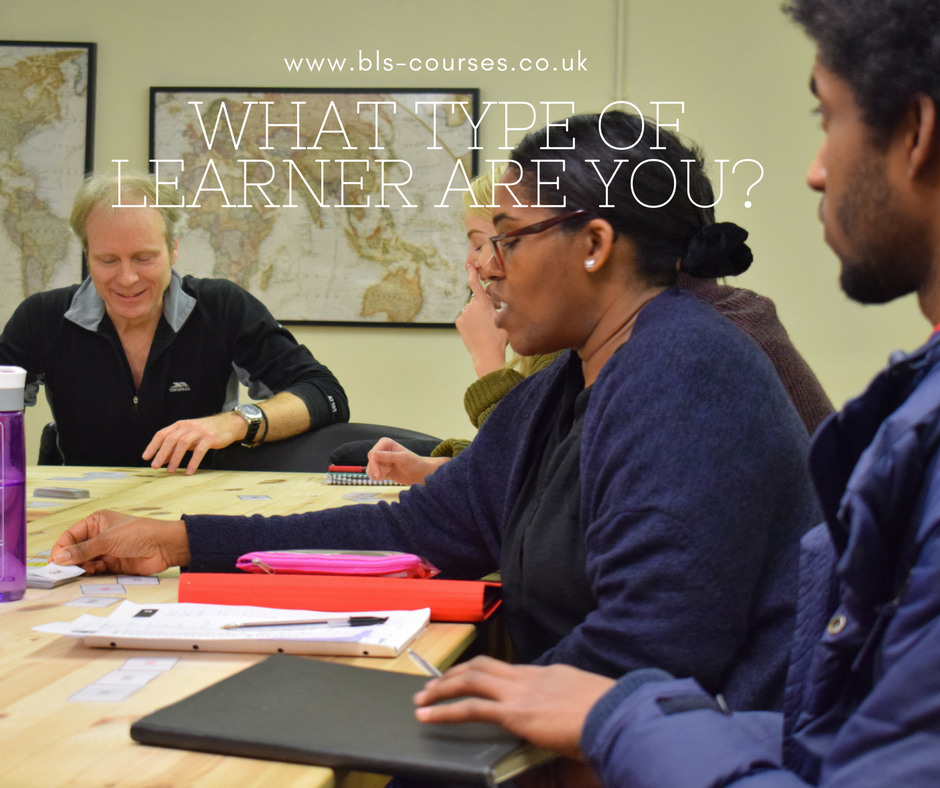
Language learning–pleasant and fun? Yes, absolutely, if you know what type of learner you are!

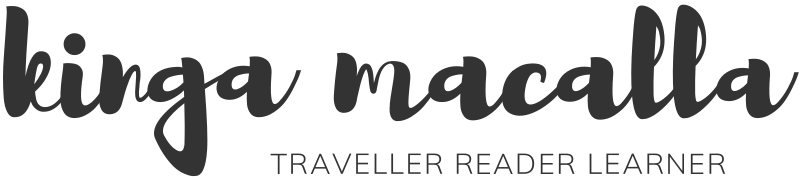
Everyone can learn a new skill, and everyone can learn a new language – but did you know that different people learn in different ways?  Not all people’s learning techniques are the same.  The type of learner you are depends on how your brain is wired.  The categories of learner are: visual learner, auditory learner, kinaesthetic learner.  A visual learner learns best if they see something written down or represented visually; an auditory learner retains information best if they hear it and a kinaesthetic learner (from ‘kinaesthesia’: the awareness of the position and movement of the parts of the body by means of sensory organs in the muscles and joints) is a hands-on learner or someone who learns through manual tasks or movement.  You might already know what kind of learner you are or you might recognise yourself in one (or more) of the learner profiles as we explore how to harness them in order to learn languages below.

Visual Learners

If you are a visual learner, you will remember things best if you have seen them represented visually.  There are a number of ways you could make use of this concept in order to learn a language.  If you are listening to a text you could write out the words or read the transcription so you see the words as they are read out.  You could draw a spider diagram of related words, e.g. with ‘dairy’ in the middle and ‘cheese’, ‘eggs’, ‘milk’ stemming off from the middle.  You could draw a table and put different categories of words (nouns, verbs, adjectives) in the different columns.  You could write out words in different colours so the image of them sticks in your mind.  You could use flash cards to learn and remember vocabulary – writing them out yourself or buying a set in a bookshop – or finding them or creating them online.  You could even draw pictures to represent words – concrete ones like a picture of a lemon to help you remember ‘lemon’ or an abstract picture such as those artists use to represent untranslatable words (you can also use them for words that have literal translations!).  You could also do this in the opposite way – creating images out of words that relate to their meanings, such as these.

Auditory Learners

If you are an auditory learner, you need to hear something in order to learn it.  You will learn a language best if you listen to it or speak it regularly.  You could listen to songs in your chosen language or listen to the radio or audio books.  Make a playlist of your favourite songs in your chosen language.  You could practise pronouncing words or read books aloud to make sure you hear the words as you read them.  You could join a conversation club, look for a language partner in your town or online or join a choir that sings songs in your chosen language.  You could watch films in order to practise your listening skills.  If you need to learn vocabulary, record yourself reading out the words and listen to the recording several times a week.  If you need to learn the spellings of words, sound out each letter and then read out the word as a whole.  If you have exercises to complete in a book, read them out as you fill them in.

Kinaesthetic Learners

If you are a kinaesthetic learner, you will learn things best if you use your hands to help you learn them or if you undertake a learning task whilst moving around.  A useful way of learning verb endings for a kinaesthetic learner could be to write them on building blocks and then work at piecing the words together to make different tenses of the same verb.  You could get a set of words or phonemes to stick on your fridge and have fun writing sentences or whole stories with them.  If you want to move your whole body and not just your hands, you could listen to an audio book in your chosen language whilst you are going for a run or working out at the gym.  Or you could join a drama group in your chosen language – speaking the words whilst acting a part will help you combine the words with their associated actions.

All-rounder

Of course, some people have more than one learning style or learn best when two or even three of these styles are combined.  If you think this might be you, don’t hesitate to give it a go.

Why not find out, and share what kind of learner you are – and your experiences of language learning – in the comments?

Written by Suzannah Young

October 4, 2017

On Languages: Japanese

Japanese (日本語 [nihõŋɡo]) is the ninth most widely spoken language in the world.  It is the official language of Japan, which has a population of over 125 million people.  There are also around 2.5 million people of Japanese origin, many of whom speak Japanese as their first language, living in the Americas, particularly Brazil and the United States (Hawaii).  There is also an expatriate presence in major cities such as London, New York and Paris.  Japan is one of the world’s leading industrial powers and Japanese language services have become extremely important in social and business settings.

Much about the roots of the Japanese language is unclear.  There are debates about which other languages Japanese is related to and it only seems certain that it is a member of the Japonic language family, which includes the Japanese language spoken on the main islands of Japan and the Ryukyuan languages spoken in the Ryukyu Islands.  Little is known of the language’s prehistory, or when it first appeared in Japan. Chinese documents from the 3rd century recorded a few Japanese words, but longer texts did not appear until the 8th century.  Old Japanese vocabulary was influenced by Chinese.  Late Middle Japanese (1185–1600) saw changes brought it closer to the modern language, as well as the first appearance of European loanwords.  Portuguese, Dutch and Spanish words, such as “pan” (bread) and “igirisu” (the UK), from the Portuguese “po” and “ingles” arrived during the 16th and 17th centuries, when missionaries and merchants started to visit the country.  Following the end in 1853 of Japan’s self-imposed isolation, the flow of loanwords from European languages increased, especially English loanwords. These include “teburu” (table), “biru” (beer), “gurasu” (glass), “aisu” (ice), “takushi” (taxi) and “hoteru” (hotel).

How Japanese works

Word order in Japanese is normally subject–object–verb.  Sentence structure starts with the topic and then gives a comment about the topic.  It uses particles (small words) to mark the grammatical function of words, such as ‘wa’ (topic marker), ‘ga’ (new information).  This means they function like cases in other languages.  For example, これは本です。(‘kore wa hon desu’) = ‘This is a book’.  A longer example is 私はブリストル に 住んでいます (‘Watashi wa Bristol (Burisutoru) ni sundeimasu’).  A literal translation into English would be ‘I (topic) Bristol (in) reside’).  Thus Japanese, like many other Asian languages, is often called a topic-prominent language, which means it has a strong tendency to indicate the topic separately from the subject, and that the two do not always coincide. The sentence Zō wa hana ga nagai (象は鼻が長い) literally means, “As for elephant(s), (the) nose(s) (is/are) long”. The topic is zō “elephant”, and the subject is hana “nose”.

Particles are used at the end of sentences to add impact (‘ne’), or make questions (‘ka’) as well.  Questions can have the same structure as statements, but with intonation rising at the end.  In the formal register, the question particle -ka is added. For example, ii desu (いいです) “It is OK” becomes ii desu-ka (いいですか。) “Is it OK?”.

Nouns do not change with number or gender, and there are no articles (‘the’ or ‘a/an’).  Verbs do change with the tense, of which there are two: past and present (or non-past), which is used for the present and the future.  For verbs that represent an ongoing process, the -te iru form indicates a continuous (or progressive) aspect, similar to the suffix ing in English.  Verb conjugations are also used for voice (active or passive), but not the person the verb is are referring to.

Japanese has a grammatical system to express politeness and formality. Broadly speaking, there are three main politeness levels in spoken Japanese: the plain form (“kudaketa”), the simple polite form (“teinei”) and the advanced polite form (“keigo”).  It also has a system of honorific language, where verbs and vocabulary change to indicate the relative status of the speaker, listener and persons mentioned.  Their status is determined by a variety of factors including job and age.  The person in the lower position is expected to use a polite form of speech, whereas the other might use a more plain form.  Japanese people often use titles of the person referred to where pronouns would be used in English. For example, when speaking to one’s teacher, it is appropriate to use sensei (先生, teacher), but inappropriate to use ‘anata’ (‘you’). This is because ‘anata’ is used to refer to people of equal or lower status, and one’s teacher has higher status.  Strangers in Japan will speak to each other politely.  Most nouns in the Japanese language may be made polite by the addition of o- or go- as a prefix. o- is generally used for words of native Japanese origin, whereas go- is affixed to words of Chinese derivation. In some cases, the prefix has become a fixed part of the word, and is included even in regular speech, such as gohan ‘cooked rice; meal.’ Such a construction often indicates deference to either the item’s owner or to the object itself.  Even if you don’t have the language skills, a softening of the voice, a discreet awareness of the other person’s personal space and undemonstrative body language go a long way when it comes to courtesy and showing respect.  Read more about honorific speech here.

Writing Japanese

The Japanese writing system has three different sets of character: Kanji (several thousand Chinese characters) and Hiragana and Katakana (syllabaries with 46 characters each).  The adaptation of Chinese characters during the sixth to ninth centuries A.D. developed the language. By the 12th century, hiragana and katakana were created out of kanji, providing the Japanese new freedom in writing their native language.  Today, Japanese is written with a mixture of the three.  Hiragana are used for words without kanji representation, for words no longer written in kanji, and also following kanji to show conjugational endings.  Katakana, like hiragana, are a syllabary; katakana are primarily used to write foreign words, plant and animal names, and for emphasis. For example, “Australia” has been adapted as Ōsutoraria (オーストラリア), and “supermarket” has been adapted and shortened into sūpā (スーパー).  Japanese texts can be written in horizontal rows left to right, or in traditional Japanese style, i.e. in vertical columns from the right to the left side of the page.

Can I learn Japanese?

Japanese is considered a difficult language to learn for speakers of European languages.  Some difficulties are learning to master the Japanese writing system.  Unless you are already familiar with Chinese characters (kanji), many years of study are necessary to achieve complete literacy.  Japanese students learn about 2000 kanji until the end of junior high school and continue to learn more until the end of their school careers. The two syllabaries Hiragana and Katakana (together about 100 signs), however, can be memorized quickly time.  Another difficulty can be the existence of honorific speech: the fact that a person’s speech can vary depending on the situation and the person. A student of Japanese has to become familiar with Japanese society and customs in order to understand the detailed rules of the different levels of speech.

However, compared to many European languages, basic Japanese grammar is relatively simple. There are not the complicating factors of gender articles and plurals, and conjugation rules for verbs and adjectives are almost entirely free of exceptions.  Nouns are not declined at all, but always appear in the same form.  This makes the language relatively easy for students starting out.

You may also have a head start when learning Japanese because it has a lot of foreign loan words, especially from English.  (外来語 [gairaigo] – ‘words from outside’ are not limited to nouns, they can be adjectives too.  The word for ‘TV’ is テレビ [terebi], サンドイッチ [sandoitchi] is ‘sandwich’, ‘bread’ is パン [pan] from the Portuguese word ‘pão’ and part-time worker is アルバイト [arubaito], from the German ‘Arbeit’, work.  You have probably heard a lot of Japanese words aleady too.  A lot of Japanese words have been absorbed into English.  See how many of these words you recognise (many thanks to An Idiot Lost in Japan for these!):

Origami

Sake

Karaoke

Sumo

Tsunami

Sushi

Haiku

Sashimi

Teriyaki

Anime

Manga

Kimono

Samurai

Ninja

Bonsai

Wasabi

Shogun

Karate

Judo

Sensei

Zen

Geisha

Emoji

Koi

Sudoku

Futon

Nintendo

Where can I learn Japanese?

You can learn Japanese at Bristol Language School.  We offer group and one-to-one lessons at all levels.

There is also a lot of information about learning Japanese on the Bristol Japan Club website.  There are also teaching and learning resources on the Japan Foundation website.  This kanji dictionary with sound can help you learn to recognise and write Japanese characters.  If you want to listen to Japanese, you can try these Japanese podcast lessons from the Japan Broadcasting Corporation, NHK.  To practice reading, you can go to asahi.com, one of Japan’s leading newspapers.

You can also find out where to buy books for learning Japanese here.  You can find websites to help you with learning Japanese and other Online Resources here.  Nihongo o Narau – Learn Japanese is a free online Japanese course.  Digital Dialects’ Japanese Games are interactive games for learning the Japanese language.  There are also Mobile Apps for iPhone, iPad, Android phones and tablets.  If you want to learn for travel, use this guide to Japanese Phrases for Travellers, with a pronunciation guide.  Plus, this Glossary for Learners is a quick reference guide to the essential elements of Japanese.

In the United Kingdom, study of the Japanese language is supported by the British Association for Japanese Studies.  The Japanese government provides standardized tests to measure spoken and written comprehension of Japanese for second language learners; the most prominent is the Japanese Language Proficiency Test (JLPT), which features five levels of exams.  The JLPT is offered twice a year.

Good luck!

Written by Suzannah Young