Tag Archive: Languages

February 1, 2017

Learning a Language: Is Individual Tuition Really for Me?

Is individual tuition really for me_-1

When we decide we want to learn a new language, we want to find a suitable tutor or a course to guide us through our journey of learning a foreign language. When is it right to have individual lessons? Let me share with you some ideas:

LANGUAGE SPECIFICATION You might want to learn an unusual or specific language, dialect or register, e.g. legal French or business Japanese.

GOAL You might have a specific goal, e.g. you want to sit an exam in 6 months.

TIME You might need to make progress within a time-scale, e.g. you have 3 months to learn communicative Spanish and you want to study every day at 7am.

BUSY You might have a busy work/life schedule, e.g. you only have time very early in the morning or at lunch-time.

TRAVEL You might travel frequently. Travelling may make studying difficult so it is important to plan your lessons in advance.

SELF-STUDY You might only need a little guidance, as you are studying on your own, e.g. help with pronunciation, specific grammar points or detailed questions.

PERSONALITY Being shy, introverted or individualistic may mean that you’ll be more active and you’ll use the language more frequently when having 1-to-1 lessons.

Empower Yourself

I believe these might be the common reasons for choosing individual tuition. What is your opinion or experience? When do you think we should have 1-to-1 lessons? Please let me know in the comments below.

January 25, 2017

Language Learning Tips: How to Use Your Language Skills Daily

What happens to a skill that you don’t use in a while?  You will be familiar with the phrases, “I’m out of practice” or “I’m a bit rusty…”.  It is a well-known fact that if you don’t keep up a skill you can forget it or it won’t come as naturally as it once did.  Well, it’s the same with languages. Any linguist will tell you that it is very important to keep practising your languages, because you can lose fluency very quickly if you don’t.  As they say, ‘use it or lose it’!

So how can you keep up your new language(s), especially if you don’t live in a country where it is/they are spoken?  To keep your skills alive, you should try to use them as often as you can, even every day if possible.  So how do you do that?  Here are a few tips on how to use your new language every day – for the fun of it too, not just to make sure your skills stay intact.


PERFECT-1

Read

You could try to read the news in your chosen language when you start your day or when you have a break, or read a novel in that language before going to bed.  Reading helps keep your vocabulary and grammar intact, and reading aloud helps you keep practising your pronunciation and helps your mouth stay used to making the sounds.  Try and read a variety of different styles so you remember what their registers are like.

Speak

If you want to keep up your speaking, you could join a MeetUp group or a conversation club, or you could look for a language partner online.  Otherwise, you can put up an advert asking for language exchange partners in your community centre or on one of the many Facebook groups for different language communities living in your city (in Bristol there are ‘Italiani a Bristol’, ‘Españoles en Bristol’, ‘Nederlanders in Bristol’, ‘Français à Bristol’, and the list goes on…).

This may sound strange, but another way to keep up your speaking skills is to talk to yourself.  Of course this is not always easy but if you are in the car or in the kitchen, or somewhere else where it’s just you, you can go over what you have to do that day or describe what you can see out of the window (or other things!) out loud to yourself in your chosen language.  You can easily fit this into your daily routine so you don’t need to make extra time to practise.  See our previous post on studying every day for more tips on how to do this.


study every day 26.10.16

Listen

You can listen to your chosen language on the radio when you have things to do around the house.  It is a good way to keep your mind occupied when you are doing things that don’t require language, like hanging the washing out or doing the ironing.  You can also sit down and listen to radio documentaries or the news that require more attention.  You can listen to music as well, which you can also do on your mp3 player whilst out for a jog, or in your car.

Watch

When you relax in the evening you can watch a film in your new language, or if you have a subscription, watch TV in that language.  There are lots of news bulletins, documentaries and interviews to watch online as well.  This is a good way to maintain your listening skills and keep up to date with the latest events in the country (countries) where the language you are learning is spoken.

Contact your friends

Do you have friends who speak your new language?  These days it is very easy to stay in touch with them, by text message, on Facebook or on Skype.  Just drop your friends a message or ring them on Skype to have a quick chat.  If you prefer writing longer texts, you can always write them a letter, which will help you keep up your writing skills.  You can ask your friends to correct you if you like.  And of course, it’s important to stay in touch with your friends, whichever language they speak!

Written by Suzannah Young

November 2, 2016

Let’s celebrate festivals from around the world!

Dear Readers,

We feel lucky to be living in Bristol, a diverse and multilingual city, but in December… it’s that time of year again, it gets dark at 4pm… Isn’t that a perfect excuse to join us for an evening of multicultural celebrations and festive treats?

bls-party-is-coming-4

Let’s come together to learn about various festivals from around the world: Christmas, Rozhdestvo Khristovo, Chinese New Year, Ganjitsu, Epifanía del Señor and many more. Food, music and great conversation provided, wanna join?

Save the date: Friday, 2nd December @ 7pm.

Visit our FB page to find out more.

See you on the 2nd!

bls-parties-colage-2

October 26, 2016

Language Learning Tips: Do I have time to learn a foreign language every day?

Do I have time to learn a foreign language every day? Of course, not! But, I think you may change your mind after reading this article, so let me explain.

Impossible possible?
First of all, I’m not talking about spending hours practising every day (although, that would be just perfect!), but about finding ways to include some language practice for as little as 5-10 minutes per day. Secondly, you do not actually need extra time to practise every day. You need to prepare yourself for learning and then follow your daily routine. Thirdly and most importantly, enjoy the whole process from the moment you decide to learn a foreign language to carrying out your everyday practice.

study-every-day-26-10-16

How does it work?

You can follow the 5 steps formula:

1.    Find the time. Think about when you could potentially learn, e.g. while driving a car/commuting, cooking/cleaning/ironing, taking a bath/brushing your teeth, walking, waiting for a meeting/appointment/meal/train/bus, etc… Yes, there are endless possibilities!

2.    Follow your interests. Research the topics that interest you, e.g. cooking (recipes), holiday phrases, music (singers), art (painters), (non-)fiction writing (writers), etc.

3.    Get the resources. Prepare/order/borrow/download books, e-books, audio-books, podcasts, radio programmes, CDs, DVDs, magazines/newspapers, grammar books, flashcards, apps, etc.

4.    Have a weekly plan. Plan what you’re going to do every day, (you can of course review it every week), e.g. on Monday it’s reading (from crime novels to news), Tuesday-listening (radio podcasts, audiobooks), Wednesday-grammar (some relevant exercises), Thursday-speaking (reading aloud or shadowing), Friday-writing (diary, emails), Saturday-watching films (with/without subtitles), Sunday-vocabulary drill (flash cards, dictionary).

5.    Learn EVERY DAY!

IMG_7498ready

If you’re new to language learning or are very busy, I would recommend starting with the simplest routine you can implement and then trying to add new skills. And don’t wait until you think you’re ready, start learning a foreign language now!

If you follow everyday learning or any other routine, let me know more about your methods in the comments below.

October 19, 2016

How to Stay Motivated While Learning a Foreign Language

I am lucky enough to speak five languages and be learning a sixth.  Part of the reason why I have learnt them is because I have lived in several different countries, but you could say the other part is because I am motivated to learn them.  I enjoy the challenge and the voyage of discovery and I like to learn as much as I can about the place I am in, and that includes the language.  What better way to get to know people than to learn their language? I feel that it is also a sign of respect to learn at least some words in the language of a place you are travelling to: hello, thank you, goodbye, that kind of thing.

People sometimes ask how it is possible to keep up a second (or third, or fourth…) language, especially when you do not live in a country where it is spoken.  The key to doing this is wanting to maintain it – if it is important to you to maintain your skills in that language, then you are already half way there! I personally try to use my languages every day. I will read books and articles in my chosen languages and listen to the radio or watch films.  I try to treat each language equally but it is not always easy, it requires a bit of discipline.  But we all have favourites and I find that I spend a bit more time on my favourite language…

img_7433-ready

There are activities you can do to keep up your language competence, but maintaining your chosen language is also about a state of mind: remind yourself why you learnt it in the first place and why you love it, and you will want to keep on using it.

Here are a few activities you can do to maintain your new language, and tips on how regularly to do them.

Read
If you like to read novels, read novels in your second language.  If you like to keep up to date with the news, read (online) newspapers in the language you have learnt.  If you like cooking, read (online) cookbooks and regale yourself with the delicious goodies you make using your linguistic knowledge!  If you pursue activities that you like, it will be easier to maintain your understanding and it will come more naturally.

IMG_7498ready

Listen
Similarly, listen to the radio or listen to music you like in your chosen language.  This way you will keep your ear tuned in to what people sound like, stay abreast of what is happening in the country of your adopted language and enjoy that great music genre you discovered when you delved deeper into the language you decided to learn and its accompanying cultural artefacts.

Watch
Remind yourself why you love the culture of the country/ies where your chosen language is spoken by watching its/their films and tv shows (these can be found relatively easily on the internet these days; foreign language films can be borrowed from most libraries or bought for a relatively reasonable price at good record stores).

Speak to People
Find a meet-up group near you where people get together to speak the language and, of course, make friends.  Find an online platform where you can speak to language partners on Skype.  Move to a country where they speak your new language… Keeping in contact with people is a sure-fire way of keeping your language skills alive!

img_7537ready

Produce
With this in mind, it is important not just to maintain your passive skills but to maintain your active skills as well.  To this end, you should try to speak the language and write in it as often as you can, to make sure you keep using it.  Perhaps you can write a blog in your chosen language, keep a diary, or write to a pen pal (not as old-fashioned as you might think!).  As the adage goes, use it or lose it!

Routine
If you are the kind of person who likes to stick to routines, and finds structure motivating, then you can decide to dedicate a specific amount of time to doing these activities, like an hour a day, or half an hour of each language each day if you have two new languages on the go.  If not, you can do what you feel like doing and when you feel like doing it, and it won’t feel like a chore to keep up your language(s).

Enjoy
Most of all, keep enjoying your language learning and practising what you have learnt.  That is the key to maintaining motivation and retaining your new-found skills.

See more tips here.

Written by Suzannah Young

October 12, 2016

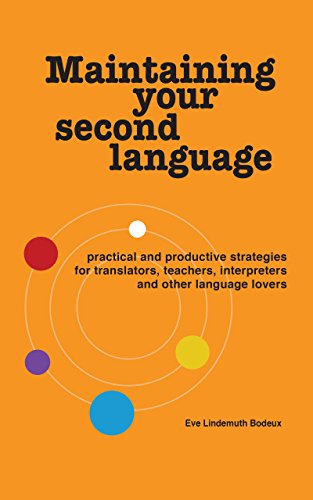
Book Review: Maintaining Your Second Language by Eve Lindemuth Bodeux

maintaining-your-second-language-1

“The big ‘secret’ to improving second language skills is practice.” Eve Lindemuth Bodeux (p. 9)

I became in love with this book from the very first page. The author, Eve Lindemuth Bodeux is an experienced second language user and the content is predominantly based on her own experience. This, I think, is what makes the book so special. As a reader, you want to implement many ideas and tips immediately, as you feel truly inspired by the strategies and techniques presented by Eve Lindemuth Bodeux.

I would need to re-write the whole content to praise it enough, but instead, I am going to introduce the book by one of its first chapters: ‘Define Your Goals’. I think it is important to know why we want to improve our language skills, what we want to achieve, what learning journey we will follow and how much time and energy will be involved in achieving our goals. I have answered the suggested-by-the-author questions for my two languages: Czech and French. It is only the beginning of this fascinating journey of maintaining and improving my language skills, but I have already started working on my Czech and French by watching films, reading out loud and having language exchange meet-ups.

Maintaining your second language is a practical and approachable guidebook for any second-language user, linguist, tutor, translator or language enthusiast. As enthusiastic as I sound I cannot recommend this book enough!

If you know more than one language, how do you maintain your second language skills? What is your favourite activity? Please share your tips in the comments below.

[All quotations and mentions come from Eve Lindemuth Bodeux, Maintaining Your Second Language, Spectacle Book Press, 2016.]

Written by Kinga Macalla

October 5, 2016

On Languages: Spanish

Spanish is spoken as a first language by more than 427 million people throughout the world and around 21 million people are learning it.  It is the second most common native language in the world.   It is the third most studied language in Europe, with 19% of school pupils learning it as a second or additional language.  Its speakers can be found in South and Central America, Europe and Africa.  Given this diversity of locations, there are also many varieties of Spanish spoken.  In the UK you will most likely learn Castellano, Castillian Spanish, as in the Spanish of Spain, but there are other varieties of the languages and ways of pronouncing it.  You are also free to choose which variety you learn, perhaps if you have a special connection to one or other variety.  Teaching and learning materials may be slightly more difficult to find for them but the internet will be of great help here.

Vocabulary
Spanish is a romance language and so shares much cognate vocabulary with languages such as French, Italian, Portuguese and Romanian.  Unlike some of these languages, though, following several centuries of Arab rule in the Spanish peninsula, 8% of Spanish vocabulary is derived from Arabic.  This can be seen, for example, in words beginning with ‘al’, such as ‘alfombra’ (‘rug’) and ‘almohada’, (‘pillow’), and also one of the words most associated with Spain, ‘aceituna’, ‘olive’.  Many place names in Spain and ones that have been transposed to Latin America reflect Arab roots, such as Guadalahara (river/valley of stones).

Pronunciation
Spanish is a phonetic language, so once you have learned the sound each letter makes, you will have no problem reading words aloud or spelling words you hear.  Spanish has some letters that do not feature in the English alphabet, but most of the sounds do exist in some form, such as ‘ll’, which is a ‘y’ sound (‘sh’ in some parts of Latin America) and ‘n’, a ‘nyuh’ sound, found between some words, such as ‘phone you’ in English.  One sound that is more difficult is ‘j’ (‘Jesús’, ‘jornada’) or ‘g’ before ‘e’ and ‘i’, (‘gestión’, ‘gimnasio’) which is pronounced a bit like ‘ch’ in the Scots word ‘loch’.  Depending on which variety you choose to learn, the pronunciation can be slightly different.  In some parts of Spain, ‘c’ and ‘z’ make a ‘th’ sound, but in other parts of Spain and Latin America, they are pronounced ‘s’.
The stress usually falls on the penultimate syllable of a word, and when the stress is somewhere else, the word is usually spelled with a helpful accent over the syllable to be stressed (guanábano, habitación, inglés).

Grammar
Again, Spanish grammar depends on which variety you choose to learn.  The main differences between the varieties is that some use the ‘’ and ‘vosotros’ forms to mean ‘you’ (singular and plural respectively), and others use ‘vos’ and ‘ustedes’ for the same groups, and the associated verb forms change slightly.  For example, ‘you have’ can be ‘(tú) tienes’ or ‘(vos) tenés’.  There is also more use of the present perfect in Castillian Spanish, whereas other forms tend to use the preterite (similar to UK and US English…).

Why Learn Spanish?
As Spanish is such a widely spoken language and the countries where it is spoken have influence in the world, speaking Spanish can give you a competitive advantage in business, give you access to popular culture such as film and music, enhance your travel experience across the world (you will be able to speak to the locals!), give you a head start in learning other romance languages, help you understand our not-so-far-away neighbours, and let you have fun!

Written by Suzannah Young

September 28, 2016

Interview with Babel Magazine

1. What is Babel Magazine, who writes it and who is your audience?

Babel magazine was set up by Lesley Jeffries and Dan McIntyre, two linguists at the University of Huddersfield. Lesley and Dan found it strange that the newsagent’s shelves had magazines for subjects such as history and geography, but nothing that covers linguistics. They knew that many people – not just linguistics professors! – are interested in all sorts of things to do with language, and decided that they ought to do something about it. Babel is a quarterly magazine for both linguists and those with a general interest in languages and linguistics, based on new research but interesting and accessible for all. (You can watch an animated take on the origins of Babel magazine here).
Each issue is written by many linguistic researchers from far and wide – this helps us make sure that we cover a wide range of topics, from the secret language of gay men in the 1950s, to the future of translation through new technology. But we also write Babel’s regular features ourselves – Lesley and Dan write the entries for our Linguistic Lexicon, and our editorial staff – Jane Lugea, Matt Evans and Hazel Price – put everything together and handle Language in the News.

babel-magazine-photo-1-1

2. How do you decide on the content? Do you receive letters from the readers? Do you consult specialists/academics? 

We have been very lucky – we have had a constant stream of contributions coming in from linguists around the world from ever since our first issue (which you can read for free). We are looking forward to publishing new articles that we have been sent on topics such as adverbs, the language of comedy and marketplace metaphors.
Sometimes we put a call out for specialists – for example, Twitter was very handy for assembling a team of contributors for our recent special issue on the pioneering linguist Ferdinand de Saussure. We also accept readers’ requests! Our regular Ask a Linguist feature addresses readers’ burning linguistic questions, and if readers suggest a topic, then we’ll try to find a linguist to write an article on it.

3. Can you tell us more about the Babel Young Writers Competition?

Our Young Writers’ Competition is our way of recognising the writing talents of young linguists. Each year, we run two categories – one for sixth form/college students, and one for undergraduates – and the winner of each is published in our November issue (as well as receiving a year’s free subscription to Babel).
The competition was inspired by an article we received out of the blue. We were stunned to find that the writer of this wonderful piece on British Sign Language was a seventeen year-old linguist, Kateryna Pavlyuk. This made us think that perhaps there were more great young writers on language out there, and so we set up the competition. So far our winners have looked at diverse topics: Konglish (a blend of Korean and English), the status of Arabic and English in Lebanon, and what spoonerisms (‘bunny rabbit’ / ‘runny babbit’) can tell us about how language works. We are currently carrying out the difficult task of picking our 2016 winners, which will be published in our next issue (No 17). Readers can read each of our previous winners on the Babel website.

babel-magazine-photo-2

4. Do you organise any events, such as meetings with researchers, linguists or writers?

Yes – at the moment, the highlight of the Babel calendar is our annual lecture. We set up the Babel Lecture in 2015 as a way to meet our readers, bring expert linguists’ thoughts to the public, and also as an excuse for a good night out!
Our first Babel lecturer was the accent and dialect coach Brendan Gunn, who gave a talk about the important role of linguistics in helping actors such as Brad Pitt, Penelope Cruz and Robert De Niro to sound convincing in their parts. Then, in May this year, David Crystal lectured on intonation in English, drawing on anecdotes from his many years as a linguist to show how intonation plays such an important role in creating meaning. We are hoping to bag another big name for our 2017 lecture, so keep your eyes peeled!

5. The subscription is available both as a hard copy and as an e-magazine. Do your readers have a preference, or do they subscribe to both?  

We have found that most readers like to have the print editions – the majority take out either a print or print plus digital subscription. We suspect that this is because of the excellent job that our designer does. The magazine is colourful, and printed on glossy paper, so it’s nice to own the print copies. It’s also not so easy to put the digital pull-out poster on your wall!
To see what our print editions are like, readers can request a free copy of our sample issue by getting in touch at editors@babelzine.com.

6. What is Lingo Magazine? Do you have many young readers?

We set up Lingo magazine to cater more directly for younger readers. We had got a bit of experience at producing Babel, and knew that we had plenty of schools among our subscribers, so we thought we would set up something especially for younger readers, with more language puzzles and contributions from young language lovers.
Readers can find out more about Lingo at lingozine.com.

7. What are your future plans? Do you have any projects you would like to work on?

We’d like to see the readership of Babel grow and expand. The magazine is a real labour of love, and we’ve had a lot of kind words from readers and other linguists, so we just want to make more!
We will be continuing to run the annual lectures and competitions, and will hopefully start to have more events where readers can hear linguists in person and tell us what they would like to see in the magazine.
There are now quite a few issues of Babel, so we are also looking forward to launching our new subsciptions and back issues in November. These will make it easier to catch up with particular back issues that catch your fancy, and to have access to the entire Babel back catalogue online.
Readers can follow us on Twitter and Facebook to keep up to date with the latest Babel news!

Thank you for your time, good luck with your future projects.

If you would like to subscribe Babel Magazine, you can do so here.

Interviewed by Bristol Language School.
August 31, 2016

Language learning: Which language to choose? With helpful videos in six languages

Estimates say that there are up to 7,000 languages spoken in the world today (in around 200 states!).  Some languages have millions of speakers and some have just a few thousand speakers.  But with so many languages to choose from, how do you decide which one to learn?  This blog post gives you a few ideas on how to make the decision.

Does it match your interests?

Have you heard a song that you like in another language and you want to know what it says?  Do you enjoy books by Sándor Márai or Milan Kundera?  Do you like Italian food?  Do you like going on holiday in a particular location?  If you learn a language that is linked to something you enjoy, you are likely to get more out of it and remember it better. If the language has relevance to your life, what you learn will stay with you.

Do you know people who speak it?

Some people are inspired to learn a language because they have friends or partners who speak it.  If you have a partner whose first language is different from your own, think about whether you need to learn it to speak to their family, their parents and siblings, or their friends.  If you go and visit their family, do you want to be able to speak to the people they grew up with? Do you want to be able to go out and interact with local people?  It is also a way to get to know a person better if you understand the language they think in, the language they spent their childhood years speaking.  You can show how much you care about them by learning the language that is dear to them and learning about their culture.  Your partner is also a good person to practice your new-found skills with – they can teach you and correct you and will want to help.

Will it be useful for your work?

Has the company you work for just signed a deal with a German business?  Have you just started importing products from Japan?  Is it going to give you the opportunity to work with your new colleagues if you learn their language?  Could you get new tasks and responsibilitites or even a promotion if you learn it?  Or do you want to look for a new, exciting job? What about one that gives you the opportunity to travel?  If you are looking for a change or a challenge in your career, learning a new language could be the perfect thing for you.

Do you want to move to a new country?

In today’s world, more and more people are emigrating and making a new life in a new country – for work or to have a new experience.  If you want to integrate in the country you wish to move to it is a good idea to learn the language spoken there, and you can give yourself a head start by learning some of it before you leave.  Learning the language will also help you get to know the country, understand the way things work, its politics and its culture.  The transition to life there will be smoother if you already understand some of the language when you get there.

Will it be useful in the future?

Some countries, like India, Bolivia, Morocco or Brazil, have economies that are developing fast and countries that are likely to become politically important on the global stage in the not-too-distant future, like Turkey.  It can be beneficial to learn the languages of those countries to be able to find employment working in or with them in the future.

Do you want to have fun?

Some people just enjoy learning languages, out of intellectual interest or as a challenge.  If you are one of these people, you can pick any language you like – because you like the way it sounds, because you like the look of the alphabet, because you like how logical it is…you name it!
BLS wishes you good luck in your learning, whichever language you choose!

Written by Suzannah Young

July 27, 2016

Language Learning Techniques: Develop your Speaking Skills in Another Language

We hope you found our post on writing skills useful.  This is the last post in the skills development series – and it talks about the most active skill of all, speaking.  Speaking is what most people want to do when they learn a language – it is how you interact with people, and it is the most natural mode of communication. It takes practice but it is very rewarding when you start to speak well in your new language. Here are a few tips to get you speaking fluently.

Speaking 2

Be Patient and Practise
Like babies, when we learn a new language, we start to understand the language we are learning before we start to be able to speak it, and long before we are able to speak it well. It will probably take you longer to master speaking, an active skill, than it does to master the other, receptive (or passive) skills. So remember that speaking takes practice, and the more you do it, the easier it will get.  Don’t be discouraged, and speak as much as you can, to as many people as you can! Don’t be afraid to make mistakes – people do that when speaking their own language, so it is perfectly fine to do it in a language you are learning. You can correct yourself just as you do in your first language.

Read Aloud and Get Active
If you are reading a text in the language you are learning, try reading it aloud.  You will get used to making the sounds and how the language works without having to think about the words first – this is good practice for when you have to speak. This is an exercise children do at school too – but you can make it less daunting by doing it in the comfort of your own home!  You don’t need an audience, unless you are a fan of theatre or slam poetry!  In fact, joining a theatre club that performs in foreign languages is a good way to practice speaking in a fun environment. Joining a multilingual choir is another idea.

Copy What People Say
We learn by imitation, and you can put this into practice in the language you are learning.  Listen to the radio or, better, an online broadcast that you can pause and play back and repeat what you hear people say. This works even better if you have a transcript of what is being said. Then you can hear the word, repeat it and check what it is if you didn’t quite catch the meaning. Time how long it takes you to read the whole transcript and see if it takes the same amount of time as the presenters.

Think of a Topic to Talk About
We speak better when we know what we are talking about, so choose a topic you are familiar with, such as your hobbies or what you did at the weekend, and practice talking about it, gradually saying more each time.  You can look up vocabulary first or draw a mind map to get your brain ready and then speak for a minute to start with and then gradually build up the time you talk for. Try this with different topics until you have built up a good conversation repertoire.

Written by Suzannah Young