Tag Archive: Spanish

February 21, 2018

The Language Journey – Suzannah’s Story (in 6 Languages)

Hello, my name is Suzannah and I’m a linguist and freelance translator.  In this video, I answer questions about my journey to speaking 6 languages. I give one answer in each of the languages I speak: French, Dutch, English, Polish, Italian and Spanish. Firstly, in French, I talk about how I discovered I had a talent for the language and almost accidentally ended up spending some time in France and eventually studying French at university, which opened the door to me learning other languages – something I never imagined I would be able to do when I was a shy, quiet teenager. Then, in Dutch, I talk about the story behind why I started to learn other languages – mainly out of curiosity and thanks to friendships I made, as well as having the opportunity to live and work abroad.  I then give away a few tips on how to learn a language – or at least I explain what works best for me and how I have gone about learning each language – in English. After that I explain (in Polish) why I chose to learn Polish, my latest language: it came down to friendships again; plus, it was/is a fun challenge for me.  Then, in Italian, I talk about the advantages of speaking and learning different languages and what I like best about being able to speak other languages. Finally, in Spanish I reveal how I keep up my language skills and what I do to practise every day so I don’t forget them!  Bon visionnement! Veel kijkplezier! Happy watching! Bawcie się dobrze! Buona visione! Disfrutéis de la película!

Suzannah Young

We need your help! Suzannah, our multilingual student speaks 6 languages and we’ve recorded an interview with her speaking them (available on YouTube). But, we need your help with translations from Dutch, French, Italian, Spanish and Polish into English.

Leave your translations here below our blog post and we’ll then add them to our video as subtitles! Good luck 🙂

May 24, 2017

Learning a Language: Learn Spanish with BLS online & FREE!

We would like to introduce a new series of blog posts/videos where we teach you some useful phrases in different languages. Sounds amazing? Let’s start with Spanish!


Learning a language -- useful phrases in Spanish 2

Are you planning your summer holiday in Spain? Do you travel frequently to Madrid? Do you dream of exploring South America?

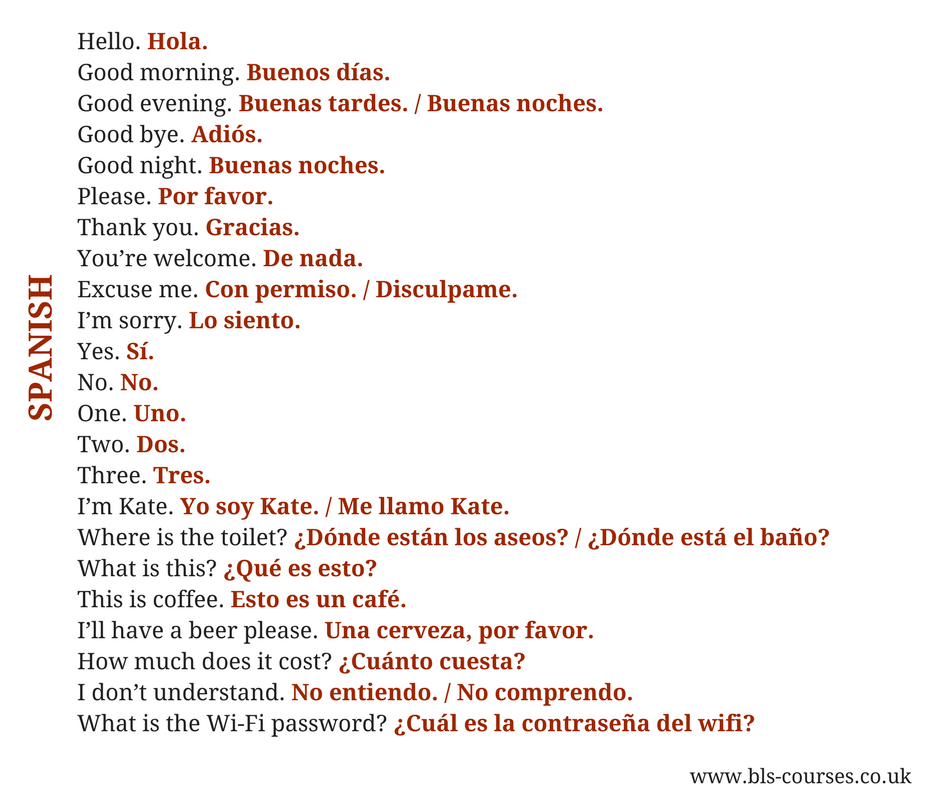
If so, we would like you to taste & learn some essential Spanish first. Below you’ll find a list of useful phrases in Spanish (greetings, polite phrases, closed question words, numerals & simple questions and sentences).

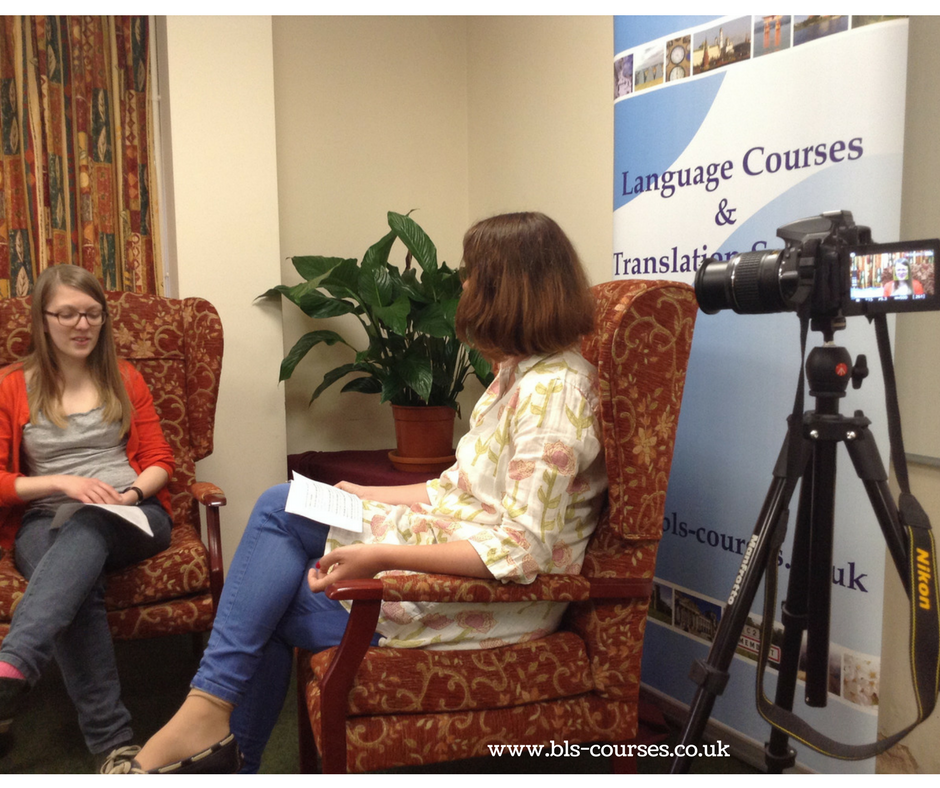
We also video recorded Noelia, our Spanish tutor to help you with reading, pronunciation and accent (available on YouTube).

We hope you’re going to enjoy this series and that you’ll come and learn Spanish with us! Good luck!

learning a language -- useful phrases in Spanish 1

Which language would like you like to learn next? Let us know in the comments below.

Written by Kinga Macalla

October 5, 2016

On Languages: Spanish

Spanish is spoken as a first language by more than 427 million people throughout the world and around 21 million people are learning it.  It is the second most common native language in the world.   It is the third most studied language in Europe, with 19% of school pupils learning it as a second or additional language.  Its speakers can be found in South and Central America, Europe and Africa.  Given this diversity of locations, there are also many varieties of Spanish spoken.  In the UK you will most likely learn Castellano, Castillian Spanish, as in the Spanish of Spain, but there are other varieties of the languages and ways of pronouncing it.  You are also free to choose which variety you learn, perhaps if you have a special connection to one or other variety.  Teaching and learning materials may be slightly more difficult to find for them but the internet will be of great help here.

Vocabulary
Spanish is a romance language and so shares much cognate vocabulary with languages such as French, Italian, Portuguese and Romanian.  Unlike some of these languages, though, following several centuries of Arab rule in the Spanish peninsula, 8% of Spanish vocabulary is derived from Arabic.  This can be seen, for example, in words beginning with ‘al’, such as ‘alfombra’ (‘rug’) and ‘almohada’, (‘pillow’), and also one of the words most associated with Spain, ‘aceituna’, ‘olive’.  Many place names in Spain and ones that have been transposed to Latin America reflect Arab roots, such as Guadalahara (river/valley of stones).

Pronunciation
Spanish is a phonetic language, so once you have learned the sound each letter makes, you will have no problem reading words aloud or spelling words you hear.  Spanish has some letters that do not feature in the English alphabet, but most of the sounds do exist in some form, such as ‘ll’, which is a ‘y’ sound (‘sh’ in some parts of Latin America) and ‘n’, a ‘nyuh’ sound, found between some words, such as ‘phone you’ in English.  One sound that is more difficult is ‘j’ (‘Jesús’, ‘jornada’) or ‘g’ before ‘e’ and ‘i’, (‘gestión’, ‘gimnasio’) which is pronounced a bit like ‘ch’ in the Scots word ‘loch’.  Depending on which variety you choose to learn, the pronunciation can be slightly different.  In some parts of Spain, ‘c’ and ‘z’ make a ‘th’ sound, but in other parts of Spain and Latin America, they are pronounced ‘s’.
The stress usually falls on the penultimate syllable of a word, and when the stress is somewhere else, the word is usually spelled with a helpful accent over the syllable to be stressed (guanábano, habitación, inglés).

Grammar
Again, Spanish grammar depends on which variety you choose to learn.  The main differences between the varieties is that some use the ‘’ and ‘vosotros’ forms to mean ‘you’ (singular and plural respectively), and others use ‘vos’ and ‘ustedes’ for the same groups, and the associated verb forms change slightly.  For example, ‘you have’ can be ‘(tú) tienes’ or ‘(vos) tenés’.  There is also more use of the present perfect in Castillian Spanish, whereas other forms tend to use the preterite (similar to UK and US English…).

Why Learn Spanish?
As Spanish is such a widely spoken language and the countries where it is spoken have influence in the world, speaking Spanish can give you a competitive advantage in business, give you access to popular culture such as film and music, enhance your travel experience across the world (you will be able to speak to the locals!), give you a head start in learning other romance languages, help you understand our not-so-far-away neighbours, and let you have fun!

Written by Suzannah Young

September 7, 2016

Language learning: Which exam should I take to prove my level?

When you are learning a language, sometimes you want to have something official to show for it, to demonstrate which level you have got up to according to recognised examination bodies.  This can be useful if you are applying for a place at a university, which often require proof of level in the language in which programmes will be taught, if you are applying for a job, if you want to emigrate to a country of acquire citizenship of a country, if you want to teach the language, to add to your CV for later, or just to give yourself the reassurance that you have reached a certain level.  But which exams should you take?  Here is a list of recognised exams and qualifications for a few of the languages we teach at Bristol Language School.
IMG_7453 ready

One good place to start is looking at the list of European Language Certificates, or telc language tests, which are international standardised tests of ten languages, which offers over 70 tests, including general language and vocational examinations and tests for students. All telc language examinations correspond to the Common European Framework of Reference for Languages (CEFR) for listening, reading, speaking and writing. Your BLS teacher can also advise you on which exam to choose.

Arabic – In the UK, you can take a number of GCSEs and iGCSEs (International GCSEs) in Arabic, and the Cambridge International Examinations.  In Europe, you can take the telc in Arabic, or alternatively the European Arabic Language Test, which is based on Level A2 of the Common European Framework of Reference (lower than the telc).  Internationally, there is the Arabic Language Proficiency Test.

French – FLE is the acronym for the Français langue étrangère or “French as a foreign language” test, which is intended for learners of French for cultural or tourism purposes. There is no single test but instead a variety of possible tests used to measure language proficiency of non-francophones in non-francophone countries.  If you wish to study at a French-speaking university, you can take the DELF/DALF, which gives a certificate of your level, and the TCF (Knowledge of French Test), which is required by universities.  There is also the DELF PRO for people wishing to work in French.  People who want to teach French will need to take a different diploma.  More information is available on the French Institute website.  The exams can be taken in Belfast, Birmingham, Cambridge, Cardiff, Edinburgh, Exeter, Glasgow, Jersey, Manchester and York.  There is also the telc in French.
IMG_7454 ready

German – The Zertifikat Deutsch is a test of general German proficiency. The Zertifikat Deutsch für den Beruf (Certificate in German for Professionals) is an internationally recognised examination which tests German language ability for business and professional purposes.  The DSH (Deutsche Sprachprüfung für den Hochschulzugang) is a language proficiency test required for entry to a German university. There is also a German telc.  The Goethe Institut will have all the information you need about German proficiency exams.

Italian – The Certificate of Italian as a Foreign Language (Certificazione di Italiano come Lingua Straniera or CILS) is recognised by the Italian Ministry of Foreign Affairs and is often used to grant acceptance in any Italian university or higher education institution in Italy. There is also an Italian telc.  The Italian cultural institute in London can tell you more.

Japanese – In the UK you can do either GCSE, the International Baccalaureate qualification, a practical language test or the Japanese language proficiency test.  There is also an aptitude test in the Japanese writing system, kanji.  The Japan Foundation has more information.

Mandarin – The Hanyu Shuiping Kaoshi (HSK) is an official examination designed to assess the Chinese language proficiency of non-native speakers from beginners to advanced Level (divided in levels 1-6).  It consists of reading, writing, listening and comprehension.  The London Confucius Institute has more information.
IMG_7498ready

Polish – In the UK, you can take GCSE & A-Level Polish or the Certificate in Polish as a Foreign Language (Polish: Egzaminy Certyfikatowe z Języka Polskiego jako Obcego), are standardised tests of Polish language proficiency for non-native Polish speakers that are currently available in CEFR levels B1-C2.  There is also a Polish telc.

Portuguese – The CAPLE (Centro de Avaliação de Português Língua Estrangeira or Centre for Evaluation of Portuguese as a Foreign Language) issues certificates of proficiency in European Portuguese as a Second language developed by the University of Lisbon.  The test is offered at CEFR levels A1 – C2.  It can be taken in London.  There is also a Portuguese telc.

Russian – The Test of Russian as a Foreign Language (TORFL) is a standardised test supervised by the Russian Ministry of Education and Science.  There is also a Russian telc. The Russian Language Centre has more information.

Spanish – The Diplomas de Español como Lengua Extranjera (English: Diplomas of Spanish as a Foreign Language), or DELE, are official diplomas issued by the Spanish Instituto Cervantes to participants who have passed a standardised test indicating their European Spanish language proficiency. The exam can be taken at the Cervantes Institute in London.  There is also a Spanish telc.

Written by Suzannah Young

August 31, 2016

Language learning: Which language to choose? With helpful videos in six languages

Estimates say that there are up to 7,000 languages spoken in the world today (in around 200 states!).  Some languages have millions of speakers and some have just a few thousand speakers.  But with so many languages to choose from, how do you decide which one to learn?  This blog post gives you a few ideas on how to make the decision.

Does it match your interests?

Have you heard a song that you like in another language and you want to know what it says?  Do you enjoy books by Sándor Márai or Milan Kundera?  Do you like Italian food?  Do you like going on holiday in a particular location?  If you learn a language that is linked to something you enjoy, you are likely to get more out of it and remember it better. If the language has relevance to your life, what you learn will stay with you.

Do you know people who speak it?

Some people are inspired to learn a language because they have friends or partners who speak it.  If you have a partner whose first language is different from your own, think about whether you need to learn it to speak to their family, their parents and siblings, or their friends.  If you go and visit their family, do you want to be able to speak to the people they grew up with? Do you want to be able to go out and interact with local people?  It is also a way to get to know a person better if you understand the language they think in, the language they spent their childhood years speaking.  You can show how much you care about them by learning the language that is dear to them and learning about their culture.  Your partner is also a good person to practice your new-found skills with – they can teach you and correct you and will want to help.

Will it be useful for your work?

Has the company you work for just signed a deal with a German business?  Have you just started importing products from Japan?  Is it going to give you the opportunity to work with your new colleagues if you learn their language?  Could you get new tasks and responsibilitites or even a promotion if you learn it?  Or do you want to look for a new, exciting job? What about one that gives you the opportunity to travel?  If you are looking for a change or a challenge in your career, learning a new language could be the perfect thing for you.

Do you want to move to a new country?

In today’s world, more and more people are emigrating and making a new life in a new country – for work or to have a new experience.  If you want to integrate in the country you wish to move to it is a good idea to learn the language spoken there, and you can give yourself a head start by learning some of it before you leave.  Learning the language will also help you get to know the country, understand the way things work, its politics and its culture.  The transition to life there will be smoother if you already understand some of the language when you get there.

Will it be useful in the future?

Some countries, like India, Bolivia, Morocco or Brazil, have economies that are developing fast and countries that are likely to become politically important on the global stage in the not-too-distant future, like Turkey.  It can be beneficial to learn the languages of those countries to be able to find employment working in or with them in the future.

Do you want to have fun?

Some people just enjoy learning languages, out of intellectual interest or as a challenge.  If you are one of these people, you can pick any language you like – because you like the way it sounds, because you like the look of the alphabet, because you like how logical it is…you name it!
BLS wishes you good luck in your learning, whichever language you choose!

Written by Suzannah Young

February 17, 2016

Learning Languages – My Story

My name is Suzannah I am a PhD student in Translation Studies.  I speak five languages (English, French, Italian, Dutch and Spanish) and am learning a sixth (Polish).  You may ask how or why I have learnt/am learning them and what I use them for.  What I will say is that I use them all regularly and they are all a big part of my life.  Actually, I don’t know what I would do without them.  It may surprise you to know, though, that it wasn’t always like this.  There was a time when I thought I wasn’t going to carry on learning any languages at all.  In the end, my circumstances changed and I did carry on – and I’m very glad I did because it changed my life!  This is my story.

Learning a Language -- My story 2

Beginnings
I started learning French when I was little, thanks to my parents having got me to watch a bilingual video about an alien who comes to Earth and learns about human life…  This video was the same story in French and English.  It was easy to follow in French if you had watched the English version (and even if you hadn’t) and the storyline and learning material was very clearly presented.  The best thing about it was that it was fun – it didn’t feel like a chore and I enjoyed watching it again and again.  I was learning without even realising it!
Another early memory is that whenever we went on holiday, my parents always tried to learn a few words of the local language and encouraged my sister and me to try the food and appreciate the places we visited.  I am very grateful to them for having done this because I believe they gave me a positive attitude to new languages and cultures and made learning about new people and places a fun thing to do.  Of course, being on holiday helped make it fun!  This attitude has definitely stuck with me.

School Time
We had French lessons at school from when I was 11 but I feel we only learnt a few set phrases and weren’t really given a love for the language.  Nevertheless, I found I understood things quite quickly and did receive some encouragement from the teacher.  The problem was, learning a language was not seen as ‘cool’ at my school and I actually hid my talent from my peers and pretended I found it as difficult and boring as they did!
I got a good mark for GCSE French and luckily decided to carry on to AS Level.  I thought I was only going to do a year but, thankfully I had a very dedicated and enthusiastic teacher who encouraged us to nurture our talent and used interesting learning material like films and newspaper articles – real life material that real French people used.  That made it more relevant to us and made us see that it was a living language.  I carried on to A-Level and did well in it.
As A-Level students, we had the opportunity to go and stay with a family in France.  My host mother was a wonderful lady, she was very supportive and was really interested in everything we did.  She introduced me to literature and a theatre group she was involved in.  We are still in touch today (almost 15 years later) and I have visited her numerous times.
I still didn’t think I was going to carry on with French and thought I was going to do English Literature at university.  In the end I didn’t get the grades I needed to do English and decided to defer my university entry for a year and reapply.  That meant I needed something to do for a year. A friend of my sister’s had just done a placement in France and suggested I do the same.  She gave me the details of a language school and I contacted them.  They signed me up for a three-month language course and a work experience placement.  I enjoyed the life at my host family’s house less than the time before but I made some really good friends at the language school.  A lot of them were Chinese and it was fun to learn about their country as well as learning French together.  They even taught me a few words of Mandarin!  At the time it was funny for me to think that we were able to communicate with each other through a language that was neither of our first languages.

University Life
Thanks to this placement, which improved my French a lot, I applied to do French and English Literature at a different University.  I was accepted and spent three years there.  The language learning experience depended on how committed you were to learning – there were resources available but you had to use them on your own initiative – but we did learn a lot about French culture and society, which helped us to understand the background to the language we were learning.
I spent my Erasmus year in Paris, France.  Initially, I started a work placement but didn’t enjoy it so enrolled in a university.  That was one of the best decisions I have ever made.  If I had stayed on the work placement, I may have got disheartened but as I went to university I met a lot of people my age and made life-long friends.  I was lucky enough to meet a group of friends who I spent every day with – you can say I was really immersed in French culture!  It was a bit difficult following lectures in French at first but I had a trusty electronic dictionary which gave me the definitions of words I didn’t know and I soon got up to speed.  My friends and I started a Spanish class together as well, which was a fun experience – learning a language through a language that was not my mother tongue!  In the summer after my Erasmus year, I went to stay with a friend in Madrid and did a language course – for fun.  That was great too because of the amazing people I met from all over the world.  We had to use Spanish to communicate with each other so it really helped us learn.

After Graduation
When I graduated, I wanted to get a job using my languages so I applied for internships in Brussels, Belgium.  I started an internship at a European NGO, where I would be speaking French and English.  It turned out that they needed my Spanish too.  Initially, I thought I was going to stay there for six months (you can see that this is a recurring theme!) but then I was offered a full-time job and ended up staying for six years!
Belgium has three official languages, Dutch, French and German (and an unofficial one, which is English!)  I was curious to know what the signs I could see in Brussels said, so I enrolled on a Dutch course.  I complemented my learning by listening to the radio and reading newspapers that were readily available.
After a few years in Brussels, I met a person who ran a theatre group in Antwerp.  I started going to the theatre group every week, and it was there that I met my partner, who is Italian.  I moved to Antwerp to live with him, which meant that I could practice Dutch all the time.  I also learnt Italian through my partner and with his family.  I had to speak Italian if I wanted to speak to them, and I did want to speak to them, so that was useful!  I found I learnt Italian fairly quickly because it is similar to French and Spanish so I could already understand quite a lot.  We have a lot of Italian friends and I speak to them all in Italian.
While still in Brussels, I met a few Polish people through work.  We became friends and I realised I was interested in learning their language.  When I moved to Antwerp, I decided to enrol on a Polish course, not least because I wanted to meet people in my new town.  I also wanted to see whether I was capable of learning a Slavic language.  I had learnt three Romance languages and a Germanic language so learning Polish was (and still is) a new challenge for me.

Back in the UK
I recently moved back to the UK and have carried on learning Polish.  I am finding it a bit more difficult to learn than it was to learn the other languages I speak.  This may be because I don’t have many people to practice with.  Learning my other languages went quite quickly because I was able to practice with people around me and, in some cases, I had to speak because there was no other option!  I think it is important not to be afraid of making mistakes and just speaking – but I am finding it a bit hard to follow my own advice in Polish at the moment!!

The Last Word
As you can see, my reasons for learning languages have been enthusiastic teachers and a positive attitude to language learning on the one hand and friendships and a desire to have new experiences on the other.  Being in an environment that has allowed me to be exposed to the languages on a regular basis has definitely been beneficial to my learning.  Speaking other languages has allowed me to meet lots of wonderful people but it has also been useful professionally.  For example, I do translation work sent to me through people I have met abroad.  The most important part of language learning for me, though, is by far the friends I have made.
I hope you can have a similarly positive experience with learning languages!

Written by Suzannah Young

September 10, 2015

Film Review: Santiago’s Path in “The Way”

Some weeks ago we were talking in class about the cities called Santiago in the world, such as Santiago de Cuba, Santiago de Chile and Santiago de Compostela (Spain). All of them have something in common: the Spanish language. For the sake of geographical proximity, although unknown to me, I will focus on the last one: Santiago de Compostela. The main reason why people know the city is because of Santiago’s pilgrimage route, known as Camino de Santiago, which runs along the north of Spain and has been walked for centuries. It takes between one and two months during which we can explore new places, enjoy the breathtaking landscapes, meet interesting people, discover new flavors and realize what we are capable. During the class conversation appeared the title of a film, The Way, an American and Spanish co-production, directed by Emilio Estévez and starring Martin Sheen.

The Way

The protagonist, Tom Avery, is a widowed ophthalmologist, who finds out that his son, Daniel, has died at the beginning of the route in the French Pyrenees. The relationship between the father and son wasn’t very close, because the first didn’t understand the lifestyle of his offspring. The last time they spoke on the phone, just before the journey, the son told him: “you don’t choose a life, you live one”. After the news of his son’s tragic death, Tom travels to France to collect the remains, and there he decides to walk the route with Daniel, each in a different world.

The film is not characterized by action scenes or sudden plot twists, but it concentrates on some Spanish topics, such as bulls, gypsies and typical foods like pinchos. The main characters are an Irishman who walks the way to lose weight, a Canadian woman who hides the fact that her husband was abusive and seems to have the purpose of quitting smoking and a writer looking for inspiration for his next book. At first, Tom shows no interest in making friends, not even engaging in conversations with fellow travelers. He only thinks of reaching the goal and scattering his son’s ashes along the way until they arrive to Galicia. There, having completed his journey, he releases the rest of the ashes into the Cantabrian Sea. He also puts his son’s name on the completion certificate awarded to each pilgrim in Santiago.

Besides the beautiful landscapes of northern Spain, several debates are presented in the film. What is the reason to begin the journey to Santiago de Compostela? Some people do it for religious reasons, others to find inspiration or as a means of meditation, others do it just for the challenge or to experience something different. Some even do the journey with a banal reason to quit smoking or to lose weight. Unlike the original travelers who used to make the journey with no help, nowadays many people choose to complete the pilgrimage on bike or use the help of modern technology. I think that the Camino should be a time to disconnect from everything to allow us to refocus on what it is important in life.

From my perspective, I think every day there are fewer people who have faith and belief in God. I would like to travel these sandy paths, crossing the refreshing rivers, but mostly I would like to have a suitable environment for meditation to regain the faith I lost some time ago. It is incredible how as the years pass, the religious origins are lost, forgotten, yet we keep the traditions and festivities. In my opinion we should be more concerned with the origins and reasons of celebrations, to understand better our roots and direct the society toward fellowship, kindness, empathy and understanding.

I cannot comment about the experience yet, but I can say the film made me even more interested to arrive in front of the Cathedral of Santiago de Compostela having found my inner peace, sticking my victory flag in the Galician land.

Written by Mireya Sevillano
Edited by Alicja Zajdel

March 31, 2015

Third Year Abroad: Study placement in Madrid

As part of my degree programme in languages, the third year is spent abroad, either on a work or study placement. It is undoubtedly the part of the course that students look forward to the most and often describe as ‘the best year of their life’. I have just started my second placement in Porto, but looking back on the first semester I had spent in Madrid, I’m not sure if those are the words I would use.

Madrid 1

So far, I think my experiences would be better described as an emotional rollercoaster. Moving to a different country all by yourself is both exciting and scary; I have been alternating between feeling like I’m on a neverending holiday to thinking I’ve been sent into exile. There are times when you’re on a trip, exploring a beautiful new place with the sun shining and sipping sangria in the shade of palm trees. But other times you are in your room, on Skype with friends and family, and all of the sudden the magical bubble bursts and you feel more alone than ever. How is it possible to keep falling from one extreme to another?

The truth is, that even though sometimes I feel like packing my suitcase and going home, I wouldn’t change my experience for anything else. Living abroad alone, although sometimes frustrating and confusing, teaches you so much about yourself. You become so much more independent and learn to cope with the strangest, most ridiculous situations life throws at you. I can guarantee that every person who has done the Year Abroad will come back with so many incredible stories. So far, my experiences have included arguing with a Spanish police officer, going on a trip with an old people’s home and having to explain what a kettle is, an invention the Spaniards apparently aren’t familiar with. These things would never happen at home and they really push you out of your comfort zone.

In terms of language practise, being forced to use a foreign language at a daily basis expands your linguistic abilities really quickly. I was really surprised, that although I already had a good level of Spanish, I found myself lacking all the basic vocabulary, such as names of kitchen utensils or other everyday objects. I guess it’s things you don’t usually learn in classes, but once you move abroad they become essential. You’re also forced to think and answer quicker, often being asked things on the spot. I have found that if you hesitate and don’t give the impression of being confident, often people will just speak to you in English or not at all.

Overall, I think it’s important to know that the Year Abroad can be hard, but on the whole it’s a really worthwhile experience. Just studying a foreign language and culture is never the same as actually experiencing it firsthand. I have learnt so much this year, but also realised that sometimes I know very little (I still don’t understand how to make the bed the Portuguese way!). But I think all the struggles of the Year Abroad are worth it in the end, when you get to come back home speaking a foreign language and feeling proud of everything you have achieved.

Written by Alicja Zajdel
Photos courtesy of Alicja Zajdel