Tag Archive: translator

May 2, 2018

Translation tips: How to improve your own translation

As well as language lessons, BLS offers a translation service.  We also encourage our students who are interested in translation as a career to have a go at it.  In this blog post, Suzannah, one of our translators, shares tips from her experience on how to translate texts effectively.  Suzannah translates into English from French, Italian, Dutch and Spanish and has been working as a freelance translator since 2015.  She has a DipTrans IoLET and is currently studying public service interpreting too.  We hope her tips will help our readers who want to try their hand at translation to find their feet and improve as translators.  Please let us know what you think and if you have any other tips you would like to share!
Know Your Text Type

When you study translation, you are advised to read any text you have received all the way through before translating it.  This can be useful when you are starting out because it gives you a feel for the types of texts you will be translating but becomes impractical when you are working as a translator and have deadlines to meet – imagine reading a whole report or even a whole book, cover to cover, before you start to translate it.  You just wouldn’t have time.  You would also be itching to translate what you are reading and most likely won’t be able to resist the urge to do so before reaching the end.  Some jobs also require a sight translation to be done so you would definitely not have the opportunity to read all the way to the end without starting the translation in those cases.

Don’t worry though, because there are ways to prepare yourself for translating a text even without knowing its full content before you begin.  For example, clients asking you to do a translation for them may tell you the field the text covers in the translation brief they send you – or, failing that, you can usually tell what field you are dealing with by casting your eye over the first few lines of the text.  You will also likely know the type of publication that the text was published in and which the translation is going to be published.  These hints will alert you to the type of vocabulary, register, style and format that you will need to use in your translation.

Keep Glossaries

If you translate similar texts regularly (or even if you don’t), it is likely that you will come across the same words or turns of phrase with some frequency.  It is helpful to keep a record of how you have translated a particular word or expression previously so that you can remind yourself if you come across that word or phrase again (especially helpful when you find the perfect translation for a term or phrase you were stuck on before).  You will find that your lists will improve over time as you will have more time to think about a particular translation and come up with alternatives.  You can also keep glossaries of terms used in certain fields that you can prepare in your spare time between translations and go to them when you need that vocabulary.

Use the Internet

An internet search engine is an extremely useful tool for the translator.  If you are unsure of the translation of a term, you can look it up in online dictionaries that may also have example translations from existing texts where the term features.  You can also search your chosen translation to check if the way you have written it is correct (good for idiomatic expressions and cultural references).  You can even find whole texts written in the field you are translating in so you can check the types of vocabulary used – and, if you are lucky, you may find an existing bilingual glossary for that field.

Come Back to It

If you cannot decide which of a variety of possible translations you want to use, put them all down and then make the decision when you are rereading your translation – go with the one that works best in the target language.  If you are unsure of a translation, but don’t want to interrupt your flow, mark the unknown word and come back to it later.  When you have finished, go back to the beginning – you should always read through your translation to make sure it flows and reads well as a coherent text in the target language.

Get Plenty of Practice

As with all things, practice makes perfect – so the more texts of different types you translate, the better you will become.  You don’t have to wait to be asked to do a translation – you can practise for fun as well.  Experiment with different fields.  If you can, also read other people’s translations to get an idea of how they translate certain things.

Read Widely

Read all kinds of texts – whatever you can get your hands on – in your source language(s) (the language(s) you are translating from) and your target language(s) (the language(s) you are translating into).  You need to have a good understanding of source texts in all different genres but you also need to have a very good grasp of the target language and write well and accurately in it.

Enjoy What You Do

The best way to get better at something is to enjoy doing it – so, if you love translation, keep doing it because you clearly have a flair for it and will be interested enough to keep improving.  Have fun!

Suzannah Young
March 8, 2017

Career Advice: Am I a Potential Translator?

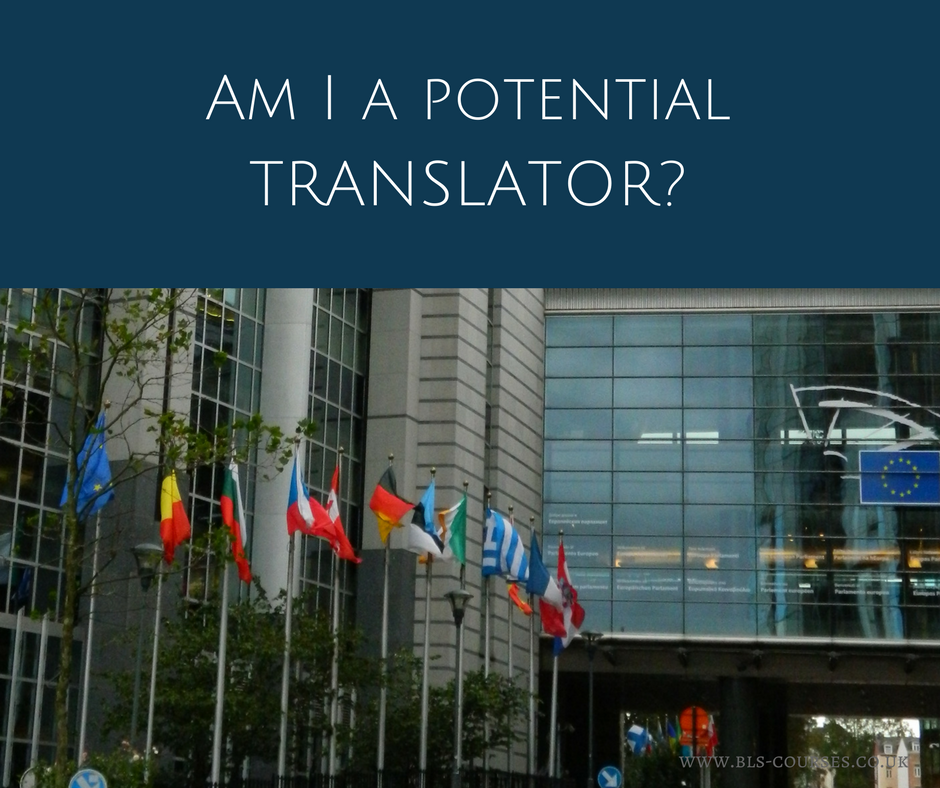
If you speak foreign languages (or if you are studying foreign languages), you might consider a career in translation.  This blog post outlines what it takes to become a translator and helps you decide whether this type of career is suited to your skills and personality.  It gives you tips on how to train to be a translator and how to start out as a freelance or in-house translator.

career advice-am i translation for me

What is translation?

Translation is the process of converting a text in one language to a text with the same meaning in another language.  As a translator you may translate short texts such as articles or leaflets or longer texts like reports, instruction manuals or novels.  Translators usually specialise in one (or more) area(s) of translation, such as literary, legal or technical translation, as they need to have developed knowledge of the field and specialist vocabulary to be able to translate accurately and authentically.

What is a career in translation like?

Working as a translator can require you to meet short deadlines and work with lots of different clients on various different projects.  Many translators work freelance for a number of clients.  To be a successful freelance translator you will have to promote yourself as well, perhaps through social media or a website.  You might need an accountant to help you manage your finances and complete your tax return.  Freelance translators either charge by the word or by the hour.  It is good to charge the going rate for your work as charging too high will put clients off and charging too low will expose you to accusations of unfair competition.  You can look on the ProZ website for an idea of average rates.  It is also possible to be an in-house translator for a company or work for a translation agency who take on translation tasks for other businesses or organisations.  Even as a freelance translator you may have face-to-face contact with your clients so it is important to have good people skills as well as good writing skills!  You can read more about working as a translator on the National Careers Service website.  There are tips on becoming a freelance translator on the ITI website.

Is a career in translation for me?

To be a successful translator you need to know your native language very well and speak at least one foreign language fluently.  It is good to have had experience of the life and culture in the country (countries) where they speak the language you are translating from (and into) as well.  You will also need to have an eye for detail and accuracy but also flair and creativity, as you will be crafting texts that are not only accurate but also readable and enjoyable.  You will need to be able to work under pressure sometimes and keep to deadlines.  You will need to be organised so as to keep track of your projects and clients.  Translation can be a solitary career, so bear this in mind – but it doesn’t have to be: instead of (or as well as) being a freelance translator, you can work in an office with other translators.  Even if you are self-employed there are forums you can join, such as the ones offered by ProZ or translatorscafé and it is likely that you will collaborate online on translation projects with other translators.  It is important to be confident with computers as not only will you be using them to write your translations and communicate with your clients, translators increasingly make use of Computer Assisted Translation (CAT) tools like Trados or Smartling that facilitate and speed up the task of translating.  For example, CAT tools can store your past translations so you can insert the same translation of the same phrase, keep terminology lists for you and allow you to dictate translation instead of typing it.

To find out whether translation could be for you, try translating every day and see how you feel.  Try to attend a workshop on starting out as a translator where you could speak to qualified translators about their work.  These may be offered by the Institute for Translation and Interpreting (ITI) or perhaps your local university.  If you know any translators, ask them what they like and dislike about their work.

How can I train to be a translator?

Translation courses are usually offered by universities and can be at BA, MA, Postgraduate Certificate or Diploma level.  To work as a translator, you should usually have a degree and will probably need a postgraduate qualification in translation, but you can also develop your skills through practice.  Many universities offer BA courses in translation studies that give you an idea of what the translation profession is like and some practical training, such as this one at Cardiff University or this one at Swansea University.  There are a number of MA translation courses in the South West, such as the MA in Translation at UWE, the MA in Translation at the University of Bristol (and a specific MA in Chinese-English translation), the MA in Translation at Cardiff University, two different MAs at Swansea University, the MA Translation at the University of Exeter or several different MAs at the University of Bath.   If you are not in the South West, you can look here for a comprehensive list of translation courses in the UK.

If you wish to take the Institute of Linguistics Diploma in Translation (DipTrans IoLET), you can train via distance learning with a tutor who communicates with you via email and phone (e.g. at Birmingham or City University London) or with some private teachers.  There is a list of institutions offering training for the DipTrans on the IoLET website.  You can get tips on studying for and passing the exam online, such as this post.  There is usually a cost for doing a translation course, for which you can take out a loan if you wish.  You could see taking the course as an investment.

If you wish to specialise in a certain type of translation (e.g. technical translation, legal translation, medical translation), it can be helpful to have a qualification in that field as well, or working experience in the field.

How do I find work in translation?

You can apply to work for a translation agency or advertise yourself as a freelance translator to potential clients by contacting them directly or through social media.  You could attend translation industry events to network with other translators.  You could also attend non-translation industry events to introduce yourself as a translator to prospective clients.  If you have had other jobs in the past, your former employers may be interested in giving you translation work.  You can also volunteer to gain experience and make a name for yourself.  Many NGOs are looking for volunteer translators.  There are also specific volunteer translation platforms, such as Translators without Borders and Trommons.  More tips are available on these blogs.

Do I need to join a professional association?

In the UK, there are two main bodies translators can become members of, the Institute of Translation and Interpreting (ITI) and the Chartered Institute of Linguists (CIOL).  Qualified membership of these bodies (MITI and MCIL) is seen as proof of a certain level of professionalism.  This is because members commit to maintaining their skills through continuous professional development (CPD) and reviews by their peers.  It is not compulsory to be a member to practise as a translator, though.  There is an assessment fee and an annual fee for membership of these bodies.  There are also other categories of membership which do not require the same level of CPD commitment but give you access to a community of translators, materials and events.  You can find a lot of tips and testimonials on the journey to becoming a qualified member of these two organisations online, such as “My journey to becoming a Qualified Member of the ITI”, “Joining the ITI as a Qualified Member (MITI) – how was it for me?”, “6 Top Tips for Translators to Achieve Chartered Linguist (Translator) Status”, “Becoming a Qualified Member of the ITI” and so on.  To help you decide which exam to take, you can read blogs by translators who have already done it, such as this one or this one.

Good luck!

We hope this has helped you make up your mind as to whether translation could be a career for you.  Good luck!

Written by Suzannah Young

August 19, 2014

Interview with Translator Antonia Lloyd-Jones

Antonia Lloyd-Jones is a full-time translator of Polish literature, and a double winner of the Found in Translation award. She has translated several works by some of Poland’s leading contemporary novelists, including Paweł Huelle and Olga Tokarczuk. Her most recent publications include Kolyma Diaries, a travel book by Jacek Hugo-Bader (Portobello Books) and Gottland: Mostly True Stories from Half of Czechoslovakia by Mariusz Szczygieł (Melville House). Her other translation projects include crime fiction, poetry, essays, and books for children. Besides working as a translator, Antonia is also a mentor for the BCLT’s Emerging Translators’ Mentorship Programme and a Translators Association committee member.

Antonia Lloyds Jones

1. Is it true that the main reason why you learned Polish had dark curly hair and was seven feet tall?
That’s a tall story – the truth is that he was six foot three.

2. The Polish language is considered to be one of the most difficult. How did you manage to master it?
I’m always sceptical when I hear Polish defined as “one of the most difficult languages”. Compared with what, and from whose perspective? In some ways Polish is a very easy language; for instance, once you know what sound each letter represents, the words aren’t difficult to spell, because all the letters are pronounced – unlike in English, where simply the word “enough” is enough to show how fiendishly difficult the spelling can be. Polish tenses are much simpler than English ones too. And those innocent little words “a” and “the” are very challenging to most students of English. So what is a difficult language?
I mainly taught myself Polish, but after studying Russian for ten years, at school and university. I also have a background in Latin and Ancient Greek, which provide a great basis for learning any other Indo-European language. I suspect that an ability to learn languages is partly an animal thing – like being good at music, or drawing – some people are born with it and find it easier than others do. There are plenty of linguists in my family, so perhaps I inherited a talent for languages. I’m sure I chose to study Russian because my father, who was a linguistic genius, didn’t know any, so he could be proud of me without correcting me every second word. Although when I started learning Polish, from my Anglophone perspective Russian seemed similar enough to be very helpful to me, the two languages have long since totally diverged in my mind, and I no longer think of them as having much in common.

3. What place in Poland do you visit most? Have you ever thought about moving there permanently?
As I write this, I am in Warsaw, a city I very much enjoy. Mostly I come here, or to Kraków, occasionally Gdańsk or Wrocław, mainly because those are the places where I know people. But in January for instance I will be in Łódź to help research a book for an American author of Polish-Jewish origin. I wish I had more opportunities to go to the Polish countryside, and the smaller towns, as there are so many fascinating and beautiful places to see. I have never thought of moving to Poland permanently; these days I have family commitments in Britain, but who knows? Perhaps one day I will.

4. Do you have a favourite word? Either in English or Polish.
Not really, though sometimes my favourite word is the very last one in the book I’m translating, simply because reaching it means finishing the project. But of course like many non-Poles, I can’t help liking the word źdźbło, which seems absurdly complicated for something meaning a blade of grass. People who know no Polish at all find it truly alarming. I have a favourite Hungarian word, which is zongora, meaning a piano – it sounds just right.

5. After years of working as a translator, are you able to pinpoint some key differences between the two languages? Perhaps the lack of an equivalent for a certain word or in the vocabulary range for a certain topic.
I could say that Polish uses more impersonal structures than English, or that its word order is much more flexible, but different languages are like different countries, the product of different experiences that result in different mentalities. So in a way everything is untranslatable, and translation is simply our best resort, short of learning the other language. But equally I could say that everything is translatable, there’s no lack of equivalents, or ways of rendering the same thing in another language.

6. The translator’s role is usually not limited to the translation itself, translators often act as cultural ambassadors for the country. What do you find most satisfying about this job?
I like being involved in promotional events with the authors whose work I translate, because it gives me the opportunity to talk to them, and often to have adventures with them. Knowing them in person and spending time with them professionally is highly enjoyable, and also contributes to my better understanding of how they write and how they think about their work. It also gives me the chance to go to inspiring literary festivals and to meet other translators and writers. I think being an advocate for the literature you translate is an important part of a translator’s job – once they’re published, the books need promotion, and it can only be in the translator’s interest to encourage people to read them.

7. How much time per day do you usually dedicate to translation?
Like any self-employed person, I spend most of the day doing my job, from first thing in the morning to late at night. Being freelance means that you have to be disciplined about getting work done, and about generating work too. If you mean every aspect of translation, then I spend my entire working day on it; if you mean actually sitting over a Polish text and putting it into English, it depends on my workload and schedule. If I am working on a particular book, there is usually a set number of pages that I aim to complete each day, but of course as the deadline approaches, and I start to get behind, the number of pages increases.

8. You don’t see much Polish literature on the shelves of British bookstores. Is it difficult to interest publishers and readers in Polish authors?
The first part of your question answers the second. It is very difficult. Publishers and bookshops have to be business-like – they’re not charities, they have to make a profit. Unfortunately Polish literature isn’t at the top of most people’s shopping list. It has to compete with the huge number of books published in English (over ten times as many as in Polish) and also with an increasing number of other translated literatures. I often ask British or American people if they can remember the name of any Polish author whose work they have read in translation, and they look sheepish as they rack their brains to think of one, but I tell them I won’t be surprised if they can’t. Occasionally someone mentions Wisława Szymborska, Czesław Miłosz, Stanisław Lem or Ryszard Kapuściński, but that’s about it. But if I ask myself when I last read a book translated from, let’s say, Greek, I can’t come up with an answer. (And I do read lots of translations.)
In this situation, where Polish literature has very few opportunities to be published in English, I think it is vital to focus on the very best books – there’s no point in trying to promote commercial Polish literature on the English-language market, which is already saturated with its own popular books. Instead it is best to save the few available slots for the best works that make a real contribution to world literature.

9. Literary translation is considered the lowest paid field of translation and it is often a second job, for example for literature professors. Is it possible to make a living from translating books alone?
I suppose I am living proof that it is possible to survive as a literary translator alone, but it is an unreliable source of income. Translation is slow work, paid by the number of words or pages, not by the hour. One of my colleagues once estimated that we’d be better off working at McDonald’s. My income comes from a wide range of jobs, not just book-length translations, but lots of much shorter ones, occasional teaching and writing, public events, book reports and so on. If I hadn’t had a sensible job in the past that earned me a high salary, I would have a much harder life now, but as it is I have my own flat and don’t have to worry about rent. That said, I do have to work hard to pay the bills. Luckily, in Britain the rates paid for literary translation are generally higher than in many other countries.

10. You are a mentor for emerging translators within the project run by the British Centre for Literary Translation. What would be your main advice for a future professional?
Apart from “don’t give up the day job unless you have a rich and generous partner”, my main piece of advice is to read as much good literature written in or translated into English as possible. Read, read, read. And when you’re translating, imagine there are two people in the room with you: the author and the reader. You must never forget either of them.

Thank you for your time and very best of luck with your future plans!
Q. prepared by Joanna Michta
Q. translated by Alicja Zajdel
Photo courtesy of Antonia Lloyd-Jones